The Power Bottleneck: Electricity as the New Strategic Asset
May 20, 2026
Read Time 8 MIN
Key Takeaways:
- U.S. power demand is reaccelerating. AI data centers, reshoring, and electrification are ending two decades of flat electricity growth.
- Reliability matters more than capacity. Always-on loads need firm, dispatchable power, which is why nuclear is back in the conversation.
- The opportunity extends beyond generation. Grid equipment, transformers, cooling, and resilience systems all benefit from rising power demand.
The Power Demand Shock Is No Longer Theoretical
After roughly two decades of essentially flat U.S. electricity demand, several converging forces appear to be driving a meaningful reacceleration in load growth. AI data centers, expanding digital infrastructure, industrial reshoring, and broader electrification across transportation and buildings are each contributing to a demand picture that looks very different from the prior cycle.
Forecasts from major utilities, regional grid operators, and federal agencies have generally been revised higher in recent years, in some cases significantly. While the timing and magnitude of demand growth will likely vary by region and by sector, many industry observers have argued that investors and grid planners may be underestimating how quickly large new loads are arriving in specific parts of the country. The directional shift away from a flat-load environment appears reasonably broad-based, even if the precise trajectory remains uncertain.
U.S. Power Demand Growth: A Reacceleration After a Flat Decade
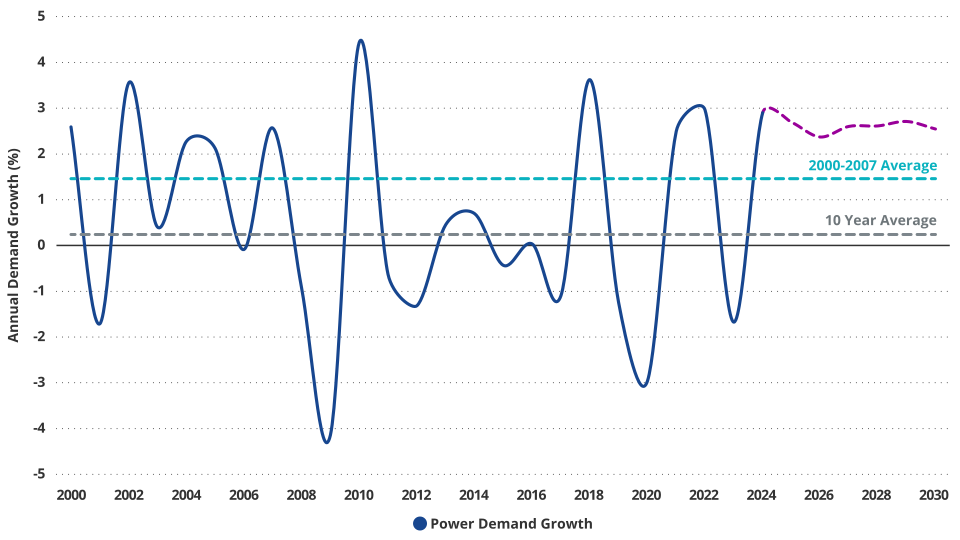
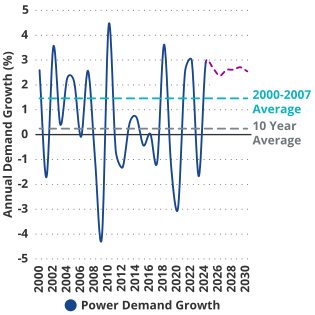
Source: Goldman Sachs. Annual U.S. power demand growth (historical and forecast). Forecasts (2025 onward) are estimates and are subject to change. Forecasts are for illustrative purposes only and are not a guarantee of future results. Past performance is not indicative of future results.
AI Turns Power Into a Constraint
Artificial intelligence is increasingly an electricity story, not just a software story. Training and inference workloads tend to require concentrated, reliable power delivered to specific locations, which can create localized stress on the grid before national average demand figures reflect any meaningful change.
Hyperscale data centers can require very large, continuous power loads at a single site, in some cases comparable to the electricity needs of a mid-sized city. Industry research groups have generally projected that data centers may grow from a low-single-digit share of U.S. electricity consumption today to a meaningfully larger share by the end of the decade.1 Where transmission, generation, or interconnection capacity is constrained, large new loads may face multi-year wait times, which in turn may shape decisions about where AI infrastructure ultimately gets built. In that sense, electricity is moving from a background input to a potential gating factor for AI deployment.
Reshoring and Reindustrialization Add a Second Layer
Beyond data centers, a renewed push toward domestic manufacturing in semiconductors, electric vehicles, batteries, and other strategically important industries is contributing to U.S. power demand growth. This second layer can broaden the demand picture across more geographies and sectors rather than concentrating it solely in data center hubs.
New industrial facilities tend to be electricity-intensive, and federal policy initiatives in recent years have provided incentives that may encourage further domestic manufacturing investment. Many of the projects announced under those programs involve large, continuous electrical loads that did not previously exist in the U.S. industrial footprint. The cumulative effect, alongside data center growth, may add up to a more durable demand story than any single driver in isolation.
Reliability May Matter More Than Raw Capacity
For strategic loads such as data centers and industrial facilities, the quality of power supply, including reliability, dispatchability, and grid stability, may matter as much as the absolute amount of new generation added. Total megawatt figures alone do not capture how power is delivered or whether it is available when and where it is needed.
Many digital and industrial loads operate continuously and can be sensitive to outages, voltage variability, or even brief interruptions. Different generation sources have different reliability and dispatchability profiles, and balancing variable resources with firm baseload, storage, transmission, and demand-side flexibility has become a central planning question for grid operators. As a result, the conversation around power infrastructure has shifted, in many cases, from focusing primarily on how many megawatts can be added to focusing on how reliably those megawatts can be delivered to specific loads.
Why Nuclear Re-Enters the Strategic Conversation
Nuclear power offers a combination of attributes, including high capacity factors, low operational carbon emissions, and long-duration baseload generation, that align reasonably well with the needs of large, persistent industrial and digital loads. As a result, nuclear has re-entered the strategic conversation among policymakers, utilities, and large power buyers in a way that was less common in prior decades.
Capacity factor measures actual electricity output as a share of maximum potential output. On this measure, U.S. nuclear has historically led other major generation sources by a wide margin, with a capacity factor of approximately 93.1%, compared with roughly 33.5% for wind and 23.3% for solar.2 That difference reflects nuclear’s ability to run continuously regardless of weather or time of day, which is one reason it has become attractive to large, always-on power buyers.
In recent years, several large technology companies have announced power purchase agreements that involve nuclear sources. Microsoft, for example, agreed to support the restart of a previously retired reactor at Three Mile Island to help power its data center operations, and Amazon entered into a multi-year arrangement to source nuclear power for its cloud infrastructure. Certain previously retired or curtailed plants have been considered for restart or life extension, and interest in next-generation reactor designs, including small modular reactors, has grown among utilities and government programs.
Nuclear is not without considerations. Historically, large nuclear projects have faced cost overruns, long permitting and construction timelines, fuel cycle complexity, and varying public perception. The current administration has acknowledged these timeline challenges and has announced executive actions and policy support intended to streamline the approval process and accelerate development of new nuclear capacity, which may help address some of the historical bottlenecks. Outcomes will likely still depend on policy follow-through, financing structures, and the industry’s ability to deliver projects on time and on budget, and investors should weigh these considerations alongside the demand-side tailwinds when evaluating exposure to the nuclear theme.
Recommended subscription
Where Does the Power Infrastructure Investment Opportunity Extend Beyond Generation?
The investment opportunity tied to rising power demand may extend well beyond electricity generation itself. It can include the broader infrastructure needed to deliver, manage, and protect the power supply, including transmission and distribution equipment, transformers and other grid components, cooling and power management systems, and resilience or backup technologies.
| Segment | What They Do | Investment Consideration |
| Grid Equipment and Transmission | Move power from generation to end use | Capital intensive, policy supported |
| Transformers and Electrical Components | Enable grid modernization and expansion | Constrained supply, rising demand |
| Nuclear Operators | Provide reliable baseload power | Long-duration contracts, growing demand |
| Power Management and Cooling | Optimize and protect critical infrastructure | AI-driven demand growth |
| Backup and Resilience Systems | Ensure uptime for critical loads | Essential for data centers and factories |
Each of these segments has its own competitive dynamics, supply chain considerations, and policy exposures, and the timing and durability of demand will likely vary across categories. Investors evaluating the broader power theme may want to consider which parts of the value chain are most directly exposed to the demand drivers they find most compelling.
Electricity as a Strategic Asset Class
Power availability and reliability appear to be moving from the background of investment analysis toward the foreground, somewhat similar to how semiconductors and logistics have increasingly been recognized as strategic considerations across the broader economy. In this framing, electricity is not simply an input cost. It can also be a constraint that helps shape where capital is deployed and which industries are able to scale.
Capital allocation decisions in artificial intelligence, cloud computing, advanced manufacturing, the defense industrial base, and broader electrification may increasingly depend on access to reliable and affordable power. For long-horizon investors, this dynamic may suggest treating power infrastructure as a thematic exposure rather than purely a defensive utility allocation, while still recognizing the cyclical and regulatory risks that have historically affected the sector.
How Can Investors Access Nuclear and Power Infrastructure Exposure?
For investors looking to express a view on nuclear power and the broader uranium and nuclear ecosystem, exchange-traded funds offer one accessible vehicle. The VanEck Uranium and Nuclear ETF (NLR) is designed to provide diversified exposure to companies involved in uranium mining and nuclear power generation, including utilities, plant operators, and related industry participants across multiple geographies.
NLR seeks to replicate as closely as possible, before fees and expenses, the price and yield performance of the MarketVector Global Uranium and Nuclear Energy Index, which is intended to track the overall performance of companies involved in the uranium and nuclear energy industry. The fund offers exposure across multiple segments of the nuclear value chain in a single, exchange-listed, daily-liquid vehicle.
As the demand for reliable, dispatchable power grows alongside the build-out of AI infrastructure, reshoring, and broader electrification, nuclear is increasingly positioned at the center of the strategic baseload conversation. NLR offers investors comprehensive exposure to the nuclear ecosystem in a single trade, providing one way to participate in the long-term theme of electricity as a strategic asset.
NLR | VanEck Uranium and Nuclear ETF
To receive more Natural Resources insights, sign up in our subscription center.

Sources
1 Industry projections of data center electricity consumption vary by methodology and source. See Electric Power Research Institute (EPRI), "Powering Intelligence: Analyzing Artificial Intelligence and Data Center Energy Consumption," 2024, and International Energy Agency (IEA), "Electricity 2024," January 2024.
2 U.S. Department of Energy, Office of Nuclear Energy, "5 Fast Facts About Nuclear Energy," based on U.S. Energy Information Administration capacity factor data, 2024.
Important Disclosures
This is not an offer to buy or sell, or a recommendation to buy or sell any of the securities, financial instruments or digital assets mentioned herein. The information presented does not involve the rendering of personalized investment, financial, legal, tax advice, or any call to action. Certain statements contained herein may constitute projections, forecasts and other forward-looking statements, which do not reflect actual results, are for illustrative purposes only, are valid as of the date of this communication, and are subject to change without notice. Actual future performance of any assets or industries mentioned are unknown. Information provided by third party sources are believed to be reliable and have not been independently verified for accuracy or completeness and cannot be guaranteed. VanEck does not guarantee the accuracy of third-party data. The information herein represents the opinion of the author(s), but not necessarily those of VanEck or its other employees.
An investment in the Fund may be subject to risks which include, but are not limited to, risks related to investments in nuclear energy companies, energy sector, utilities sector, industrials sector, special risk considerations of investing in Asian, Canadian, European and Australian issuers, foreign securities, foreign currency, depositary receipts, small- and medium-capitalization companies, cash transactions, equity securities, market, operational, index tracking, authorized participant concentration, no guarantee of active trading market, trading issues, passive management, fund shares trading, premium/discount and liquidity of fund shares, issuer-specific changes, non-diversified, index-related concentration and high portfolio turnover risks, all of which may adversely affect the Fund. Foreign investments are subject to risks, which include changes in economic and political conditions, foreign currency fluctuations, changes in foreign regulations, and changes in currency exchange rates that may negatively impact the Fund’s return. Small- and medium-capitalization companies may be subject to elevated risks.
Investing involves substantial risk and high volatility, including possible loss of principal. An investor should consider the investment objective, risks, charges and expenses of the Fund carefully before investing. To obtain a prospectus and summary prospectus, which contains this and other information, call 800.826.2333 or visit vaneck.com/etfs. Please read the prospectus and summary prospectus carefully before investing.
© 2026 Van Eck Securities Corporation, Distributor, a wholly owned subsidiary of Van Eck Associates Corporation.
Related Funds
Sources
1 Industry projections of data center electricity consumption vary by methodology and source. See Electric Power Research Institute (EPRI), "Powering Intelligence: Analyzing Artificial Intelligence and Data Center Energy Consumption," 2024, and International Energy Agency (IEA), "Electricity 2024," January 2024.
2 U.S. Department of Energy, Office of Nuclear Energy, "5 Fast Facts About Nuclear Energy," based on U.S. Energy Information Administration capacity factor data, 2024.
Important Disclosures
This is not an offer to buy or sell, or a recommendation to buy or sell any of the securities, financial instruments or digital assets mentioned herein. The information presented does not involve the rendering of personalized investment, financial, legal, tax advice, or any call to action. Certain statements contained herein may constitute projections, forecasts and other forward-looking statements, which do not reflect actual results, are for illustrative purposes only, are valid as of the date of this communication, and are subject to change without notice. Actual future performance of any assets or industries mentioned are unknown. Information provided by third party sources are believed to be reliable and have not been independently verified for accuracy or completeness and cannot be guaranteed. VanEck does not guarantee the accuracy of third-party data. The information herein represents the opinion of the author(s), but not necessarily those of VanEck or its other employees.
An investment in the Fund may be subject to risks which include, but are not limited to, risks related to investments in nuclear energy companies, energy sector, utilities sector, industrials sector, special risk considerations of investing in Asian, Canadian, European and Australian issuers, foreign securities, foreign currency, depositary receipts, small- and medium-capitalization companies, cash transactions, equity securities, market, operational, index tracking, authorized participant concentration, no guarantee of active trading market, trading issues, passive management, fund shares trading, premium/discount and liquidity of fund shares, issuer-specific changes, non-diversified, index-related concentration and high portfolio turnover risks, all of which may adversely affect the Fund. Foreign investments are subject to risks, which include changes in economic and political conditions, foreign currency fluctuations, changes in foreign regulations, and changes in currency exchange rates that may negatively impact the Fund’s return. Small- and medium-capitalization companies may be subject to elevated risks.
Investing involves substantial risk and high volatility, including possible loss of principal. An investor should consider the investment objective, risks, charges and expenses of the Fund carefully before investing. To obtain a prospectus and summary prospectus, which contains this and other information, call 800.826.2333 or visit vaneck.com/etfs. Please read the prospectus and summary prospectus carefully before investing.
© 2026 Van Eck Securities Corporation, Distributor, a wholly owned subsidiary of Van Eck Associates Corporation.