SMHC ETF: Question & Answer
Read Time 7 MIN
The global semiconductor industry is increasingly defined by two parallel ecosystems. While most investors are familiar with the U.S.- and Taiwan-centered supply chain, a separate semiconductor industry is rapidly taking shape within China. Driven by industrial policy, capital investment, and the push for technological self-sufficiency, China is building capabilities across the semiconductor value chain.
The VanEck China Semiconductor ETF (SMHC) is designed to provide targeted exposure to companies participating in that build-out. This Q&A explores the industry, the investment case, and how SMHC seeks to provide exposure to this opportunity.
- Why is China building its own semiconductor industry?
- How does China's semiconductor ecosystem differ from the U.S. model?
- How have U.S. export controls affected China's domestic semiconductor industry?
- How is China's semiconductor build-out funded?
- What is the VanEck China Semiconductor ETF (SMHC)?
- How does SMHC's index work?
- What are the key risks of investing in SMHC?
- How does SMHC fit in a portfolio?
Why is China building its own semiconductor industry?
China is the world's largest consumer of semiconductors, yet domestic production has historically fallen well short of that demand. Closing that gap has become a strategic priority, as policy makers seek to reduce reliance on foreign technology.
In 2025, China was the world's largest spender on semiconductor manufacturing equipment, highlighting the pace of development and reflecting a deliberate national priority. Rather than focusing on one layer of the supply chain, China is constructing every layer simultaneously and domestically: fabless design, foundry capacity, equipment, and packaging. The goal, as set by state policy, is a fully self-sufficient semiconductor supply chain with zero foreign dependency.
China Leads 2025 Spend on Semiconductor Manufacturing Equipment
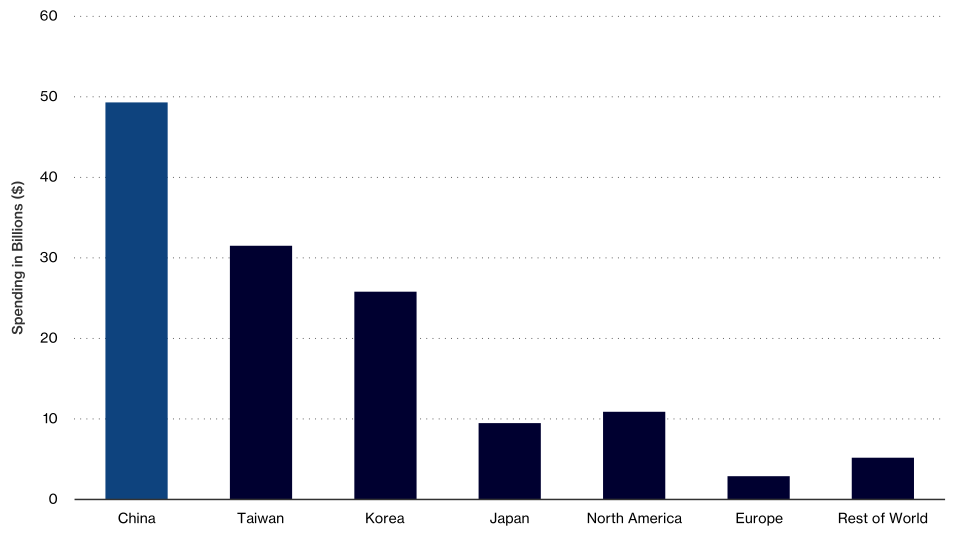
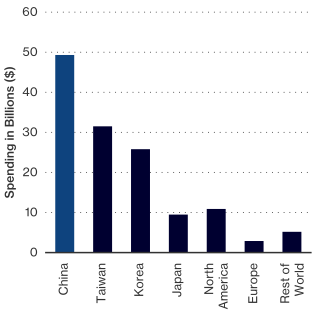
Source: SEMI as of April 2026. Past performance is no guarantee of future results. Not intended as a forecast or prediction of future results. For illustrative purposes only.
How does China's semiconductor ecosystem differ from the U.S. model?
The U.S. model is built around design concentration and manufacturing outsourcing. A few dominant fabless companies, including Nvidia, Qualcomm, Broadcom, and AMD, design the world's most advanced chips. Fabrication is then outsourced to foundries in Taiwan, primarily TSMC. The U.S. captures extraordinary value in the design layer but is structurally dependent on foreign manufacturing for downstream activities.
China is building every layer, from design and manufacturing to equipment, and packaging. An investor who holds conventional semiconductor exposure has none of the Chinese companies capturing this domestic build-out.
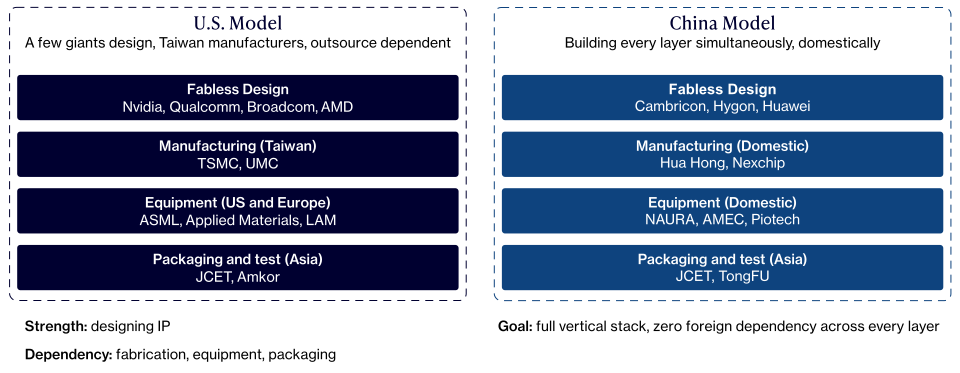
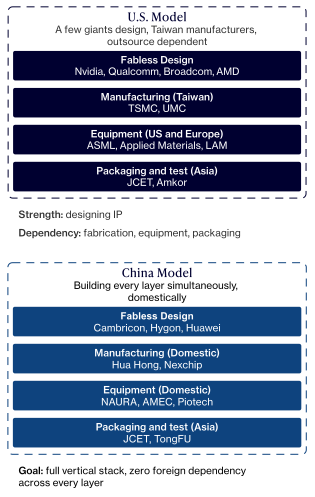
Source: VanEck, MSCI.
SMHC | VanEck China Semiconductor ETF
How have U.S. export controls affected China's domestic semiconductor industry?
Restrictions have increased the incentive for China to develop domestic alternatives and accelerated the build-out, rather than slowing it.
Since 2019, the U.S. has progressively tightened controls on China's access to technology. Notable actions included restrictions on Huawei and SMIC, sweeping export controls on advanced chips and equipment in October 2022, and coordinated measures with the Netherlands and Japan to restrict ASML and Tokyo Electron sales in 2023. Controls expanded further in 2024 and 2025.
The result of these measures has been to increase emphasis on localization, as each restriction creates a procurement mandate with the potential to benefit a local provider. Chinese fabs that can no longer source etch and deposition tools from Applied Materials or Lam Research may source from NAURA. Chinese data centers that cannot purchase Nvidia GPUs may source from Cambricon. The geopolitical pressure that creates uncertainty for investors may also support a more durable opportunity.
China’s Equipment Spending Grew as Export Controls Expanded


Source: VanEck, SEMI as of April 2026. These are not recommendations to buy or to sell any security. Securities and holdings may vary. For illustrative purposes only.
How is China's semiconductor build-out funded?
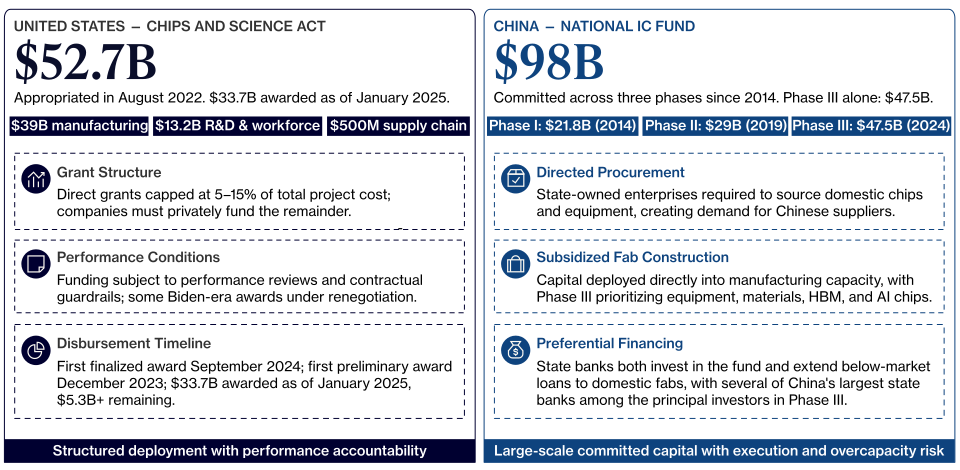
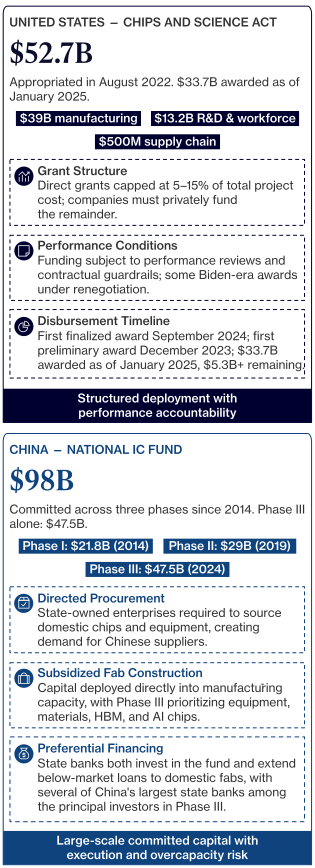
Government support has been a significant driver of China's semiconductor development. Since 2014, China's National IC Fund has committed approximately $98 billion across three funding phases, including a $47.5 billion funding round in May 2024. That capital is deployed through directed procurement, subsidized fab construction, and preferential financing from state banks. With this scale comes structural risks, including potential overcapacity, boom-bust cycles, and below-market financing, which can sustain uneconomic capacity over time.
In comparison, the U.S. CHIPS Act appropriated $52.7 billion in 2022, of which $39 billion was earmarked for manufacturing incentives. As of early 2025, approximately $33.7 billion had been awarded. Grants are capped at 5 to 15% of total project cost, with funding tied to performance conditions and contractual guardrails. China's capital is larger and faster-moving, while the U.S. model is more conditional and slower to deploy. Both carry tradeoffs.
U.S. vs China Semiconductor Funding: How Scale, Structure and Risks Differ
Source: CHIPS and Science Act (Public Law 117-167), Commerce Office of Inspector General, Status Report OIG-25-021-I, Document 79 (2022 SASAC directive), State Council Guo Fa [2020] No. 8, Beijing Municipal Administration for Market Regulation on May 24, 2024. For illustrative purposes only.
What is the VanEck China Semiconductor ETF (SMHC)?
SMHC is a passively managed ETF that seeks to track the MarketVector China Semiconductor 25 Index. The index targets 25 of the largest and most liquid Chinese companies across the semiconductor value chain, from chip design to manufacturing equipment to advanced packaging.
Most semiconductor ETFs are concentrated in U.S. and Taiwanese companies, capturing the design and fabrication layers of the global supply chain but not the parallel build-out happening inside China. The companies in this index are not represented in conventional semiconductor or broad China equity strategies.
How does SMHC's index work?
The MarketVector China Semiconductor 25 Index is a rules-based index designed to provide pure-play exposure to the Chinese semiconductor industry.
A company must be headquartered or incorporated in China or Hong Kong and derive at least 50% of its revenues from semiconductors or semiconductor equipment to be qualify for inclusion. This eligible universe is then screened for size and liquidity, with minimum requirements including a market cap of at least $150 million and average daily trading volume of at least $1 million. The index targets 25 constituents based on a combination of free-float market capitalization and three-month average daily trading volume.
The index uses a modified free-float market capitalization weighting approach, with individual position caps to balance exposure across the portfolio. The index reconstitutes semi-annually in March and September and rebalances quarterly.
What are the key risks of investing in SMHC?
Investing in SMHC involves both country-specific and industry-specific concentration risk. China policy risk is significant, including government intervention, trade tensions or sanctions, and potential conflict over Taiwan could cause sudden and severe losses. Semiconductor companies also face rapid technological obsolescence, high capital costs, and intense pricing pressure. The sovereign capital underpinning China's build-out carries its own risks, including potential overcapacity and debt overhang from below-market financing.
For a complete list of risks, please read the fund prospectus carefully before investing.
How does SMHC fit in a portfolio?
SMHC is designed to fill a gap in existing allocations. Chinese semiconductor companies do not appear meaningfully in conventional semiconductor ETFs, which are concentrated in U.S. and Taiwanese names, or in broad China equity strategies, which are dominated by consumer, internet, and financial companies. Investors with either or both of these of exposures have no meaningful allocation to China's domestic semiconductor build-out.
SMHC provides targeted, pure-play access to that opportunity through a rules-based, liquid vehicle of 25 names, and provides additive exposure to existing semiconductor and China allocations.
How to buy VanEck ETFs?


To receive more Thematic Investing insights, sign up in our subscription center.

IMPORTANT DISCLOSURES
This is not an offer to buy or sell, or a recommendation to buy or sell any of the securities, financial instruments or digital assets mentioned herein. The information presented does not involve the rendering of personalized investment, financial, legal, tax advice, or any call to action. Certain statements contained herein may constitute projections, forecasts and other forward-looking statements, which do not reflect actual results, are for illustrative purposes only, are valid as of the date of this communication, and are subject to change without notice. Actual future performance of any assets or industries mentioned are unknown. Information provided by third party sources are believed to be reliable and have not been independently verified for accuracy or completeness and cannot be guaranteed. VanEck does not guarantee the accuracy of third party data. The information herein represents the opinion of the author(s), but not necessarily those of VanEck or its other employees.
MarketVector™ China Semiconductor 25 Index intends to track the performance of 25 of the largest and most liquid Chinese companies in the semiconductor industry.
Fund holdings will vary and are subject to change. For a complete list of fund holdings, please visit vaneck.com.
An investment in the VanEck China Semiconductor ETF (SMHC) may be subject to risks which include, among others, risks related to investing in the semiconductor industry, information technology sector, equity securities, depositary receipts, foreign securities, foreign currency, special risk considerations of investing in China issuers, special risk considerations of investing in Chinese-issued A-Shares, Stock Connect, emerging market issuers, PRC tax, medium- and large capitalization companies, cash transactions, market, operational, index tracking, authorized participant concentration, new fund, no guarantee of active trading market, trading issues, passive management, fund shares trading, premium/discount, liquidity of fund shares, non-diversified, index-related concentration, and issuer-specific changes risks, all of which may adversely affect the Fund. Emerging market issuers and foreign securities may be subject to securities markets, political and economic, investment and repatriation restrictions, different rules and regulations, less publicly available financial information, foreign currency and exchange rates, operational and settlement, and corporate and securities laws risks. Medium- and large-capitalization companies may be subject to elevated risks. Investments in Chinese issuers may entail additional risks that include, among others, lack of liquidity and price volatility, currency devaluations and exchange rate fluctuations, intervention by the Chinese government, nationalization or expropriation, limitations on the use of brokers, and trade limitations.
Investing involves substantial risk and high volatility, including possible loss of principal. An investor should consider the investment objective, risks, charges and expenses of a Fund carefully before investing. To obtain a prospectus and summary prospectus, which contain this and other information, call 800.826.2333 or visit vaneck.com. Please read the prospectus and summary prospectus carefully before investing.
© 2026 Van Eck Securities Corporation, Distributor, a wholly owned subsidiary of Van Eck Associates Corporation.
Related Funds
IMPORTANT DISCLOSURES
This is not an offer to buy or sell, or a recommendation to buy or sell any of the securities, financial instruments or digital assets mentioned herein. The information presented does not involve the rendering of personalized investment, financial, legal, tax advice, or any call to action. Certain statements contained herein may constitute projections, forecasts and other forward-looking statements, which do not reflect actual results, are for illustrative purposes only, are valid as of the date of this communication, and are subject to change without notice. Actual future performance of any assets or industries mentioned are unknown. Information provided by third party sources are believed to be reliable and have not been independently verified for accuracy or completeness and cannot be guaranteed. VanEck does not guarantee the accuracy of third party data. The information herein represents the opinion of the author(s), but not necessarily those of VanEck or its other employees.
MarketVector™ China Semiconductor 25 Index intends to track the performance of 25 of the largest and most liquid Chinese companies in the semiconductor industry.
Fund holdings will vary and are subject to change. For a complete list of fund holdings, please visit vaneck.com.
An investment in the VanEck China Semiconductor ETF (SMHC) may be subject to risks which include, among others, risks related to investing in the semiconductor industry, information technology sector, equity securities, depositary receipts, foreign securities, foreign currency, special risk considerations of investing in China issuers, special risk considerations of investing in Chinese-issued A-Shares, Stock Connect, emerging market issuers, PRC tax, medium- and large capitalization companies, cash transactions, market, operational, index tracking, authorized participant concentration, new fund, no guarantee of active trading market, trading issues, passive management, fund shares trading, premium/discount, liquidity of fund shares, non-diversified, index-related concentration, and issuer-specific changes risks, all of which may adversely affect the Fund. Emerging market issuers and foreign securities may be subject to securities markets, political and economic, investment and repatriation restrictions, different rules and regulations, less publicly available financial information, foreign currency and exchange rates, operational and settlement, and corporate and securities laws risks. Medium- and large-capitalization companies may be subject to elevated risks. Investments in Chinese issuers may entail additional risks that include, among others, lack of liquidity and price volatility, currency devaluations and exchange rate fluctuations, intervention by the Chinese government, nationalization or expropriation, limitations on the use of brokers, and trade limitations.
Investing involves substantial risk and high volatility, including possible loss of principal. An investor should consider the investment objective, risks, charges and expenses of a Fund carefully before investing. To obtain a prospectus and summary prospectus, which contain this and other information, call 800.826.2333 or visit vaneck.com. Please read the prospectus and summary prospectus carefully before investing.
© 2026 Van Eck Securities Corporation, Distributor, a wholly owned subsidiary of Van Eck Associates Corporation.