SpaceX IPO: What Reusable Rockets Mean for Investors
June 24, 2026
Read Time 7 MIN
Key Takeaways:
- Reusable rockets changed the economics of space. SpaceX turned launches into repeatable commercial operations, making new space business models viable.
- Lower launch costs underpin the entire space economy. Broadband, defense, and orbital infrastructure all depend on affordable, frequent access to orbit.
- SpaceX is a space infrastructure platform, not just a rocket company. Starlink's growth shows how launch capabilities fuel a flywheel of recurring revenue.
- For investors, structure matters as much as access. "SpaceX exposure" varies widely across vehicles in liquidity, fees, and what you actually own.
SpaceX Update (June 22, 2026):
SpaceX (SPCX) began trading on Nasdaq on June 12, 2026. Following the MarketVector Space Index (MVWARP) methodology’s provision for large IPOs, SpaceX has been added to WARP at the index’s 20% maximum security weight as of today. This addition follows MVWARP’s rules-based process entirely: a company meeting the eligibility, size, and free-float criteria is added according to methodology, independent of market attention or investor enthusiasm. The 20% cap is a deliberate feature designed to allow meaningful exposure to a dominant constituent while limiting single-name concentration. WARP’s differentiated value remains its focused, rules-based core exposure to the long-term space theme.
SpaceX Update (June 12, 2026):
On the eve of SpaceX’s debut, S&P Dow Jones Indices reaffirmed that it will not bend its eligibility rules to fast-track large, newly public companies into the S&P 500. After a consultation that proposed shortening the 12-month seasoning period and waiving profitability and public-float requirements for the biggest IPOs, S&P concluded that exceptions should not be granted on the basis of market capitalization alone. The practical effect is that SpaceX, which begins trading today on the Nasdaq will not be greeted by forced buying from the trillions of dollars in funds that track the S&P 500, even as it qualifies for fast entry into other major benchmarks like the Nasdaq-100 and the Russell 1000. For a company that reported a sizable GAAP loss in its most recent quarter, that distinction is the point. S&P’s framework, like WARP’s, is built to let a newly public business establish a trading history and demonstrate financial viability before passive capital flows in. Importance to a theme, or sheer size, does not override the rules, a reminder that eligibility, not enthusiasm, determines inclusion.
SpaceX IPO: What Reusable Rockets Mean for Investors
For decades, space captured the imagination of scientists, governments, and investors. But for much of that time, space was more of a frontier than a functioning commercial market. The ambition was clear. The economics were not.
That is what makes SpaceX so important.
The excitement around the SpaceX IPO was not about another high-profile company entering the public markets, but the possibility that SpaceX has helped change the cost structure of space itself. By developing reusable rockets, the company has made launches more frequent, more reliable, and potentially more economical. That matters because lower-cost access to orbit is the foundation on which a broader commercial space economy can be built.
An easy way to think about it is air travel.
"Commercial aviation would never have scaled if every flight required discarding the airplane after one trip."
Historically, rockets worked much closer to that disposable model, for example the shuttle was reusable but rockets that got it to orbit were not. SpaceX's reusable launch technology changed that equation by allowing the most expensive parts of the rocket to be flown again.
How Are Lower Launch Costs Expanding the Space Economy?
That shift may sound technical, but its implications are very practical. If it becomes cheaper and easier to reach orbit, more business models become possible. Satellite broadband, global communications, defense applications, earth observation, space logistics, lunar infrastructure, and future orbital services all depend on one basic requirement: access to space must become less expensive and more repeatable.
Lower Launch Costs Are Expanding the Viable Space Economy
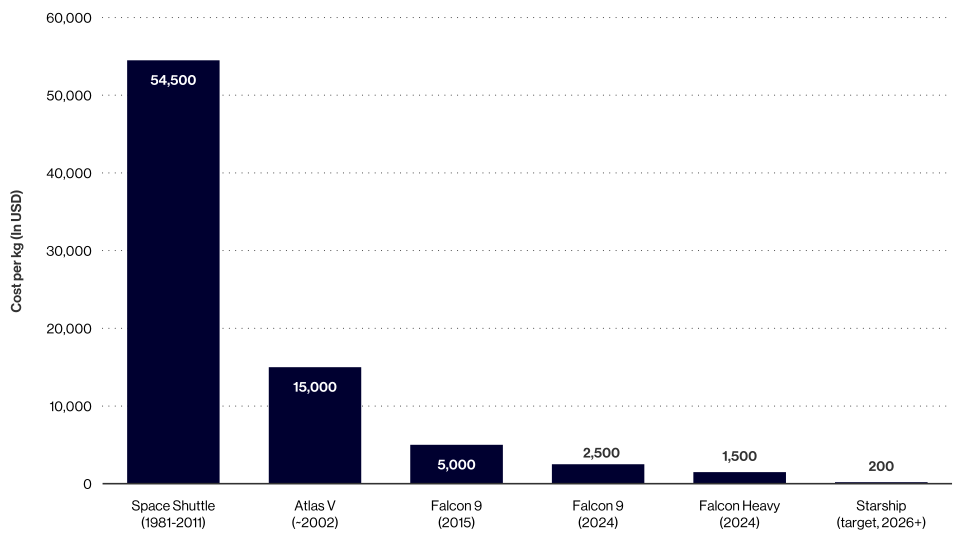
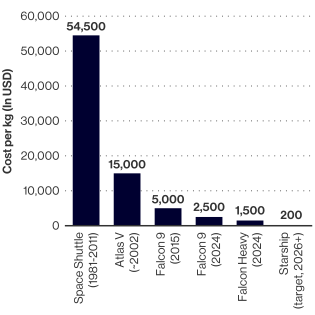
Source: SpaceX (March 2026). NASA/CSIS. AEI. BryceTech (Apr 2024). Space Foundation. Jonathan McDowell/Payload Space.
That is why reusable rockets are central to the SpaceX story. They are the economic engine that helps make the rest of the company's ambitions more credible.
Why Is SpaceX Considered More Than a Rocket Company?
The most visible part of SpaceX is its launch business. Rockets make headlines. Landings make videos. But the broader investment conversation has increasingly shifted toward what reusable launch enables.
Starlink is the clearest example.
Starlink Subscriber Growth Shows Satellite Broadband Is Here To Stay
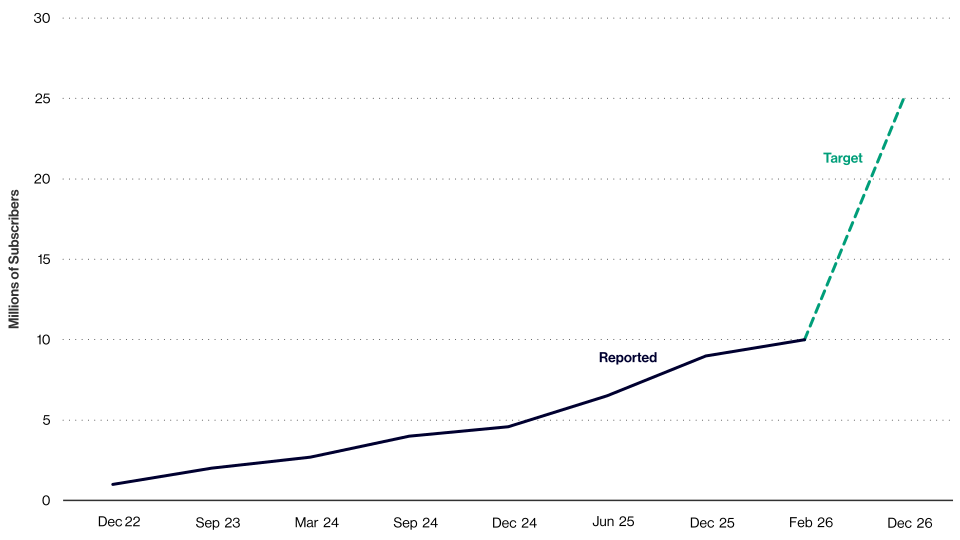
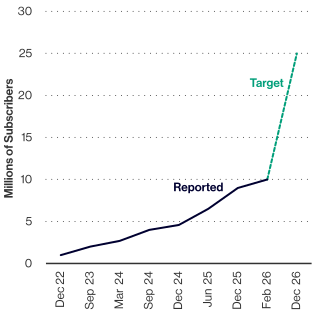
Source: SpaceX, Broadband breakfast (2026), SDxCentral (2026), DISHYtech (2025). For illustrative purposes only. Not intended as a forecast or prediction of future results.
What Does Starlink's Growth Tell Us About the Satellite Broadband Market?
By using its own launch capabilities to deploy a large satellite network, SpaceX created a global broadband business built on top of its core launch infrastructure. This creates a powerful business flywheel: rockets help deploy satellites, satellites help generate recurring revenue, and that revenue can support further investment in launch systems, satellite networks, and future technologies.
This is one reason the company is often discussed less like a traditional aerospace manufacturer and more like an infrastructure platform. SpaceX is building the tools, transportation systems, and networks that could support a larger space-based economy over time.
That distinction matters. Investors are not only trying to value what SpaceX is today. They are trying to understand what it could become if lower-cost access to space unlocks new markets over the next decade and beyond.
Why Has the SpaceX IPO Attracted So Much Investor Attention?
The IPO has drew significant attention because SpaceX sits at the center of several major themes at once.
SpaceX is one of the most widely known private companies in the world
For years, most public-market investors had limited direct access to SpaceX, even as the company grew in size, visibility, and strategic importance. That scarcity has created pent-up demand.
SpaceX is tied to multiple long-term growth areas
It is connected to satellite broadband, national security, launch services, global communications, and potentially future space infrastructure. The company's role in these markets gives investors a way to think about SpaceX as more than a single-product business.
SpaceX has reshaped what is possible with reusable rockets
Reusable rockets have made launches feel less like rare national events and more like repeatable commercial operations. That change in perception is important. Markets often assign greater value to companies that appear to expand the size of the opportunity itself.
SpaceX has become a symbol of the private-market growth story
Many investors have watched large private companies remain private for longer, capturing substantial value before public investors have a chance to participate. The SpaceX IPO was more than a listing, it was the test of how public markets value one of the most important private companies of the last two decades.
Recommended subscription
Why Have Investment Funds Been Built Around SpaceX Exposure?
The number of funds and investment vehicles seeking SpaceX exposure reflects a simple reality: demand exists before direct access is widely available.
Some funds have tried to provide access through private shares, special purpose vehicles, closed-end fund structures, interval funds, or portfolios that include SpaceX alongside other public and private companies. These vehicles differ meaningfully in liquidity, expenses, transparency, concentration, and the type of SpaceX exposure they provide.
That point is important for investors. "Exposure to SpaceX" does not always mean the same thing across investment products. One fund may hold preferred shares. Another may own an interest through a private vehicle. Another may provide only partial or indirect exposure as part of a broader portfolio.
For retail investors, the key takeaway is not that SpaceX exposure exists, but that the structure matters. Access, liquidity, fees, valuation methodology, and concentration can all meaningfully affect the investor experience.
Why Might Investors Pay a Premium for SpaceX Stock?
A premium valuation also means more room to fall. If growth disappoints, the stock can decline sharply and investors may lose money — there is no guarantee SpaceX will achieve what its valuation implies.
The premium attached to SpaceX reflects the possibility that the company may sit at the center of a much larger future market.
That does not mean the valuation is risk-free. Companies priced for large future opportunities can be sensitive to execution delays, competition, regulation, capital needs, and changing investor expectations. Space is also technically difficult, capital intensive, and dependent on complex supply chains and government relationships.
But the reason investors may be willing to pay a premium today is that SpaceX is viewed by many as a category-defining company. If reusable rockets continue to lower the cost of reaching orbit, and if Starlink and other services continue to scale, SpaceX could benefit from multiple growth drivers at once.
WARP | VanEck Space ETF
To receive more Thematic Investing insights, sign up in our subscription center.

IMPORTANT DISCLOSURES
This is not an offer to buy or sell, or a recommendation to buy or sell any of the securities, financial instruments or digital assets mentioned herein. The information presented does not involve the rendering of personalized investment, financial, legal, tax advice, or any call to action. Certain statements contained herein may constitute projections, forecasts and other forward-looking statements, which do not reflect actual results, are for illustrative purposes only, are valid as of the date of this communication, and are subject to change without notice. Actual future performance of any assets or industries mentioned are unknown. Information provided by third party sources are believed to be reliable and have not been independently verified for accuracy or completeness and cannot be guaranteed. VanEck does not guarantee the accuracy of third party data. The information herein represents the opinion of the author(s), but not necessarily those of VanEck or its other employees.
Holdings will vary for the VanEck Space ETF and its corresponding Index. For a complete list of holdings in the WARP ETF, please click here: vaneck.com/WARP
MarketVector™ Space Index (MVWARPTR): An index designed to track the overall performance of companies involved in the space industry.
An investment in the VanEck Space ETF (WARP) may be subject to risks which include, among others, risks related to investing in space companies, equity securities, industrials sector, communication services sector, foreign securities, foreign currency, depositary receipts, small-cap, medium-cap and, large-cap companies, market, operational, index tracking, authorized participant concentration, new fund, no guarantee of active trading market, trading issues, passive management, fund shares trading, premium/discount, liquidity of fund shares, non-diversified, and index-related concentration risks, all of which may adversely affect the Fund. Large-capitalization companies may be subject to elevated risks.
Investing involves substantial risk and high volatility, including possible loss of principal. An investor should consider the investment objective, risks, charges and expenses of a Fund carefully before investing. To obtain a prospectus and summary prospectus, which contain this and other information, call 800.826.2333 or visit vaneck.com . Please read the prospectus and summary prospectus carefully before investing.
© 2026 Van Eck Securities Corporation, Distributor, a wholly owned subsidiary of Van Eck Associates Corporation.
Related Funds
IMPORTANT DISCLOSURES
This is not an offer to buy or sell, or a recommendation to buy or sell any of the securities, financial instruments or digital assets mentioned herein. The information presented does not involve the rendering of personalized investment, financial, legal, tax advice, or any call to action. Certain statements contained herein may constitute projections, forecasts and other forward-looking statements, which do not reflect actual results, are for illustrative purposes only, are valid as of the date of this communication, and are subject to change without notice. Actual future performance of any assets or industries mentioned are unknown. Information provided by third party sources are believed to be reliable and have not been independently verified for accuracy or completeness and cannot be guaranteed. VanEck does not guarantee the accuracy of third party data. The information herein represents the opinion of the author(s), but not necessarily those of VanEck or its other employees.
Holdings will vary for the VanEck Space ETF and its corresponding Index. For a complete list of holdings in the WARP ETF, please click here: vaneck.com/WARP
MarketVector™ Space Index (MVWARPTR): An index designed to track the overall performance of companies involved in the space industry.
An investment in the VanEck Space ETF (WARP) may be subject to risks which include, among others, risks related to investing in space companies, equity securities, industrials sector, communication services sector, foreign securities, foreign currency, depositary receipts, small-cap, medium-cap and, large-cap companies, market, operational, index tracking, authorized participant concentration, new fund, no guarantee of active trading market, trading issues, passive management, fund shares trading, premium/discount, liquidity of fund shares, non-diversified, and index-related concentration risks, all of which may adversely affect the Fund. Large-capitalization companies may be subject to elevated risks.
Investing involves substantial risk and high volatility, including possible loss of principal. An investor should consider the investment objective, risks, charges and expenses of a Fund carefully before investing. To obtain a prospectus and summary prospectus, which contain this and other information, call 800.826.2333 or visit vaneck.com . Please read the prospectus and summary prospectus carefully before investing.
© 2026 Van Eck Securities Corporation, Distributor, a wholly owned subsidiary of Van Eck Associates Corporation.