Top AI Companies to Watch in 2026
April 17, 2026
Read Time 6 MIN
Key Takeaways:
- AI exposure is not one trade. Investors can think about the space across infrastructure enablers, AI developers and AI adopters.
- As AI moves from pilot programs to everyday workflows, demand for compute, memory, networking and fabrication capacity may remain durable.
- For investors who want exposure to the building blocks of AI, semiconductor companies offer a way to participate without needing to pick a single application-layer winner.
Why AI Is a Structural Theme, Not a Speculative Trend
AI is increasingly looking less like a one-cycle technology story and more like a long-duration shift in how software, services and physical devices operate. The key question is no longer whether AI will be used, but how deeply it becomes embedded in enterprise workflows, consumer products and industrial systems.
That distinction matters for investors. As AI tools become more reliable, more integrated and easier to deploy, usage can move from experimentation toward habit. In that environment, demand is no longer tied only to excitement around new models. It is supported by recurring compute needs across training, inference and edge deployment.
How Should Investors Think About AI Exposure?
Investing in AI through public markets is not always as direct as it seems. Many of the companies building the most prominent AI models are not pure-play public investments, and many public companies talking about AI have only partial exposure to the theme.
At a high level, investors can think about AI exposure in three buckets: infrastructure enablers, AI developers and AI adopters.
Infrastructure enablers include the semiconductor, memory, foundry, equipment and networking companies that make AI possible.
AI developers are the model builders and software platforms trying to monetize AI directly.
AI adopters are companies using AI to improve products, operations or productivity.
For investors, that distinction matters. Developers and adopters may offer upside, but semiconductors can be the clearest public-market way to access AI because they sit at the enabling layer of the stack. Every model trained, every inference request processed and every edge device deployed still runs through silicon first.
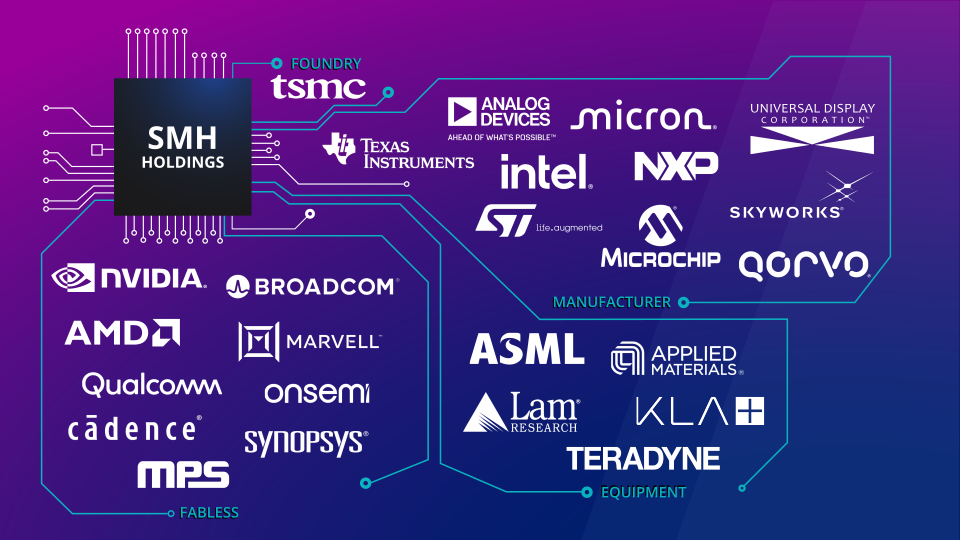
Source: Factset. As of 06/30/2025. These are not recommendations to buy or to sell any security. Securities and holdings may vary.
Top 5 AI Companies to Watch
Top holdings in SMH as of 04/10/2026.
1. Nvidia (NVDA) - 18.63% holding in SMH
- What They Do:
Nvidia remains the most visible company in AI infrastructure. Its GPUs have become the standard for training frontier models, and its software ecosystem gives it influence well beyond the chip itself. - Outlook for 2026:
Nvidia remains central to the AI buildout, but the story is broadening beyond training alone. Investors will likely be watching how much of demand is driven by inference, networking and full-system deployments rather than just standalone accelerator shipments. The more AI usage shifts from experimentation to production, the more important Nvidia’s role across the full compute stack becomes.
2. Taiwan Semiconductor Manufacturing Co. (TSM) - 11.39% holding in SMH
- What They Do:
TSMC is the leading advanced foundry manufacturing many of the chips powering the AI ecosystem. It sits at a critical point in the value chain, producing processors designed by many of the industry’s most important fabless companies. - Outlook for 2026:
TSMC is a company to watch because AI demand is not only about better chip design. It also depends on whether enough leading-edge manufacturing and advanced packaging capacity can come online to support that demand. As more custom silicon is developed for AI workloads, TSMC remains one of the clearest bottlenecks in the stack.
3. Broadcom (AVGO) - 8.21% holding in SMH
- What They Do:
Broadcom is best known for its connectivity, networking and custom silicon capabilities. In AI, that makes it relevant not only as a chip company, but as an enabler of how large-scale compute systems communicate and scale. - Outlook for 2026:
Broadcom is worth watching as hyperscalers continue building custom AI architectures. If the next phase of AI includes more internal accelerator development and more networking intensity inside data centers, Broadcom may remain important to the buildout even if investor attention stays focused on GPUs.
4. Intel (INTC) - 5.38% holding in SMH
- What They Do:
Intel remains a major semiconductor company with exposure across CPUs, manufacturing and broader compute infrastructure. While it has not been the market’s preferred AI name, its position in enterprise computing still makes it relevant. - Outlook for 2026:
Intel is one of the more interesting companies to watch because the upside case is tied less to current AI leadership and more to execution. Investors will likely be monitoring whether improvements in manufacturing, packaging and foundry strategy can reposition the company for a more meaningful role in the next phase of AI infrastructure.
5. Lam Research (LRCX) - 4.98% holding in SMH
- What They Do:
Lam Research provides critical wafer fabrication equipment used to make semiconductors. It sits upstream in the ecosystem, supplying tools needed to increase capacity and manufacture more advanced chips. - Outlook for 2026:
Lam is a reminder that AI demand does not stop with chip designers. If training clusters, inference demand and memory intensity keep rising, the equipment companies that enable new capacity may continue to benefit. Lam gives investors exposure to the buildout behind the buildout.
What Are the Key Risks of Investing in AI Companies?
AI remains one of the most compelling long-term themes in the market, but it is not without risk. Valuations across parts of the ecosystem can become extended, and expectations can move faster than realized earnings. The industry is also exposed to export restrictions, supply chain disruptions and geopolitical concentration, especially at the leading edge of manufacturing.
There is also the simple reality that not every company associated with AI will be a long-term winner. Some businesses may benefit from excitement without building durable economics. That is one reason many investors separate exposure between application-layer companies and the infrastructure businesses supplying the compute backbone.
SMH Sub-Industy Breakdown
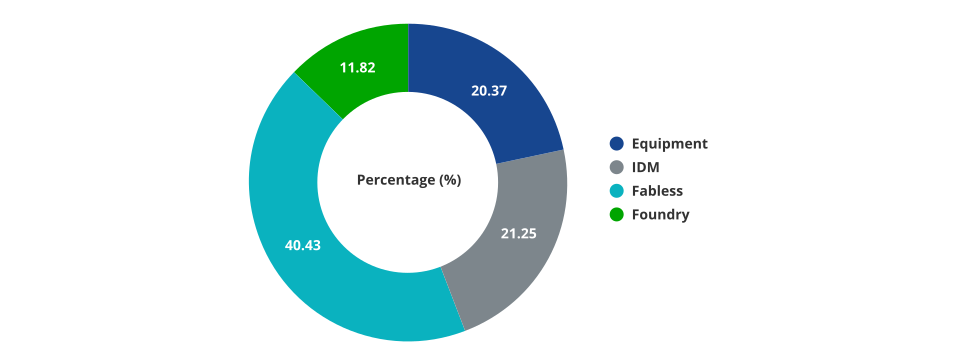
Source: Factset. As of 12/31/2025. Index holdings and performance are not illustrative of fund holdings or performance. It is not possible to invest directly in an index.
Recommended subscription
How Can Investors Access AI Exposure Through Semiconductors?
One of the challenges in AI investing is that the public market does not always offer clean exposure to the parts of the ecosystem getting the most attention. Many software and model-layer companies are diversified businesses, and in some cases the market is still debating how durable their long-term economics will be as competition increases and pricing evolves.
Semiconductors offer a different way to approach the theme. Rather than trying to predict which chatbot, model provider or application layer winner will ultimately capture the most value, investors can focus on the infrastructure that all of them require. Every training run, every inference query and every on-device AI feature still depends on chips, memory, networking and manufacturing capacity.
That is what makes semiconductors such an important part of the AI value chain. They are not dependent on a single AI platform winning. They benefit from the broader expansion of AI usage across the economy. As AI becomes more embedded in enterprise workflows, consumer products and physical devices, the demand for compute can remain central regardless of who owns the end customer relationship.
For investors looking to express that view in public markets, SMH can be one way to access many of those building blocks in a single portfolio. The fund includes companies across the semiconductor stack, from chip designers to foundries to equipment providers, giving investors exposure to the infrastructure layer underlying the AI buildout.
In that sense, the case for semiconductors is not just that they participate in AI. It is that they may represent the most direct and scalable public-market expression of the theme itself.
SMH | VanEck Semiconductor ETF
To receive more Thematic Investing insights, sign up in our subscription center.

Important Disclosures
Holdings will vary for the SMH ETF. For a complete list of holdings in the ETF, please click here.
This is not an offer to buy or sell, or a recommendation to buy or sell any of the securities, financial instruments or digital assets mentioned herein. The information presented does not involve the rendering of personalized investment, financial, legal, tax advice, or any call to action. Certain statements contained herein may constitute projections, forecasts and other forward-looking statements, which do not reflect actual results, are for illustrative purposes only, are valid as of the date of this communication, and are subject to change without notice. Actual future performance of any assets or industries mentioned are unknown. Information provided by third party sources are believed to be reliable and have not been independently verified for accuracy or completeness and cannot be guaranteed. VanEck does not guarantee the accuracy of third party data. The information herein represents the opinion of the author(s), but not necessarily those of VanEck or its other employees.
An investment in the VanEck Semiconductor ETF (SMH) may be subject to risks which include, among others, risks related to investing in the semiconductor industry, equity securities, special risk considerations of investing in Asian, European and Taiwanese issuers, foreign securities, emerging market issuers, foreign currency, depositary receipts, medium-capitalization companies, issuer-specific changes, market, operational, index tracking, authorized participant concentration, no guarantee of active trading market, trading issues, passive management, fund shares trading, premium/discount risk and liquidity of fund shares, non-diversified, and industry concentration risks, all of which may adversely affect the Fund. Emerging market issuers and foreign securities may be subject to securities markets, political and economic, investment and repatriation restrictions, different rules and regulations, less publicly available financial information, foreign currency and exchange rates, operational and settlement, and corporate and securities laws risks. Medium-capitalization companies may be subject to elevated risks.
Investing involves substantial risk and high volatility, including possible loss of principal. An investor should consider the investment objective, risks, charges and expenses of the Fund carefully before investing. To obtain a prospectus and summary prospectus, which contains this and other information, call 800.826.2333 or visit vaneck.com/etfs. Please read the prospectus and summary prospectus carefully before investing.
© Van Eck Securities Corporation, Distributor, a wholly owned subsidiary of Van Eck Associates Corporation.
Related Funds
Important Disclosures
Holdings will vary for the SMH ETF. For a complete list of holdings in the ETF, please click here.
This is not an offer to buy or sell, or a recommendation to buy or sell any of the securities, financial instruments or digital assets mentioned herein. The information presented does not involve the rendering of personalized investment, financial, legal, tax advice, or any call to action. Certain statements contained herein may constitute projections, forecasts and other forward-looking statements, which do not reflect actual results, are for illustrative purposes only, are valid as of the date of this communication, and are subject to change without notice. Actual future performance of any assets or industries mentioned are unknown. Information provided by third party sources are believed to be reliable and have not been independently verified for accuracy or completeness and cannot be guaranteed. VanEck does not guarantee the accuracy of third party data. The information herein represents the opinion of the author(s), but not necessarily those of VanEck or its other employees.
An investment in the VanEck Semiconductor ETF (SMH) may be subject to risks which include, among others, risks related to investing in the semiconductor industry, equity securities, special risk considerations of investing in Asian, European and Taiwanese issuers, foreign securities, emerging market issuers, foreign currency, depositary receipts, medium-capitalization companies, issuer-specific changes, market, operational, index tracking, authorized participant concentration, no guarantee of active trading market, trading issues, passive management, fund shares trading, premium/discount risk and liquidity of fund shares, non-diversified, and industry concentration risks, all of which may adversely affect the Fund. Emerging market issuers and foreign securities may be subject to securities markets, political and economic, investment and repatriation restrictions, different rules and regulations, less publicly available financial information, foreign currency and exchange rates, operational and settlement, and corporate and securities laws risks. Medium-capitalization companies may be subject to elevated risks.
Investing involves substantial risk and high volatility, including possible loss of principal. An investor should consider the investment objective, risks, charges and expenses of the Fund carefully before investing. To obtain a prospectus and summary prospectus, which contains this and other information, call 800.826.2333 or visit vaneck.com/etfs. Please read the prospectus and summary prospectus carefully before investing.
© Van Eck Securities Corporation, Distributor, a wholly owned subsidiary of Van Eck Associates Corporation.