WARP Speed Ahead: Space Economy Reaching Escape Velocity
May 07, 2026
Read Time 5 MIN
The space economy is reaching an inflection point as costs fall and markets scale, creating more investment opportunities. WARP offers focused exposure to the companies driving this shift.
Key Takeaways:
- The space economy is becoming a multi-layered commercial market.
- Falling launch costs are unlocking scale across satellites, data, and communications.
- Space is shifting from exploration to infrastructure supporting real-world applications.
- Commercial demand is expanding across satellite, defense and data-driven use cases.
- WARP provides pure-play exposure to the companies building the space economy.
For decades, space was viewed primarily as a government endeavor. Space was a strategic and capital-intensive domain that was largely limited to a small group of national programs and defense contractors.
That picture is changing.
Today, space is becoming a commercial economy with real infrastructure, expanding end markets, and a growing universe of companies building the systems that make it all work. From launch providers and satellite manufacturers to communications networks, earth observation platforms and orbital intelligence, space is no longer just about exploration. It is increasingly about connectivity, data, security and infrastructure here on Earth.
The biggest reason for that shift is simple: it is becoming far less expensive to get to orbit.
The Investment Case for Space Looks Different Today
Every major industry expansion has begun with falling costs.
The internet scaled as computing and bandwidth became more affordable. Electric vehicles became viable as battery costs came down. Cloud software accelerated as storage and processing costs declined.
Space appears to be reaching a similar inflection point.
Advances in launch technology, particularly reusability, have fundamentally changed the economics of access to orbit. Launch costs have historically been one of the biggest bottlenecks, and lowering them have reduced one of the most important barriers to entry across the entire ecosystem.
Declining Launch Costs Creating Economies of Scale for Space
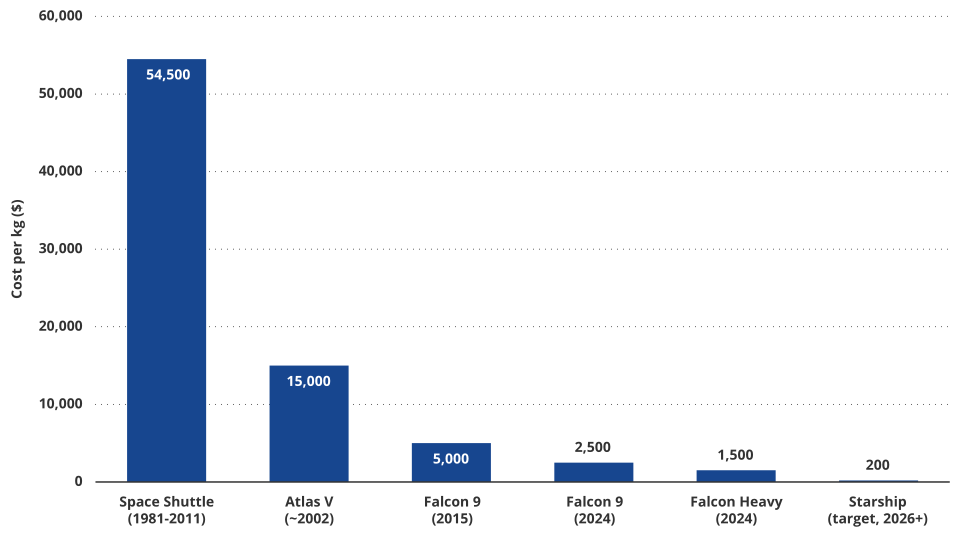
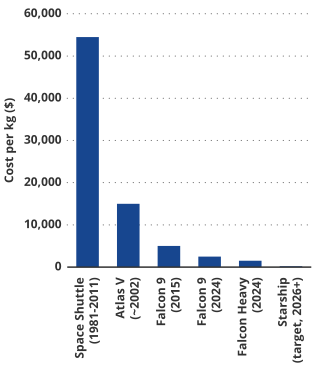
Source: SpaceX (March 2026). NASA/CSIS. AEI. BryceTech (Apr 2024). Space Foundation. Jonathan McDowell/Payload Space.
When launch was prohibitively expensive, participation was limited. As launch becomes cheaper, faster, and more frequent, the market opens up. More satellites can be deployed. More services can be built on top of those networks. More commercial models can emerge around communications, imagery, geospatial intelligence, navigation, and in-orbit services.
In other words, lower launch costs do more than simply making space cheaper. They transform the broader space economy into a more scalable and commercially viable ecosystem.
Space Becoming an Economy, Not Just an Industry
One of the most important shifts underway is that space is no longer defined by a single use case. It is expanding across multiple commercial layers as key drivers of demand:
- Satellite communications: Space-based connectivity is becoming a critical part of modern communications infrastructure, especially in regions and applications where terrestrial networks fall short.
- Earth observation and data: Satellites are increasingly used to monitor infrastructure, agriculture, supply chains, weather patterns, and geopolitical activity, creating a growing market for real-time, space-based intelligence.
- Launch and propulsion: Launch is becoming more frequent and more scalable, helping create a stronger foundation for recurring commercial activity in orbit.
- Defense and national security: Governments are investing more heavily in space as a strategic domain, supporting demand for communications, surveillance, missile warning, and space situational awareness capabilities.
- AI and orbital intelligence: Artificial intelligence is making satellite data more useful by helping convert imagery and signals into actionable insights more quickly and at greater scale.
Taken together, these developments point to a broader reality: space is becoming an ecosystem with multiple layers of economic activity, rather than a narrow theme.
Recommended subscription
The Shift from Exploration to Infrastructure
For some investors, space may still sound speculative. The theme often brings to mind tourism, moonshots or futuristic concepts that seem disconnected from the real economy.
The more compelling investment case is much more practical.
Space is increasingly becoming part of the infrastructure that supports modern life. It plays a growing role in communications, navigation, logistics, defense, environmental monitoring and enterprise data collection. Many of these functions are becoming more essential over time.
That is why the reduction in launch costs is so important.
Lower-cost access to orbit makes it easier to build and expand infrastructure. More infrastructure enables more services. More services support more durable business models. Over time, that can lead to a broader and deeper commercial opportunity set.
This is what makes the current moment important. Space is moving from a state-led frontier to a commercially supported economy.
Global Rocket Launches Annually 2015-2025
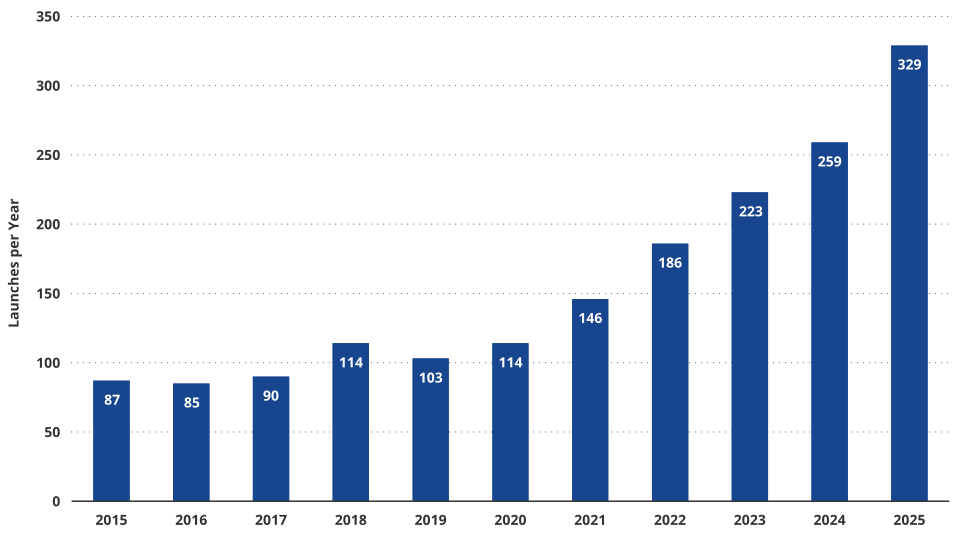
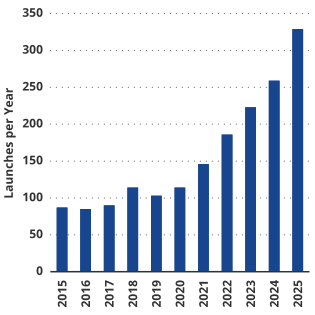
Source: NASA/CSIS. AEI. Citi. SpaceX. Jonathan McDowell/Payload Space. Sentinel Mission. Space Foundation.
Why the WARP ETF
The VanEck Space ETF (WARP) is designed to provide investors with targeted exposure to companies participating in the growing space economy.
Rather than treating space as a side business within large industrial or defense conglomerates, WARP is built around a more focused approach, emphasizing companies with meaningful revenue exposure to space-related activities. That includes areas such as launch, satellite communications, earth observation, and the technologies and services that support space infrastructure.
For investors who believe the space economy is moving into a more commercial phase, WARP seeks to offer a way to access that theme through a rules-based, pure-play framework.
What This Means for Investors
At VanEck, we have long believed that some of the most durable opportunities come from identifying structural change early and giving investors targeted exposure to the businesses helping drive it.
The case for space fits that view.
This is not simply a story about rockets. It is a story about falling costs unlocking new markets, infrastructure becoming more scalable, services becoming more commercial, and space becoming increasingly integrated into the global economy.
The final frontier may still sound distant. But as launch becomes more affordable and access continues to expand, space is beginning to look less like science fiction and more like the next major economic platform.
WARP | VanEck Space ETF
To receive more Thematic Investing insights, sign up in our subscription center.

IMPORTANT DISCLOSURES
This is not an offer to buy or sell, or a recommendation to buy or sell any of the securities, financial instruments or digital assets mentioned herein. The information presented does not involve the rendering of personalized investment, financial, legal, tax advice, or any call to action. Certain statements contained herein may constitute projections, forecasts and other forward-looking statements, which do not reflect actual results, are for illustrative purposes only, are valid as of the date of this communication, and are subject to change without notice. Actual future performance of any assets or industries mentioned are unknown. Information provided by third party sources are believed to be reliable and have not been independently verified for accuracy or completeness and cannot be guaranteed. VanEck does not guarantee the accuracy of third party data. The information herein represents the opinion of the author(s), but not necessarily those of VanEck or its other employees.
An investment in the VanEck Space ETF (WARP) may be subject to risks which include, among others, risks related to investing in space companies, equity securities, industrials sector, communication services sector, foreign securities, foreign currency, depositary receipts, small-cap, medium-cap and, large-cap companies, market, operational, index tracking, authorized participant concentration, new fund, no guarantee of active trading market, trading issues, passive management, fund shares trading, premium/discount, liquidity of fund shares, non-diversified, and index-related concentration risks, all of which may adversely affect the Fund. Large-capitalization companies may be subject to elevated risks.
Investing involves substantial risk and high volatility, including possible loss of principal. An investor should consider the investment objective, risks, charges and expenses of a Fund carefully before investing. To obtain a prospectus and summary prospectus, which contain this and other information, call 800.826.2333 or visit vaneck.com. Please read the prospectus and summary prospectus carefully before investing.
© 2026 Van Eck Securities Corporation, Distributor, a wholly owned subsidiary of Van Eck Associates Corporation.
Related Funds
IMPORTANT DISCLOSURES
This is not an offer to buy or sell, or a recommendation to buy or sell any of the securities, financial instruments or digital assets mentioned herein. The information presented does not involve the rendering of personalized investment, financial, legal, tax advice, or any call to action. Certain statements contained herein may constitute projections, forecasts and other forward-looking statements, which do not reflect actual results, are for illustrative purposes only, are valid as of the date of this communication, and are subject to change without notice. Actual future performance of any assets or industries mentioned are unknown. Information provided by third party sources are believed to be reliable and have not been independently verified for accuracy or completeness and cannot be guaranteed. VanEck does not guarantee the accuracy of third party data. The information herein represents the opinion of the author(s), but not necessarily those of VanEck or its other employees.
An investment in the VanEck Space ETF (WARP) may be subject to risks which include, among others, risks related to investing in space companies, equity securities, industrials sector, communication services sector, foreign securities, foreign currency, depositary receipts, small-cap, medium-cap and, large-cap companies, market, operational, index tracking, authorized participant concentration, new fund, no guarantee of active trading market, trading issues, passive management, fund shares trading, premium/discount, liquidity of fund shares, non-diversified, and index-related concentration risks, all of which may adversely affect the Fund. Large-capitalization companies may be subject to elevated risks.
Investing involves substantial risk and high volatility, including possible loss of principal. An investor should consider the investment objective, risks, charges and expenses of a Fund carefully before investing. To obtain a prospectus and summary prospectus, which contain this and other information, call 800.826.2333 or visit vaneck.com. Please read the prospectus and summary prospectus carefully before investing.
© 2026 Van Eck Securities Corporation, Distributor, a wholly owned subsidiary of Van Eck Associates Corporation.