Floating Rates: Capturing Short-Term Yields as the Yield Curve Normalizes
November 25, 2025
Read Time 3 MIN
Key Takeaways:
- Investors may benefit from shifting toward floating rate notes to capture higher yields and move beyond low-return cash holdings.
- Investment grade floating rate notes currently yield 5.12%, offering attractive income potential while minimizing duration risk.
- Combining FRNs with CLO exposure can enhance portfolio resilience through diversified, floating-rate income streams.
After two years of inversion, the yield curve has normalized. On October 31, 2025, the 2s/10s spread closed at +0.49% following the late October policy cut, with longer-maturity yields remaining elevated as markets reassess inflation and Treasury supply conditions. The Fed lowered the policy rate to 3.75%–4.00% on October 29 and indicated it will halt balance-sheet runoff on December 1.
Investors, however, continue to sit on record levels of cash with money market fund assets at approximately $7 trillion. While cash has been a safe rate-sensitive haven, it provides limited upside once policy rates peak. With the curve only modestly positive, a rate cutting cycle that is expected to be shallow, and continued pressure on long-term bond yields, investment-grade floating-rate notes (FRNs) remain a compelling short duration income option.
The Curve Continues to Normalize
The steepening marks a transition from the “higher-for-longer” stance that defined 2023 - 2024. However, the slow pace and shallow magnitude of rate cuts have continued to make floating rate an attractive option within an income portfolio. Market-implied expectations point to modest, maybe 2 or 3, additional cuts through 2026, contingent on data. If the labor market softens faster, easing could come sooner; if growth holds, cuts may be delayed. Elevated inflation, widening fiscal deficits and geopolitical tension have kept upward pressure on long term yields even as the Fed cuts rates.
Difference Between 10-Year and 2-Year US Treasury Yields
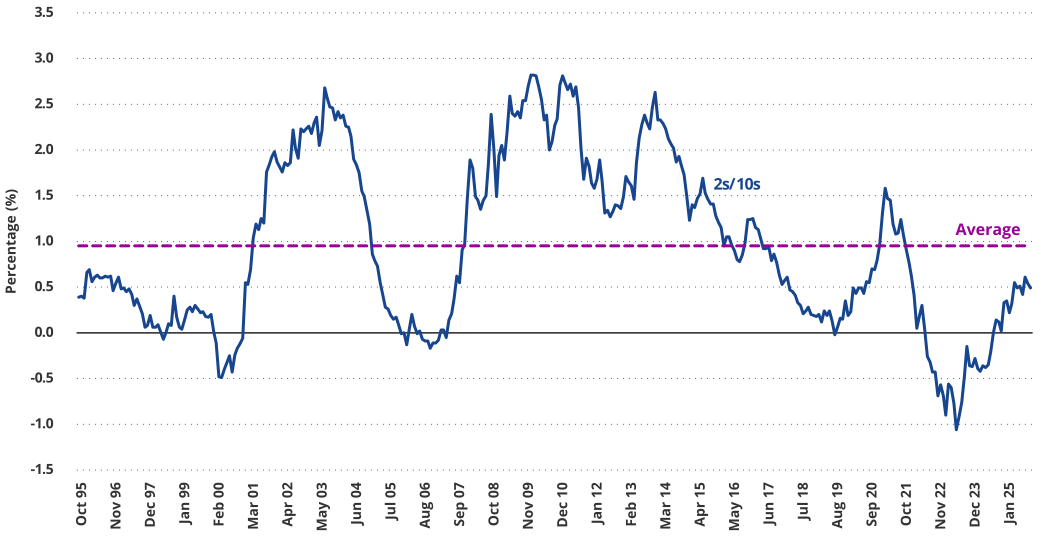
Source: ICE Data Services, VanEck.Past performance is no guarantee of future results.
Recommended subscription
For investors, this environment challenges traditional playbooks. Long-duration bonds, which prospered during decades of falling yields, now offer limited price appreciation and heightened downside if yields rise again. The recent volatility in Treasuries reflects shifting expectations for inflation and policy. Extending duration preemptively could prove costly should long yields remain stubbornly high.
Why Floating Rate Notes Still Make Sense
We believe that these factors continue to support an allocation to the short end of the yield where FRNs may provide a way to earn attractive income while minimizing exposure to rate volatility.
Floating rate notes, such as the VanEck IG Floating Rate ETF (FLTR), offer an efficient way to navigate today’s shifting rate environment. FRNs pay coupons that reset, usually quarterly, based on SOFR plus fixed spread, giving them near-zero duration and insulating prices from rate swings.
At the end of October, IG FRNs yielded 5.12%, comparing favorably with short- and fixed-rate corporate bonds (3.82% and 4.82%, respectively). Because their coupons adjust with market rates, FRNs exhibit low price sensitivity across both tightening and easing cycles. This structure helps reduce mark-to-market volatility while preserving income potential.
In short, FRNs capture today’s elevated short-term yields without adding duration risk. If short term rates decline, coupon income adjusts lower, but prices typically remain stable, a balanced trade-off between income and capital stability.
FLTR | VanEck IG Floating Rate ETF
Building Resilience Through Diversification
To further strengthen an ultrashort duration approach, investors can pair FRNs with exposure to CLOs through VanEck CLO ETF (CLOI) and VanEck AA–BB CLO ETF (CLOB). CLOs are portfolios of senior secured loans with floating coupons and structural credit protection.
- CLOI focuses on IG tranches which were yielding yields 4.95% and have low credit risk. Notably, no investment grade CLO has ever defaulted post GFC.
- CLOB primarily holds AA–BB rated tranches which recently offered yields of 6.82%.
CLO structures also include built-in protections such as diversification across hundreds of loans and priority in payment waterfalls. These features have helped maintain strong performance through past cycles. For investors seeking to maintain income without extending duration, CLOs represent an attractive complement to corporate FRNs.
To receive more Income Investing insights, sign up in our subscription center.

IMPORTANT DISCLOSURES
The performance data quoted represents past performance. Past performance is not a guarantee of future results. Investment return and principal value of an investment will fluctuate so that an investor's shares, when redeemed, may be worth more or less than their original cost. Performance may be lower or higher than performance data quoted. Please call 800.826.2333, or click for performance current to the most recent month end.
FLTR 30-Day SEC Yield: 4.80%. Please click here for FLTR standardized performance.
CLOI 30-Day SEC Yield: 5.29%. Please click here for CLOI standardized performance.
CLOB 30-Day SEC Yield: 6.36%. Please click here for CLOB standardized performance.
30-Day SEC Yield figures above are as of 11/20/2025.
This is not an offer to buy or sell, or a recommendation to buy or sell any of the securities, financial instruments or digital assets mentioned herein. The information presented does not involve the rendering of personalized investment, financial, legal, tax advice, or any call to action. Certain statements contained herein may constitute projections, forecasts and other forward-looking statements, which do not reflect actual results, are for illustrative purposes only, are valid as of the date of this communication, and are subject to change without notice. Actual future performance of any assets or industries mentioned are unknown. Information provided by third party sources are believed to be reliable and have not been independently verified for accuracy or completeness and cannot be guaranteed. VanEck does not guarantee the accuracy of third party data. The information herein represents the opinion of the author(s), but not necessarily those of VanEck or its other employees.
30-Day SEC Yield is a standard yield calculation developed by the Securities and Exchange Commission that allows for fairer comparison among funds. It is based on the most recent 30-Day period. This yield figure reflects the interest earned during the period after deducting the Fund’s expenses for the period. It does not reflect the yield an investor would have received if they had held the Fund over the last twelve months assuming the most recent NAV.
The principal risks of investing in VanEck ETFs and mutual funds include, but are not limited to, sector, market, economic, political, foreign currency, world event, index tracking, active management, social media analytics, derivatives, blockchain, commodities and non-diversification risks, as well as fluctuations in net asset value and the risks associated with investing in less developed capital markets. VanEck ETFs may also be subject to authorized participant concentration, no guarantee of active trading market, trading issues, passive management, fund shares trading, premium/discount risk and liquidity of fund shares risks. VanEck ETFs or mutual funds may loan their securities, which may subject them to additional credit and counterparty risk. ETFs or mutual funds that invest in high-yield securities are subject to subject to risks associated with investing in high-yield securities; which include a greater risk of loss of income and principal than funds holding higher-rated securities; concentration risk; credit risk; hedging risk; interest rate risk; and short sale risk. ETFs or mutual funds that invest in companies with small capitalizations are subject to elevated risks, which include, among others, greater volatility, lower trading volume and less liquidity than larger companies. Please see the prospectus of each Fund for more complete information regarding each Fund’s specific risks.
The indices listed are unmanaged indices and do not reflect the payment of transaction costs, advisory fees, or expenses that are associated with an investment in any underlying exchange-traded funds. An index’s performance is not illustrative of any underlying exchange-traded fund’s performance. Indices are not securities in which investments can be made.
ICE 0-5 Year US Floating Rate Corporate & Quasi-Government Index is a subset of ICE USD Floating Rate Corporate & Quasi-Government Index including all US domestic securities with a remaining term to final maturity less than five years. The ICE USD Floating Rate Corporate & Quasi-Government Index tracks the performance of floating rate U.S. dollar denominated investment grade debt publicly issued in the U.S. domestic market, including U.S. agency, foreign government, supranational and corporate securities. MVIS US Investment Grade Floating Rate Index (MVFLTR) is a modified market capitalization-weighted index that consists of U.S. dollar-denominated floating rate notes issued by corporate issuers and rated investment grade.
Investing involves substantial risk and high volatility, including possible loss of principal. Bonds and bond funds will decrease in value as interest rates rise. An investor should consider the investment objective, risks, charges and expenses of the Fund carefully before investing. To obtain a prospectus and summary prospectus, which contains this and other information, call 800.826.2333 or visit vaneck.com. Please read the prospectus and summary prospectus carefully before investing.
© 2025 Van Eck Securities Corporation, Distributor, a wholly-owned subsidiary of Van Eck Associates Corporation.
Related Funds
IMPORTANT DISCLOSURES
The performance data quoted represents past performance. Past performance is not a guarantee of future results. Investment return and principal value of an investment will fluctuate so that an investor's shares, when redeemed, may be worth more or less than their original cost. Performance may be lower or higher than performance data quoted. Please call 800.826.2333, or click for performance current to the most recent month end.
FLTR 30-Day SEC Yield: 4.80%. Please click here for FLTR standardized performance.
CLOI 30-Day SEC Yield: 5.29%. Please click here for CLOI standardized performance.
CLOB 30-Day SEC Yield: 6.36%. Please click here for CLOB standardized performance.
30-Day SEC Yield figures above are as of 11/20/2025.
This is not an offer to buy or sell, or a recommendation to buy or sell any of the securities, financial instruments or digital assets mentioned herein. The information presented does not involve the rendering of personalized investment, financial, legal, tax advice, or any call to action. Certain statements contained herein may constitute projections, forecasts and other forward-looking statements, which do not reflect actual results, are for illustrative purposes only, are valid as of the date of this communication, and are subject to change without notice. Actual future performance of any assets or industries mentioned are unknown. Information provided by third party sources are believed to be reliable and have not been independently verified for accuracy or completeness and cannot be guaranteed. VanEck does not guarantee the accuracy of third party data. The information herein represents the opinion of the author(s), but not necessarily those of VanEck or its other employees.
30-Day SEC Yield is a standard yield calculation developed by the Securities and Exchange Commission that allows for fairer comparison among funds. It is based on the most recent 30-Day period. This yield figure reflects the interest earned during the period after deducting the Fund’s expenses for the period. It does not reflect the yield an investor would have received if they had held the Fund over the last twelve months assuming the most recent NAV.
The principal risks of investing in VanEck ETFs and mutual funds include, but are not limited to, sector, market, economic, political, foreign currency, world event, index tracking, active management, social media analytics, derivatives, blockchain, commodities and non-diversification risks, as well as fluctuations in net asset value and the risks associated with investing in less developed capital markets. VanEck ETFs may also be subject to authorized participant concentration, no guarantee of active trading market, trading issues, passive management, fund shares trading, premium/discount risk and liquidity of fund shares risks. VanEck ETFs or mutual funds may loan their securities, which may subject them to additional credit and counterparty risk. ETFs or mutual funds that invest in high-yield securities are subject to subject to risks associated with investing in high-yield securities; which include a greater risk of loss of income and principal than funds holding higher-rated securities; concentration risk; credit risk; hedging risk; interest rate risk; and short sale risk. ETFs or mutual funds that invest in companies with small capitalizations are subject to elevated risks, which include, among others, greater volatility, lower trading volume and less liquidity than larger companies. Please see the prospectus of each Fund for more complete information regarding each Fund’s specific risks.
The indices listed are unmanaged indices and do not reflect the payment of transaction costs, advisory fees, or expenses that are associated with an investment in any underlying exchange-traded funds. An index’s performance is not illustrative of any underlying exchange-traded fund’s performance. Indices are not securities in which investments can be made.
ICE 0-5 Year US Floating Rate Corporate & Quasi-Government Index is a subset of ICE USD Floating Rate Corporate & Quasi-Government Index including all US domestic securities with a remaining term to final maturity less than five years. The ICE USD Floating Rate Corporate & Quasi-Government Index tracks the performance of floating rate U.S. dollar denominated investment grade debt publicly issued in the U.S. domestic market, including U.S. agency, foreign government, supranational and corporate securities. MVIS US Investment Grade Floating Rate Index (MVFLTR) is a modified market capitalization-weighted index that consists of U.S. dollar-denominated floating rate notes issued by corporate issuers and rated investment grade.
Investing involves substantial risk and high volatility, including possible loss of principal. Bonds and bond funds will decrease in value as interest rates rise. An investor should consider the investment objective, risks, charges and expenses of the Fund carefully before investing. To obtain a prospectus and summary prospectus, which contains this and other information, call 800.826.2333 or visit vaneck.com. Please read the prospectus and summary prospectus carefully before investing.
© 2025 Van Eck Securities Corporation, Distributor, a wholly-owned subsidiary of Van Eck Associates Corporation.