A Framework for Valuing Bitcoin Miners as AI Infrastructure
June 16, 2026
Read Time 10+ MIN
Please note that VanEck has exposure to bitcoin and may have positions in certain companies mentioned.
Key Takeaways
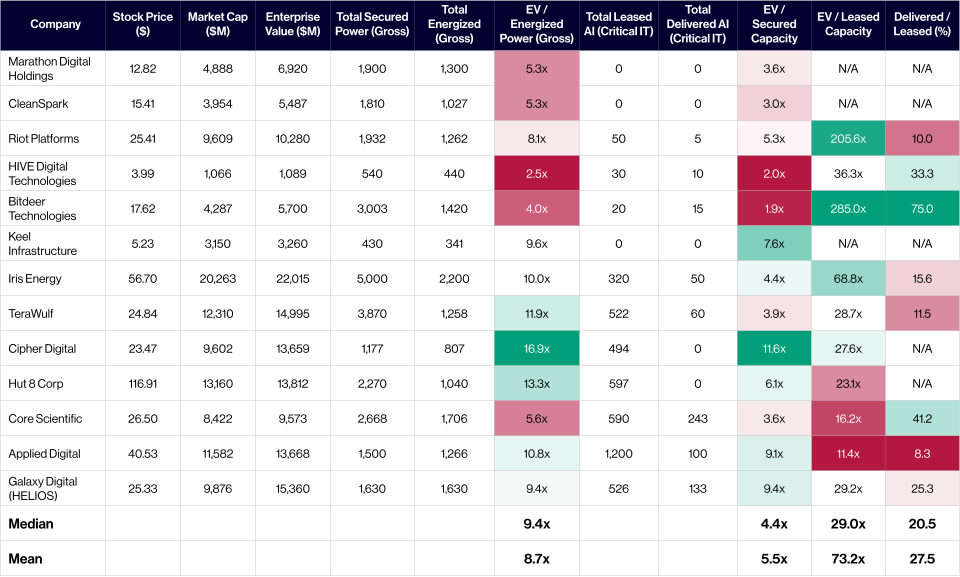
- Energized power is the cleanest valuation lens for now: with disclosures varying widely and cash flows still nascent, names with leases in hand command above 10x gross energized power, while those still selling a pipeline trade at 2-6x.
- Execution, not signing, becomes the next premium: the group has delivered only ~25% of leased capacity, so valuation premiums should shift toward operators that build on time and on budget, with missed construction milestones risking structural de-ratings.
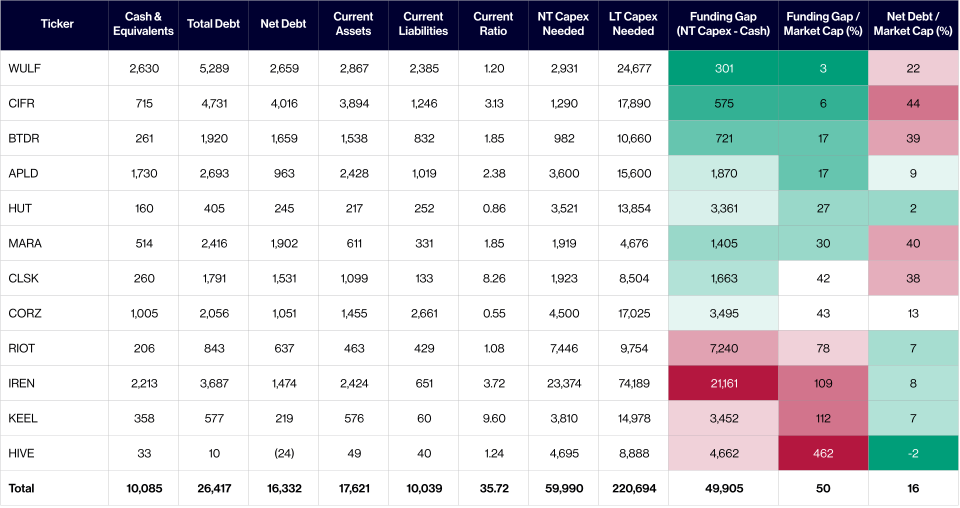
- A ~$50B near-term funding gap separates pipeline from delivery: near-term capex needs far exceed cash on hand, and long-term needs approach ~$221B, making access to equity, debt, and partnership capital a key differentiator.
This material is VanEck's research commentary, for informational and educational purposes only as of the publication date. It is not an offer of advisory services, a solicitation, investment advice, or a recommendation regarding any security or strategy. Companies are referenced only to illustrate the framework discussed. VanEck, its affiliates, and their personnel may hold or trade positions in bitcoin and the companies mentioned, and may have conflicting interests. Views may change without notice.
Few sectors have transformed as rapidly as Bitcoin mining, so it's unsurprising that these companies, now pivoting to AI, have been among the most volatile equity performers of the past year. The investment thesis is compelling, as existing power infrastructure is re-deployed to serve AI customers that are willing to pay premium rates in a capacity-constrained market. That said, the financial performance of these businesses has yet to reflect the strategic narrative, creating a valuation challenge. Investors are given the task of pricing companies based on a mix of legacy mining operations with declining relevance and nascent AI infrastructure businesses with uncertain timelines to cash flow generation, all while raising significant capital up-front to fund these endeavors. Below we attempt to help navigate this challenge, by providing a framework for how we think about valuations.
How the Market Values Bitcoin Miners Pivoting to AI/HPC
With disclosures varying widely and each company at a different stage of its AI pivot, no clear framework exists for valuing bitcoin miners through this transformation. Until more contracts are secured and cash flows begin, we believe the cleanest available benchmark is gross energized power, as it cuts through disclosure gaps and highlights the companies actually leasing capacity vs those that are still selling a pipeline. The comp sheet below highlights that companies with little to no contracted capacity trade at 2-6x energized power (MARA, CLSK), while those with leases in hand command >10x (CIFR, HUT, WULF). We also see credit given to those that have begun to deliver leases (APLD, CORZ), while significant re-rating potential remains in those that are still in the proof of concept stage (BTDR, HIVE, KEEL).
Over time we expect valuation to migrate from megawatts (MW) of energized power toward those actually leased and delivered, until cash flow generation begins and more rigorous fundamental work becomes valuable. For now, we find that the market is paying for contracted and energized capacity, while discounting everything still in the pipeline.
Our Read on Relative Value
Based on energized power today, we see HIVE and BTDR trading at the lowest multiples (given their risk and minimal contracted to date), followed by MARA and CLSK (names still tied to bitcoin (BTC)). Ultimately, we expect those focusing on an AI/HPC (high-performance computing) pivot more likely to re-rate in the near-term, but believe those currently capturing a higher multiple may have the potential to compound their cost of capital advantage into economies of scale and profitable long-term growth, given the quality of the contracted tenants and ability to execute additional deals at increasingly favorable terms (CIFR, HUT, WULF).
Comp Sheet - Capacity
Source: VanEck Research, Bloomberg as of 6/4/2026. Past performance is no guarantee of future results. Not intended as a recommendation to buy or sell any securities named herein.
How Valuation Frameworks Could Evolve
While we view energized power as the best valuation lens for now, we see it as a placeholder for the metrics that will matter once the group matures (Cash flow, Unit Economics, Capital Efficiency, Contract Quality). As more contracts are secured, we expect focus to move from how much capacity a company has energized to how much it actually delivers on schedule. The delivery to leased ratio will become a key metric, and timelines to cash flow generation will start to dominate the discussion as investors shift from counting megawatts to monitoring deployment velocity. Near to medium-term we expect valuations to remain anchored to contracted power and proven delivery, with the market only beginning to price expected equity value from future leases (we expect a busy 2H26 on contract announcements).
We expect valuation premiums to shift from companies with signed contracts to those that can execute delivery on time and on budget: Getting signed leases is only the first step, with the delivery execution bar to be high given that very few companies in this space have experience in building out the infrastructure required for AI. Today the group has only delivered ~25% of its leased capacity, and that figure is likely to decline further before it improves as new contracts kick off large-scale construction in 2027-2028. Companies that miss construction milestones are likely to face structural de-ratings.
REIT Transition: Discounted cash flow (DCF) approaches incorporating a cost of capital reflective of the terms and customer type of each deal will gain importance, as these companies will begin to look more like real estate investment trusts (REITs) with valuations highly sensitive to these variables. We expect the end state of many of these contracts and companies to be sale or conversion to REITs, so identifying an appropriate terminal value (or exit sale price) will be critical in determining the current value to these companies.
Monitoring Execution Risks
As market focus shifts from contract wins to delivery, we expect execution timelines to take center stage. Our estimated delivery schedule below attempts to quantify how many MWs of leased critical IT we expect each company to bring online over the next 3 years. The picture is inherently lumpy until more deals are announced, but based on the timelines communicated so far, we see a long runway ahead. We'll sharpen these estimates as additional contracts get disclosed and construction milestones land throughout the year, which can act as a key tracker of how companies are progressing as planned.
Comp Sheet - Est Delivery Schedule

Source: VanEck Research, Bloomberg as of 6/4/2026. Past performance is no guarantee of future results. Not intended as a recommendation to buy or sell any securities named herein.
Our Deal Tracker Suggests a Busy 2H26
Based on the latest commentary for each company (primarily 1Q earnings cycle), we estimate the likelihood for the next lease announcement. While 'wen deal' is not the most fundamental way to evaluate these companies, we believe it remains an important catalyst for each as many companies are sitting on large uncontracted power supplies. We would expect volatility around future deal announcements to become less pronounced over time, reducing its catalyst potential in the medium-term.
Deal Pipeline
| Company | Deal Status | Latest Communication | Expected Timeline | Last Updated |
| WULF | Advanced Negotiations | Engaged in advanced negotiations at Kentucky 480MW - expect to have customer in place in 2Q, highly confident | 2Q26 | 6/4/2026 |
| BTDR | Advanced Negotiations | “We are well on our way towards converting our Tydal, Norway facility into what is expected to be Norway's largest AI data center with a lease tenant in advanced stages of negotiation.”; “This will bring our total power capacity at Rockdale to over 740 megawatts. We are actively engaged in discussion with several prospective colocation tenants for this site.” | 3Q26 | 6/4/2026 |
| HIVE | Active Discussions | “GPU Deals soon” - per mgmt mtg | 2Q-3Q26 | 6/4/2026 |
| APLD | Active Discussions | “We do expect that (uncontracted 100MW at Polaris Forge 2) to be contracted in the near term.” | 2Q-3Q26 | 6/4/2026 |
| KEEL | Active Discussions | “Our 2026 priority is to sign three leases by year-end. One at Panther Creek, one at Sharon and one at Moses Lake.” “Mid to late summer” | 3Q26 | 6/4/2026 |
| RIOT | Active Discussions | “Active discussions underway across hyperscale and other high quality tenants for Rockdale 700MW / Corsicana 400MW.” | 3Q26 | 6/4/2026 |
| MARA | Active Discussions | “Multiple leases by year end” | 2H26 | 6/4/2026 |
| CIFR | Advanced Discussions | “We are in active and advanced discussions with multiple potential tenants for an HPC hosting lease at this site (Reveille).” “We are similarly in advanced discussions with prospective tenants for an HPC hosting lease here (Ulysses).” | 2H26 | 6/4/2026 |
| CLSK | Active Discussions | “We received a range of indications of interest with several coming from high credit quality tenants. Among those, we are progressing with a lead prospective tenant.” | 2H26 | 6/4/2026 |
| IREN | Active Discussions | Sweetwater energized. | 2H26 | 6/4/2026 |
| CORZ | Active Discussions | “As we previously discussed, we are engaged in an exclusivity process with a hyperscale across Pecos and Muskogee. That exclusivity is now expired. However, three hyperscalers immediately engaged on those same sites and we are now in active discussions.” | 2H26 | 6/4/2026 |
| HUT | Active Discussions | “The tenant does have a ROFO right on the remaining capacity at the campus, and some exclusivity for a short period of time to decide what they want to do on, kind of the next phase.” | 2H26 | 6/4/2026 |
Source: VanEck Research, Bloomberg as of 6/4/2026. Past performance is no guarantee of future results. Not intended as a recommendation to buy or sell any securities named herein.
Bottom-Up Approach to Understanding Valuations
Given that the vast majority of signed contracts are pre-revenue in the construction phase, we conducted a bottom-up sum-of-the-parts (SOTP) build for each company to get a sense for what the market is currently pricing in, and where valuation disconnects may be most evident. In conducting this analysis, we find significant re-rate potential for several names (HIVE, KEEL, WYFI, IREN), while acknowledging their limited history and elevated execution risk. Companies that look more appropriately valued based on their current pipeline include those that have not yet secured an AI lease (MARA/CLSK), and those who have already secured contracts and are focusing on execution (WULF/CORZ). Using this analysis as a starting point, we can better understand how investors perceive each name and gauge the upside/downside potential as the group continues to progress through signing new contracts.
Bottoms-Up SOTP

Source: VanEck Research, Bloomberg as of 6/4/2026. Past performance is no guarantee of future results. Not intended as a recommendation to buy or sell any securities named herein.
Unpacking Our SOTP
What do we do? Our SOTP combines existing contracts, uncontracted co-location/AI cloud site capacity, mining operations and HODL (retained bitcoin) balances for each name. In doing this analysis, we incorporate every site the company has that is likely to be leased over the next several years. Future site acquisitions, or those that remain unlikely to be eligible for delivery until after 2030 are not incorporated. This keeps our methodology closer aligned to the total 'energized power' each company has today rather than its 'blue sky' pipeline.
How do we calculate? We address inconsistent deal disclosures across the sector by developing standardized estimates for each company's uncontracted capacity. For each MW of critical IT load a site is expected to have we apply a baseline net operating income (NOI) of $1.5M/MW, and adjust based on company guidance or deal expectations when available. We then apply a ~15x enterprise value (EV) multiple derived from a 10% weighted average cost of capital (WACC) and 3% terminal growth rate, adjusted based on the expected or contracted tenant risk profile. For capex, we assume $10M/MW to fully build out greenfield sites, adjusted based on company guidance or for brownfield retrofits. For further out locations, we apply a slightly higher build cost (~$12M/MW) to account for potential construction cost inflation in the coming years. For AI cloud businesses we estimate potential GPU capacity based on MWs of capacity at each site, and then calculate the annual revenues based on price per hour. In some cases, we apply a higher NOI per MW (~$10M), in line with prior deal disclosures. For existing contracts, we calculate the implied equity value based on the disclosed terms of the deal, including NOI per MW and capex per MW.
To calculate the implied equity value for uncontracted sites, we subtract the expected capex from the implied enterprise value, and then apply a probability-weighted discount that reflects the likelihood and timing of revenue generation for each potential contract. Our base case assigns 50% and 15% probabilities for near-term and longer-term sites, respectively, while bull case scenarios apply 75%/30% and bear case scenarios apply 25%/5%. For companies with BTC holdings, we incorporate estimated HODL balances at a price of $70K per BTC, and apply multiples to existing mining operations using a mix of 30x current EH/s and ~6x '27E EBITDA. We also are mindful of mining sites that would convert their power to AI, impacting the current mining operations in the following years.
The spread between our bull and bear cases is itself a key output. The companies focused on AI cloud businesses (IREN, BTDR, HIVE) carry the widest ranges, while those with a number of contracts already secured (CORZ, WULF, APLD) show less variability. There may be a sweet spot for those companies with strong anchor deals and more modest re-rate potential (CIFR, WULF, HUT), although those with zero or only one anchor deal may have significant upside potential as more contracts are secured (KEEL, IREN, BTDR, HIVE). The miner/AI hybrids generally appear more fairly valued today (MARA, CLSK, RIOT), with limited AI progress and higher BTC sensitivity. We note that companies that may not screen as having the highest re-rate potential could still outperform with strong delivery execution and by acquiring additional capacity.
Tenant Quality Drives the Cost of Capital
Tenant quality is a critical factor in valuing AI leases, as it is the primary input to the cost of capital to support 10-15+ years of cash flows. A MW leased to an investment-grade hyperscaler under a long-dated, triple-net structure supports a far lower discount rate, and a higher exit multiple, than the same MW sold to a smaller GPU cloud on a shorter duration. This is why investor focus has centered on the type of customers these companies expect at their sites, and where we believe a fundamental mismatch exists between perception and reality. On a standalone basis, these companies carry a mid-to-high teens cost of capital, close to or above the yields many of these contracts are capturing on capex, leaving little spread. A credible tenant changes that math, as the cash flow is financed against the customer's credit quality rather than the company's own, pulling the effective cost of capital down toward ~6-10%, significantly increasing the value created.
We believe this mismatch is a dynamic still underappreciated by the Street, evidenced by Bloomberg (BBG) WACC estimates ~400 basis points (bps) higher (on average) than we estimate using more appropriate cost of debt assumptions. BBG's WACC still anchors on historical equity volatility and backward-looking debt costs that reflect legacy mining businesses, not the contracted AI/HPC revenue these companies are building towards. Our cost of debt is estimated based on the actual and expected tenant base, where companies with investment-grade (IG) and hyperscaler backstops (CIFR, HUT, WULF) warrant closer to 6%, while those with shorter-duration AI cloud contracts still warrant >10%. As lease signings progress and cash flows mature, we expect market-implied discount rates to compress towards our estimates.
Recent debt raises have come at increasingly favorable terms, with hyperscaler-backstopped structures and prepayments pushing borrowing costs toward 6-7%. As more contracts are secured and these companies begin generating meaningful cash flows, we would expect their valuations to move closer to those of pure-play data center REITs (>20x EV/EBITDA), though likely remaining slightly below given the heavier ongoing capital deployment and less seasoned cash flows.
Cost of the Equity Build

Source: VanEck Research, Bloomberg as of 6/4/2026. Past performance is no guarantee of future results. Not intended as a recommendation to buy or sell any securities named herein.
Returns on CapEx
Given the high upfront costs in delivering these deals, assessing the expected return on capex is important in comparison with the cost of funding. Unlevered EBITDA yields on capex across recent deals span a wide range, roughly 12% to 32%, and the dispersion is driven almost entirely by capex per MW rather than by lease economics, which are fairly consistent. The standouts are retrofit conversions of existing mining sites, RIOT's initial AMD leases at ~28-32%, while reusing already-built infrastructure pushes capex per MW (~$3-4M) far below the ~$10-12M typical of greenfield builds that yield closer to 12-15%.
EBITDA Yield on CapEx

Source: VanEck Research, Bloomberg as of 6/4/2026. Past performance is no guarantee of future results. Not intended as a recommendation to buy or sell any securities named herein.
Governance Separates the Group More Than the Market Realizes
Given the nascency of the space and the varying levels of management experience across it, governance is a critical lens for assessing these companies. We implemented a governance scorecard to measure the metrics we consider most telling in evaluating management teams, namely insider ownership, management tenure, management KPIs, executive compensation, and related-party transactions. Each category is scored 1-5 and equally weighted, for a maximum total score of 25. Across the group we see a divergence between stronger and weaker governance profiles, and while the cohort has improved relative to its early mining-company roots, there remains several areas for maturity.
What we look for: Beyond management experience/tenure, we look for high insider ownership (we treat ~10% for directors and executives as a strong benchmark), clear management KPIs that tie compensation to investor interests, reasonable total executive compensation with the majority tied to performance, and minimal related-party transactions. The space has seen too many cases of outsized management compensation divorced from shareholder returns, or dealings with other companies in which management or directors hold an interest. We view these metrics as crucial to maintaining shareholder trust and creating value over the long term.
Reading the scorecard, CIFR, RIOT, CORZ and CLSK screen at the top, reflecting a combination of higher insider ownership, cleaner related-party records, and compensation more clearly tied to performance. HIVE and BTDR sit at the bottom, with HIVE dragged down by low insider ownership and BTDR by related-party concerns. We'd stress these are relative marks within a young cohort rather than absolute grades, and would flag that no companies score close to the potential perfect rating of "25", highlighting the amount that could improve across the space.
Governance Scoreboard

Source: VanEck Research, Bloomberg as of 6/4/2026. Past performance is no guarantee of future results. Not intended as a recommendation to buy or sell any securities named herein.
Looking at BTC Exposure and Crypto Strategies
While the majority of the group is abandoning mining entirely for a pure AI/HPC pivot, a handful of names (MARA, CLSK, RIOT, HIVE, BTDR) are maintaining a hybrid approach. Our view is that the market still paints the whole group with too broad a brush, treating these names as more BTC-driven than the underlying businesses warrant.
For the group, daily-return correlation to BTC is running around 0.55 YTD, actually higher than it has been over the past several years, and the average beta to BTC sits at ~1.05, meaning the typical name still moves close to one-for-one with BTC. That said, we think part of this relationship is driven by both of these assets trading as high-beta risk assets rather than genuine mining exposure. Looking at betas across the group we see a wider split, with CLSK and MARA standing out as genuinely BTC-levered names, while CORZ, WULF, APLD and IREN all sit well below 1.0.
| Correlation (Daily Returns) | |||||||||||||
| MARA | RIOT | CLSK | CIFR | IREN | BTDR | CORZ | WULF | HUT | KEEL | HIVE | APLD | Avg | |
| YTD | 0.70 | 0.60 | 0.72 | 0.49 | 0.46 | 0.46 | 0.48 | 0.51 | 0.49 | 0.62 | 0.57 | 0.46 | 0.55 |
| 1-year | 0.70 | 0.58 | 0.67 | 0.45 | 0.39 | 0.49 | 0.36 | 0.35 | 0.49 | 0.53 | 0.52 | 0.32 | 0.49 |
| 2-year | 0.70 | 0.63 | 0.67 | 0.51 | 0.46 | 0.52 | 0.39 | 0.42 | 0.57 | 0.57 | 0.58 | 0.28 | 0.53 |
| 3-year | 0.63 | 0.58 | 0.61 | 0.47 | 0.47 | 0.40 | NM | 0.41 | 0.53 | 0.53 | 0.55 | 0.26 | 0.49 |
| 5-year | 0.61 | 0.59 | 0.55 | 0.40 | NM | NM | NM | 0.28 | 0.57 | 0.56 | 0.55 | 0.22 | 0.48 |
| 2025 | 0.69 | 0.56 | 0.63 | 0.44 | 0.43 | 0.54 | 0.35 | 0.36 | 0.55 | 0.49 | 0.53 | 0.28 | 0.49 |
| 2024 | 0.60 | 0.63 | 0.60 | 0.53 | 0.48 | 0.46 | NM | 0.44 | 0.57 | 0.55 | 0.58 | 0.23 | 0.51 |
| 2023 | 0.67 | 0.60 | 0.54 | 0.51 | 0.54 | 0.06 | NM | 0.35 | 0.62 | 0.59 | 0.59 | 0.11 | 0.47 |
| Beta to BTC (Weekly - 1 year) | |||||||||||||
| MARA | RIOT | CLSK | CIFR | IREN | BTDR | CORZ | WULF | HUT | KEEL | HIVE | APLD | Avg | |
| 1-year | 1.247 | 1.107 | 1.375 | 1.045 | 0.896 | 1.057 | 0.581 | 0.872 | 1.130 | 1.261 | 1.152 | 0.867 | 1.05 |
Source: VanEck Research, Bloomberg as of 6/4/2026. Past performance is no guarantee of future results. Not intended as a recommendation to buy or sell any securities named herein.
BTC Exposure Snapshot
Measured as BTC holdings against market cap, only MARA (51%), CLSK (24%), RIOT (11%), and HUT (7%) carry meaningful balance-sheet exposure, while everyone else sits around 1% or holds no treasury at all. Put simply, the whole group trades with a roughly 1.0 beta to BTC, but only a couple of names actually hold enough BTC to warrant it, and that gap represents some level of mispricing.
For the companies that do still warrant some BTC linkage, the profiles vary widely:
- MARA: Operates large mining fleet at 72.2 exahashes per second (EH/s) with a ~35k BTC treasury with full HODL strategy, and mining as primary business (strategically pivoting into AI/HPC with Starwood).
- CLSK: 50 EH/s low cost focused mining operation with AI/HPC buildout underway.
- RIOT: ~42.5 EH/s anchored at Rockdale and Corsicana sites that are being discussed for partial/full AI/HPC pivot given their size.
- HIVE: ~25.3 EH/s green-powered mining across Canada, Sweden and Paraguay, while expanding into AI cloud with existing and growing inventory of GPUs. Limiting future mining capex in favor of AI (mining cash flows as funding mechanism).
- BTDR: ~65 EH/s of self-mining but recently sold its entire HODL. Vertically integrated with SEALMINER ASICs that can be sold or used for own mining purposes. Currently growing its potential AI/HPC footprint.
- HUT: Maintains large HODL balance but mining now runs through its ~80% owned subsidiary of ABTC corporation (~28 EH/s, ~7.3k BTC), as HUT focuses on executing leases across its large power portfolio for AI/HPC.
Ongoing mining and a growing HODL treasury cut both ways. They add to stock volatility, but in a rising BTC environment they also generate free cash flow that can help fund the AI/HPC buildout. On balance, we expect the BTC link across the group to keep fading as mining becomes a smaller share of the mix, and the operators that have genuinely moved on (CORZ, WULF, APLD, IREN) should continue to de-correlate from here. The practical takeaway is that BTC remains a real swing factor for only a shrinking subset of the group, and treating the whole cohort as one BTC-beta trade increasingly misprices those that have already moved past it.
| C1Q26 | |||||
| Ticker | EH/S | BTC Mined | HODL | BTC Balance @ $70K ($M) | % of Mrkt Cap |
| MARA | 72.2 | 2,247 | 35,303 | 2,471 | 51 |
| CLSK | 50 | 1,799 | 13,561 | 949 | 24 |
| RIOT | 42.5 | 1,473 | 15,679 | 1,098 | 11 |
| HIVE | 25.3 | 1,125 | 150 | 11 | 1 |
| BTDR | 65 | 2,033 | 31 | 2 | 0 |
| KEEL | NM | NM | NM | NM | NM |
| IREN | NM | NM | NM | NM | NM |
| WULF | NM | NM | NM | NM | NM |
| CIFR | 11.6 | NM | 1,200 | 84 | 1 |
| HUT | NM | NM | 13,696 | 959 | 7 |
| CORZ | NM | NM | 600 | 42 | 0 |
| APLD | NM | NM | NM | NM | NM |
Source: VanEck Research, Bloomberg as of 6/4/2026. Past performance is no guarantee of future results. Not intended as a recommendation to buy or sell any securities named herein.
Who Actually Moves with Bitcoin?
Going a step further, we size how much of each name's equity value is actually tied to BTC by isolating the BTC-sensitive portion of the business, using the HODL balance plus a 6.0x multiple on annual mining gross profit, and flex it across a $50K to $100K BTC range. The output is the share of market cap that moves with BTC, and how far equity value swings at the tails. We estimate each company's cost to mine one BTC based on its disclosed power and energy costs, to the extent the information is available.
The dispersion is wide and maps cleanly to fundamentals rather than to how the market tends to lump these names together. MARA screens as almost a pure BTC proxy, with BTC-sensitive value equal to ~98% of its market cap, reflecting its large treasury and mining-led model. CLSK follows at ~53%, while RIOT (23%), BTDR (18%), and HIVE/HUT (13%) carry moderate exposure.
Looking at equity sensitivity tells a similar story, with MARA’s and BTDR’s equity value most sensitive to swings in BTC price relative to CLSK/RIOT (given higher hash rates). We notice that HIVE also shows meaningful swing potential relative to their mining operations today, but is skewed given its much smaller market cap. A drop to $50K would take ~45% off MARA's equity value and ~50% off HIVE's, versus just ~4% for HUT, while a rise to $100K delivers ~68% upside for MARA and 75% for HIVE, while only ~11% for HUT. That takeaway reinforces our broader point that BTC remains a genuine swing factor for only a handful of companies, and to a varying extent even within that bucket, and the market's tendency to price the cohort as a single BTC trade overstates the linkage for those that have already pivoted.
Equity Sensitivity to BTC Price
| Assumptions | |
| Current BTC price ($) | $70,000 |
| Global hashrate (EH/s) | 1,000 |
| Network BTC issuance per year | 164,250 |
| BTC price – bear case ($) | $50,000 |
| BTC price – bull case ($) | $100,000 |
| Ticker | HODL Balance | Hashrate (EH/s) | Cost / BTC ($) | Mining GM Multiple (x) | Market Cap ($mn) |
| MARA | 35,303 | 72.2 | 40,047 | 6.0x | 4,690 |
| CLSK | 13,561 | 50.0 | 49,000 | 6.0x | 3,775 |
| RIOT | 15,679 | 42.5 | 44,629 | 6.0x | 9,246 |
| BTDR | 31 | 65.0 | 58,000 | 6.0x | 4,246 |
| HIVE | 150 | 25.3 | 65,000 | 6.0x | 1,008 |
| HUT (ABTC) | 17,903 | 21.9 | 36,200 | 6.0x | 12,915 |
Sensitivity Output
| Ticker | Annual BTC mined | Gross profit/yr ($mn) | Treasury value ($mn) | Mining Value ($mn) | BTC-sensitive EV ($mn) | % of Market Cap | Equity @ BTC $50K ($mn) | Equity @ BTC $70K ($mn) | Equity @ BTC $100K ($mn) |
| MARA | 11,869 | 355 | 2,471 | 2,131 | 4,602 | 98.1 | 2,561 | 4,690 | 7,883 |
| CLSK | 8,213 | 172 | 949 | 1,035 | 1,984 | 52.6 | 2,518 | 3,775 | 5,660 |
| RIOT | 6,981 | 177 | 1,098 | 1,063 | 2,160 | 23.4 | 6,095 | 9,246 | 10,973 |
| BTDR | 10,676 | 128 | 2 | 769 | 771 | 18.2 | 2,964 | 4,246 | 6,168 |
| HIVE | 4,156 | 21 | 11 | 125 | 135 | 13.4 | 507 | 1,008 | 1,761 |
| HUT (ABTC) | 3,597 | 122 | 1,253 | 438 | 1,691 | 13.1 | 12,417 | 12,915 | 14,392 |
% Change in Equity Value
| Ticker | BTC $50K (bear) (%) | BTC $100K (bull) (%) |
| MARA | (45.4) | 68.1 |
| CLSK | (33.3) | 49.9 |
| RIOT | (12.5) | 18.7 |
| BTDR | (30.2) | 45.3 |
| HIVE | (49.8) | 74.6 |
| HUT (ABTC) | (3.9) | 11.4 |
Source: VanEck Research, Bloomberg as of 6/4/2026. Past performance is no guarantee of future results. Not intended as a recommendation to buy or sell any securities named herein.
A $50B Funding Gap Stands Between Pipeline and Delivery
Across the peer group, near-term capex needs substantially exceed current cash balances, creating a combined funding gap of ~$50B. This snapshot illustrates the capital intensity of the AI buildout and helps gauge how much each company will need to raise. HIVE's gap is driven primarily by its AI Gigafactory ambitions (>100K GPUs), IREN's reflects its AI cloud GPU deployment at Sweetwater, and RIOT's reflects two large site developments at Corsicana and Rockdale.
We estimate near- and long-term capex for each company using our sum-of-the-parts (SOTP) build. The near-term figure captures funding for each site slated to begin construction over the next ~12-18 months, while the long-term estimate includes all sites currently on the radar over the next several years. We measure the funding gap without contributions of operating and BTC-driven cash generation, so for the mining names in particular, the true cliff may be somewhat softer than the headline suggests.
The dispersion is wide and HIVE screens as the starkest case, with a near-term funding need multiples above its current market cap today, driven by the Gigafactory ramp. IREN and KEEL carry the next-heaviest near-term loads, while WULF and CIFR screen as the best-funded already relative to their needs. This is consistent with the re-rate potential cutting both ways, as the same growth ambitions that drive the upside also drive the funding risk.
The funding route matters as much as the size of the gap, and it ties to our BTC framework. The treasury names (MARA, CLSK, RIOT, HIVE, BTDR, HUT) can lean on BTC monetization, whether credit lines against HODL balances or selective sales, to part-fund the buildout. IREN in particular pairs a 109% near-term gap with no treasury to monetize, leaving dilutive equity or incremental debt as the primary options. MARA's funding needs are also structurally lower, as its existing sites count as equity contributions into the Starwood JV, reducing the upfront capex required before additional capital commitments begin. This, along with the company's BTC holdings, creates a much stronger funding profile than other pure-pivot miners that have already sold their BTC balances.
Finally, the near-term gap is only part of the story. Long-term capex needs across the group total ~$221B, nearly 4x the near-term figure, underscoring just how capital-intensive the full buildout becomes if these pipelines convert. We stop short of framing a "LT funding gap" given the wide range of outcomes on timing and deal flow, but the figure frames the scale of equity, debt, and partnership capital the sector will need to absorb over the next several years.
Balance Sheet Snapshot ($M)
Source: VanEck Research, Bloomberg as of 6/4/2026. Past performance is no guarantee of future results. Not intended as a recommendation to buy or sell any securities named herein.
Frequently Asked Questions
Why are bitcoin miners pivoting to AI infrastructure?
Miners hold large, energized power capacity that can be re-deployed to serve artificial intelligence and high-performance computing (HPC) customers paying premium rates in a capacity-constrained market. The economics can be compelling: unlevered EBITDA yields on recent deals span roughly 12% to 32%, with retrofit conversions of existing mining sites at the high end because reused infrastructure pushes capex per megawatt far below greenfield builds.
How do investors value bitcoin miners transitioning to AI?
With financial results still lagging the strategic narrative, the cleanest current benchmark is gross energized power, which cuts through inconsistent disclosures. Names with leases in hand trade above 10x energized power, while those with little contracted capacity trade at 2-6x. Over time, metrics such as delivery-to-leased ratios, unit economics, and timelines to cash flow should take over.
What determines the cost of capital for an AI data center lease?
Tenant quality is the primary driver. A megawatt leased to an investment-grade hyperscaler on a long-dated, triple-net structure supports a far lower discount rate than the same megawatt sold to a smaller GPU cloud on a shorter term, pulling the effective cost of capital from the mid-to-high teens toward ~6-10%.
Recommended subscription
To receive more Digital Assets insights, sign up in our subscription center.


Important Disclosures
Definitions
Bitcoin (BTC) is a decentralized digital currency, without a central bank or single administrator, that can be sent from user to user on the peer-to-peer bitcoin network without intermediaries.
Application-specific integrated circuit (ASIC) is a specialized computer chip designed to perform a single task, such as mining bitcoin.
Basis point (bps) is one one-hundredth of a percentage point (0.01%), commonly used to describe changes in interest rates or yields.
Discounted cash flow (DCF) is a valuation method that estimates an asset's value as the present value of its expected future cash flows.
EBITDA is earnings before interest, taxes, depreciation, and amortization, a common measure of operating profitability.
Enterprise value (EV) is a measure of a company's total value, equal to the market value of its equity plus net debt.
Exahashes per second (EH/s) is a unit of computing power, or hashrate, that measures how much processing a miner contributes to the Bitcoin network.
High-performance computing (HPC) is the use of powerful, specialized computing infrastructure to run data-intensive workloads such as artificial intelligence.
Hyperscaler is a large-scale cloud computing provider that operates extensive data center capacity, such as Amazon, Microsoft, Google, or Meta.
Net operating income (NOI) is the income generated by an asset after operating expenses but before financing costs, taxes, depreciation, and amortization.
Real estate investment trust (REIT) is a company that owns or finances income-producing real estate, often valued using property cash flow metrics.
Sum-of-the-parts (SOTP) is a valuation approach that values a company's individual business segments separately and sums them to estimate total value.
Weighted average cost of capital (WACC) is the blended required rate of return on a company's debt and equity, used to discount future cash flows.
Index performance is not representative of fund performance. It is not possible to invest directly in an index.
Risk Considerations
The information, valuation scenarios and price targets presented on any digital assets in this blog are not intended as financial advice, a recommendation to buy or sell these digital assets, or any call to action. There may be risks or other factors not accounted for in these scenarios that may impede the performance of these digital assets; their actual future performance is unknown, and may differ significantly from any valuation scenarios or projections/forecasts herein. Any projections, forecasts or forward-looking statements included herein are the results of a simulation based on our research, are valid as of the date of this communication and subject to change without notice, and are for illustrative purposes only. Please conduct your own research and draw your own conclusions.
The information, valuation scenarios and price targets presented on any digital assets in this blog are not intended as financial advice, a recommendation to buy or sell these digital assets, or any call to action. There may be risks or other factors not accounted for in these scenarios that may impede the performance these digital assets; their actual future performance is unknown, and may differ significantly from any valuation scenarios or projections/forecasts herein. Any projections, forecasts or forward-looking statements included herein are the results of a simulation based on our research, are valid as of the date of this communication and subject to change without notice, and are for illustrative purposes only. Please conduct your own research and draw your own conclusions.
Past performance is not an indication, or guarantee, of future results. Hypothetical or model performance results have certain inherent limitations. Unlike an actual performance record, simulated results do not represent actual trading, and accordingly, may have undercompensated or overcompensated for the impact, if any, of certain market factors such as market disruptions and lack of liquidity. In addition, hypothetical trading does not involve financial risk and no hypothetical trading record can completely account for the impact of financial risk in actual trading (for example, the ability to adhere to a particular trading program in spite of trading losses). Hypothetical or model performance is designed with benefit of hindsight.
Index performance is not representative of fund performance. It is not possible to invest directly in an index.
Investments in digital assets and Web3 companies are highly speculative and involve a high degree of risk. These risks include, but are not limited to: the technology is new and many of its uses may be untested; intense competition; slow adoption rates and the potential for product obsolescence; volatility and limited liquidity, including but not limited to, inability to liquidate a position; loss or destruction of key(s) to access accounts or the blockchain; reliance on digital wallets; reliance on unregulated markets and exchanges; reliance on the internet; cybersecurity risks; and the lack of regulation and the potential for new laws and regulation that may be difficult to predict.
Moreover, the extent to which Web3 companies or digital assets utilize blockchain technology may vary, and it is possible that even widespread adoption of blockchain technology may not result in a material increase in the value of such companies or digital assets. Digital asset prices are highly volatile, and the value of digital assets, and Web3 companies, can rise or fall dramatically and quickly. If their value goes down, there’s no guarantee that it will rise again. As a result, there is a significant risk of loss of your entire principal investment.
Digital assets are not generally backed or supported by any government or central bank and are not covered by FDIC or SIPC insurance. Accounts at digital asset custodians and exchanges are not protected by SIPC and are not FDIC insured.
Digital assets, also referred to as cryptocurrencies, are a type of digital currency that utilizes cryptographic techniques and blockchain technology to regulate the generation of currency units and validate transactions, operating independently of a central bank or governmental authority.
Web3 companies include but are not limited to companies that involve the development, innovation, and/or utilization of blockchain, digital assets, and/or crypto technologies.
All investing is subject to risk, including the possible loss of the money you invest. As with any investment strategy, there is no guarantee that investment objectives will be met and investors may lose money. Past performance is no guarantee of future results.
© Van Eck Associates Corporation.
Important Disclosures
Definitions
Bitcoin (BTC) is a decentralized digital currency, without a central bank or single administrator, that can be sent from user to user on the peer-to-peer bitcoin network without intermediaries.
Application-specific integrated circuit (ASIC) is a specialized computer chip designed to perform a single task, such as mining bitcoin.
Basis point (bps) is one one-hundredth of a percentage point (0.01%), commonly used to describe changes in interest rates or yields.
Discounted cash flow (DCF) is a valuation method that estimates an asset's value as the present value of its expected future cash flows.
EBITDA is earnings before interest, taxes, depreciation, and amortization, a common measure of operating profitability.
Enterprise value (EV) is a measure of a company's total value, equal to the market value of its equity plus net debt.
Exahashes per second (EH/s) is a unit of computing power, or hashrate, that measures how much processing a miner contributes to the Bitcoin network.
High-performance computing (HPC) is the use of powerful, specialized computing infrastructure to run data-intensive workloads such as artificial intelligence.
Hyperscaler is a large-scale cloud computing provider that operates extensive data center capacity, such as Amazon, Microsoft, Google, or Meta.
Net operating income (NOI) is the income generated by an asset after operating expenses but before financing costs, taxes, depreciation, and amortization.
Real estate investment trust (REIT) is a company that owns or finances income-producing real estate, often valued using property cash flow metrics.
Sum-of-the-parts (SOTP) is a valuation approach that values a company's individual business segments separately and sums them to estimate total value.
Weighted average cost of capital (WACC) is the blended required rate of return on a company's debt and equity, used to discount future cash flows.
Index performance is not representative of fund performance. It is not possible to invest directly in an index.
Risk Considerations
The information, valuation scenarios and price targets presented on any digital assets in this blog are not intended as financial advice, a recommendation to buy or sell these digital assets, or any call to action. There may be risks or other factors not accounted for in these scenarios that may impede the performance of these digital assets; their actual future performance is unknown, and may differ significantly from any valuation scenarios or projections/forecasts herein. Any projections, forecasts or forward-looking statements included herein are the results of a simulation based on our research, are valid as of the date of this communication and subject to change without notice, and are for illustrative purposes only. Please conduct your own research and draw your own conclusions.
The information, valuation scenarios and price targets presented on any digital assets in this blog are not intended as financial advice, a recommendation to buy or sell these digital assets, or any call to action. There may be risks or other factors not accounted for in these scenarios that may impede the performance these digital assets; their actual future performance is unknown, and may differ significantly from any valuation scenarios or projections/forecasts herein. Any projections, forecasts or forward-looking statements included herein are the results of a simulation based on our research, are valid as of the date of this communication and subject to change without notice, and are for illustrative purposes only. Please conduct your own research and draw your own conclusions.
Past performance is not an indication, or guarantee, of future results. Hypothetical or model performance results have certain inherent limitations. Unlike an actual performance record, simulated results do not represent actual trading, and accordingly, may have undercompensated or overcompensated for the impact, if any, of certain market factors such as market disruptions and lack of liquidity. In addition, hypothetical trading does not involve financial risk and no hypothetical trading record can completely account for the impact of financial risk in actual trading (for example, the ability to adhere to a particular trading program in spite of trading losses). Hypothetical or model performance is designed with benefit of hindsight.
Index performance is not representative of fund performance. It is not possible to invest directly in an index.
Investments in digital assets and Web3 companies are highly speculative and involve a high degree of risk. These risks include, but are not limited to: the technology is new and many of its uses may be untested; intense competition; slow adoption rates and the potential for product obsolescence; volatility and limited liquidity, including but not limited to, inability to liquidate a position; loss or destruction of key(s) to access accounts or the blockchain; reliance on digital wallets; reliance on unregulated markets and exchanges; reliance on the internet; cybersecurity risks; and the lack of regulation and the potential for new laws and regulation that may be difficult to predict.
Moreover, the extent to which Web3 companies or digital assets utilize blockchain technology may vary, and it is possible that even widespread adoption of blockchain technology may not result in a material increase in the value of such companies or digital assets. Digital asset prices are highly volatile, and the value of digital assets, and Web3 companies, can rise or fall dramatically and quickly. If their value goes down, there’s no guarantee that it will rise again. As a result, there is a significant risk of loss of your entire principal investment.
Digital assets are not generally backed or supported by any government or central bank and are not covered by FDIC or SIPC insurance. Accounts at digital asset custodians and exchanges are not protected by SIPC and are not FDIC insured.
Digital assets, also referred to as cryptocurrencies, are a type of digital currency that utilizes cryptographic techniques and blockchain technology to regulate the generation of currency units and validate transactions, operating independently of a central bank or governmental authority.
Web3 companies include but are not limited to companies that involve the development, innovation, and/or utilization of blockchain, digital assets, and/or crypto technologies.
All investing is subject to risk, including the possible loss of the money you invest. As with any investment strategy, there is no guarantee that investment objectives will be met and investors may lose money. Past performance is no guarantee of future results.
© Van Eck Associates Corporation.