Avalanche 201: The Institutional Platform
February 25, 2026
Read Time 10+ MIN
Please note that VanEck may have a position(s) in the digital asset(s) described below.
Key takeaways:
- Avalanche is a high-speed, multi-chain platform: It is a system of many blockchains designed to solve scalability issues by allowing applications to run on their own dedicated, purpose-built networks.
- Enterprise adoption anchors long-term value: Major financial institutions such as J.P. Morgan, Apollo, and Citi are using Avalanche for real-world asset tokenization and backend infrastructure.
- Strategic pricing shift drives network activity: Recent fee reductions have successfully sparked growth in daily active users and transaction volume, positioning the network for broader mainstream adoption.
Introduction to Avalanche
Avalanche is a high-performance platform that powers a network of interconnected, customizable blockchains. It has attracted both crypto-native users and enterprises, with Avalanche L1s processing about 40M transactions per day and supporting roughly 38M daily active users across 81 active blockchains. Avalanche has also brought $1.4B of real-world asset value onchain through institutions such as BlackRock, Janus Henderson, Franklin Templeton, and Republic. These teams are drawn to Avalanche’s predictable performance and scaling model built to support tens of millions of future users.
From the start, Avalanche was built around different priorities than many legacy blockchains. Rather than centering the “digital gold” narrative, Avalanche focused on performance and scale, pioneering a novel consensus design and a multi-chain architecture. After launching in 2020, early adoption came from crypto-native users who wanted a faster alternative to Ethereum. Avalanche still maintains meaningful activity in DeFi and gaming, but it has increasingly evolved into a leading platform for custom Layer 1 blockchains, real-world asset tokenization, and enterprise deployment.
Today, Avalanche focuses on enterprise, financial institution, and public sector use cases through its “AvaCloud” offering. The goal is to operate as a scalable, reliable backend infrastructure while preserving the core benefits of blockchain: transparency, fast settlement, and interoperability.
We believe Avalanche’s long-term opportunity depends on whether it can convert enterprise interest into sustained production deployments. Progress to date is encouraging, even if broad adoption is still in its early stages. Overall, Avalanche offers investors differentiated exposure to a “suit and tie” platform that is working to bring large organizations onchain.
Avalanche Stablecoin Transfer Volume Up 330% Y/Y in 2025
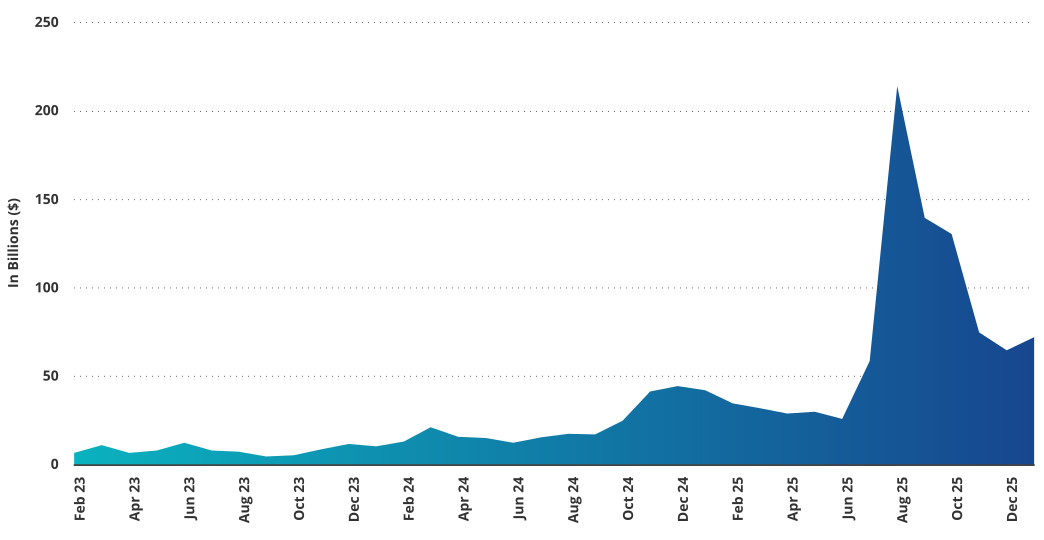
Source: Artemis XYZ as of 2/06/2026. Past performance is no guarantee of future results. Not intended as a recommendation to buy or sell any securities named herein.
Avalanche Design for Rapid Consensus: Snowman
Avalanche offers a key breakthrough called the “Snowman Consensus.” Consensus is the method by which a chain agrees on blocks, and Avalanche’s innovation is to implement a more efficient, faster polling technique between validators. This allows it to produce blocks at a faster rate with more transaction capacity in each block than Ethereum.
On legacy blockchains, this means far more communication than necessary, slowing block processing time. By contrast, Avalanche does not have a fixed “leader,” and instead allows any validator to propose blocks from the transactions they observe. Avalanche validators then ping one another in small, randomly selected groups to conduct repeated polls on the correct ledger and its content. Validators repeat these small-group polls until they have enough mathematical confidence that their view has finalized, and the network will converge on the same ledger.
The result of this process is that Avalanche can process a block every 1.2 seconds, and the transactions within each block are considered “final” almost instantly. Avalanche competitor Ethereum produces blocks every 12 seconds while finality takes around 12.8 minutes. This allows Avalanche users to recognize settlement of their transactions within a few seconds, giving the chain significant practical advantages for financial use cases.
Avalanche’s Multi-Chain Architecture
Avalanche is not a single blockchain but a system composed of many blockchains built using Avalanche’s software. There are 81 live blockchains in the ecosystem, with hundreds more in development. Each Avalanche L1 can bootstrap its own validators or use core validators operating on Avalanche’s primary chains. Many L1s also modify Avalanche’s core software to tailor performance, governance, and functionality, including cross-chain connections to other Avalanche L1s and to the Avalanche C-Chain. Some L1s are public while others are private and permissioned.
The Avalanche Primary Network comprises the three original Avalanche chains. These are the C, P, and X chains. While the C-Chain is the epicenter of Avalanche’s crypto activity, the P-Chain is the network that coordinates Avalanche’s validators. The X-chain is currently only used to mint inflationary AVAX tokens. Each of these chains uses AVAX as the native token for payments and usage.
The Avalanche C-Chain is the most economically valuable blockchain in the Avalanche ecosystem and, on average, processes $528M in economic activity each day. It uses the Ethereum Virtual Machine, which allows Avalanche developers to use the same smart contract language and tooling used to build Ethereum applications. Thus, Ethereum developers can quickly deploy their applications to Avalanche with only a few tweaks. In practice, this opened the aperture for new entrants to the Avalanche ecosystem by tapping into a huge pool of potential builders.
The C-Chain offers economic and scaling advantages over Ethereum. It can process (+88%) more transaction throughput (measured by gas) while pricing transactions at 1/50ththe cost of Ethereum’s fees. Avalanche also has the unique ability to rapidly increase its block size during periods of high demand, meaning that Avalanche’s throughput advantage grows during stressful periods.
Avalanche Prices Transaction Fees are Lower Than Competitors
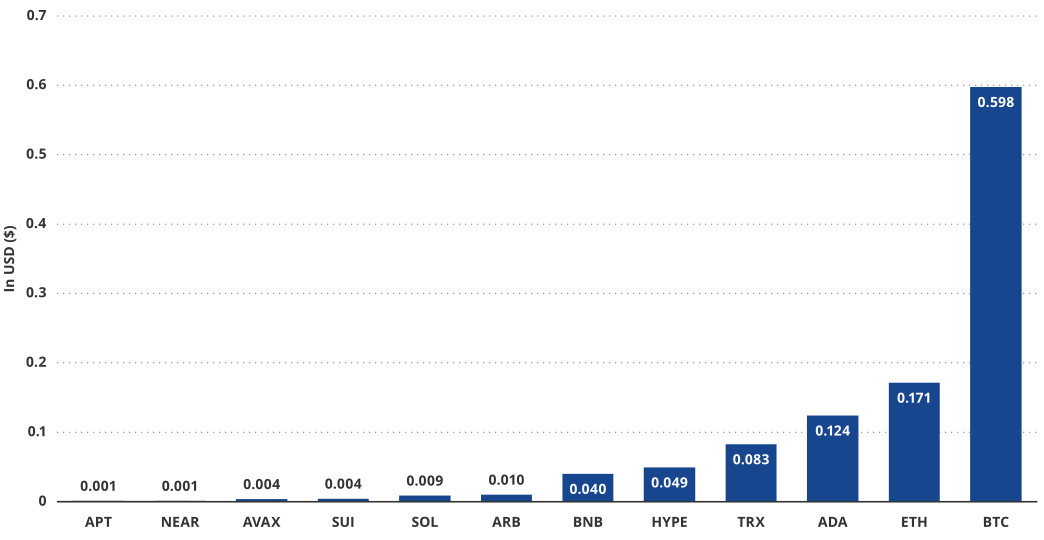
Source: Artemis XYZ as of 1/28/2026. Past performance is no guarantee of future results. Not intended as a recommendation to buy or sell any securities named herein.
Outside of the Primary Network, an L1 with notable traction is Binary Holdings, which runs a rewards and loyalty program for South Asian telecommunications firms. It reports 36M daily active addresses and roughly 40M transactions per day, reflecting a “blockchain-as-infrastructure” thesis where end users may not even realize they are interacting with a blockchain.
Another is Dexalot L1, designed to provide centralized-exchange-like speed and capacity while preserving onchain transparency. Dexalot operates a dual-chain setup: users bridge and deposit via Avalanche C-Chain and execute trades on a customized L1 optimized for large trading volumes.
Enterprise Adoption for Traditional Finance and Tokenization
Avalanche has launched public pilots for private markets tokenization with well-known traditional finance participants. For example, Apollo tokenized a $50M credit fund on Avalanche in January 2026. Avalanche has also pursued distribution-oriented partnerships aligned with enterprise requirements, including AWS support for government-oriented deployment and compliance pathways.
Deloitte has used Avalanche to create a platform intended to improve the speed, security, and accuracy of FEMA reimbursements following disasters. These examples highlight the direction of travel: Avalanche is positioning itself as infrastructure that can plug into real workflows, not just crypto-native applications.
Avalanche has key advantages over competing blockchains, but a practical question is: “Why would someone want to deploy an Avalanche L1 instead of an Ethereum L2?”
Service and accountability
Avalanche offers builders a dedicated, for-profit engineering organization, Ava Labs, that can provide direct support, implementation assistance, and customization in a way that feels closer to a SaaS vendor relationship. Ethereum has excellent vendors and L2 teams, but creating an L2 on Ethereum typically requires a builder to choose a team with an opinionated framework. In some cases, those Ethereum L2 consultants may also push design decisions that benefit their own economic model rather than the builder’s.
Sovereign chain design
An Avalanche L1 is a sovereign network where the deployer can set rules, define execution, and choose the virtual machine. That flexibility matters when an application or use case cannot be implemented within the EVM's limits, or when the builder needs to tune governance and performance for a specific workflow.
Operational and compliance flexibility
Avalanche offers SOC 2 certified infrastructure that supports enterprise-grade security, with options for compliant operations in regulated sectors. An enterprise can define validator requirements, including hardware standards and participation restrictions tied to governance or compliance. In practice, this can be harder to replicate on Ethereum L2s without adding extra trust assumptions around sequencers, committees, or bespoke bridging.
Enterprise-friendly economics
Avalanche L1s can define their own fee markets and use the token of their choice, meaning they do not need to use AVAX for gas. Operating costs are also easier for enterprises to budget because they are tied more directly to the validator footprint than to fluctuating usage. Avalanche’s L1 validator fee model is structured as an ongoing charge to run validators, whereas Ethereum is closer to a pay-as-you-go business arrangement. As a result, Avalanche L1s can feel more like SaaS licensing models with costs that scale with deployment requirements rather than short-term demand spikes. This makes the costs for Avalanche L1 operators more predictable.
Risk and performance isolation
Ethereum L2s ultimately inherit key constraints from Ethereum, especially around settlement back to L1 and the specific rollup's design choices. For example, optimistic rollup L2s have built-in delay periods for withdrawals that would prevent L2 users from quickly withdrawing funds. Additionally, Ethereum L2 can still experience congestion if Ethereum Mainnet is overloaded with activity.
Because Avalanche L1s isolate performance and fees from other chains, enterprises can avoid congestion problems caused by unrelated activity. Also, Avalanche L1s can adjust throughput, latency, and governance to fit the needs of the application.
Simplicity of deployment
Avalanche has built the tooling and support to allow potential developers to quickly create Avalanche blockchains. In fact, builders without deep coding experience can create an Avalanche L1 without code and deploy it within minutes. Because Avalanche offers cross-chain support out of the box, sophisticated developers can create dozens of blockchains that act in concert to meet their needs.
Key partnerships
- Cloud and infrastructure partners for lowering the operational friction of operating Avalanche blockchains or using Avalanche blockchains,
Partners: Amazon Web Services (AWS), Alibaba Cloud, Tencent Cloud.
- Public sector and government process partners modernizing heavy workflows, improving auditability, and reducing fraud and administrative overhead in government adjacent processes.
Partners: Deloitte and the California Department of Motor Vehicles (DMV).
- Payments and onboarding partners that reduce the adoption bottleneck for users and mainstream applications, allowing them to quickly get funds onchain while abiding by compliance rules.
Partners: Stripe, Mastercard, Visa
- Capital markets, banking, and institutional tokenization partners to prove Avalanche’s potential to operate backend infrastructure for major financial institutions, including tokenization, fund operations, and credit market infrastructure.
Partners: Sumitomo Corporation, FIS and Intain, Citi and Wellington Management and WisdomTree and ABN AMRO and DTCC Digital Assets and Tokeny, J.P. Morgan Onyx and Apollo and WisdomTree and LayerZero, Securitize.
- Commerce and consumer distribution partners that see digital assets and onchain experiences as additive to customer acquisition and retention.
Partners: FIFA, Uptop, Sports Illustrated, EVEN, TITAN
The corporate partnerships in this blog reflect the use of the Avalanche network and do not imply endorsement of AVAX as an investment.
Avalanche C-Chain Revenue
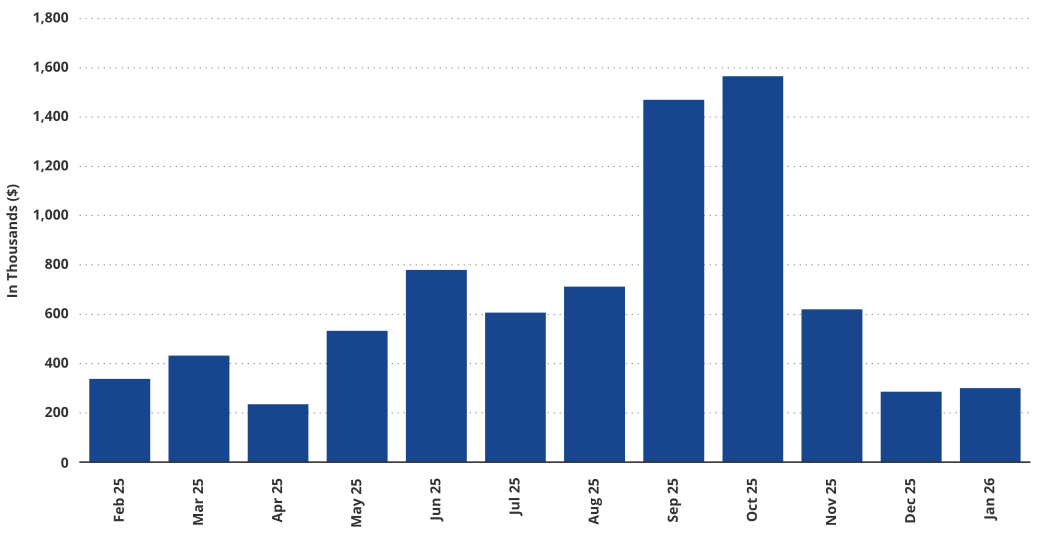
Source: Artemis XYZ as of 2/06/2026. Past performance is no guarantee of future results. Not intended as a recommendation to buy or sell any securities named herein.
The AVAX token is the “native token” of all Avalanche blockchains but is most used on Avalanche’s C-Chain. This means that all transactions on that network necessitate AVAX to be processed. Because the C-Chain’s capacity for transactions is limited, as the level of activity increases, the amount of AVAX needed to transact rises as well. Like Ethereum, Avalanche also implements an economic policy that burns base fees to offset inflation. As Avalanche transaction velocity increases, more AVAX tokens are burned, and the total can be enormous during times of high activity. To date, 4.9M AVAX has been permanently removed from circulation.
The current supply of AVAX is 431M, while the maximum supply of the token is 720M. To reach the maximum supply of AVAX, Avalanche mints new tokens to reward validators and stakers for running and securing the network. The current inflation rate for new AVAX tokens is (~3.5%) per year, and the number of new tokens emitted fluctuates based on the number of AVAX staked and their staking duration.
Because Avalanche is a Proof-of-Stake (PoS) blockchain, AVAX is used to back validators who run and secure Avalanche’s C-Chain. Each validator must be backed by a minimum of 2,000 AVAX “bond” to operate on the blockchain, but in practice, validator stakes are often much larger because larger validators can receive more rewards (up to 3M AVAX). To satisfy the bonding requirement, validators often source AVAX bonds from tokenholders seeking to earn rewards on their AVAX holdings. However, validators who are dishonest or who demonstrate poor uptime can lose their access to rewards or even be booted from the network. This economic incentive drives stakers to seek high-quality validators.
The current reward rate for Avalanche stakers is (>7%), which is greater than the rate of inflation because not all AVAX tokens on Avalanche are staked. To stake on Avalanche, someone must bond a minimum of 25 AVAX and choose the duration of their lock-up. Those who choose to delegate their AVAX to a validator for longer periods receive higher rewards than those who opt for shorter bonding periods.
Outside of Avalanche C-Chain, validators of other Avalanche L1s must pay a per-validator fee of 1.33 AVAX per month. These fees are burned. With ~850 L1 validators, this amounts to $160k in annual revenue.
The Bear and Bull Case for AVAX
The Bear Case: Declining Metrics and Competitive Pressures
Currently, Avalanche is at a crossroads, making some bearish about its future. Once a member of the “SOLUNAVAX” triad meme spawned by immense returns in the summer of 2021 (>+1000% returns in 4 months), AVAX has lost (-62%) of its value in the past year. Aside from broad, weak alt-token performance (MarketVector Smart Contract Leaders Index: -37% y/y), competitive pressures have driven Avalanche to reduce its transaction pricing on the C-Chain by (-96%). This has led to a (-42%) y/y reduction in revenues.
Avalanche onchain metrics have also generally lagged those of its competitors. Revenue has fallen to 13thin the 30-day trailing period, down from 8thplace 2 years ago and 4thplace 4 years ago. In TVL, over the past four years, it has dropped from the 3rd-ranked blockchain to the 7th-ranked blockchain.
At the same time, there is concern that Avalanche L1s do not remit enough value to AVAX because they have little use in their frameworks. This is due to the lack of requirement to use AVAX as a native token on Avalanche L1s. Previously, Avalanche L1s (formerly 'Subnets') were required to stake 2,000 AVAX per validator, but this requirement was nixed, removing a major token sink for AVAX.
Potential risks
- Competition from other blockchains
- Value of blockchain technologies accruing to existing financial institutions
- Emerging blockchains offering better technology
- Regulation of DeFi
- Increase in the inflation rate or expansion of the token supply
- Technical risks and hacking attacks
- Potential risks related to team dynamics and strategic priorities of core developers
The Bull Case: Pivot to Enterprise and Ecosystem Growth
However, it is important to remember that investors valuing tokens like AVAX must look to the future, not Avalanche’s past identity. Avalanche technology was initially used to facilitate speculation, and it was presumed that this would evolve towards more sustainable financial products and services. However, the speculative narrative has evaporated as systematically overvalued cryptocurrencies failed to mature into more sustainable use cases. At the same time, existing financial institutions began adopting the most promising components of crypto to navigate many blockchain ecosystems effectively. As a result, Avalanche is moving towards enterprise use cases and real-world assets to build the products that can attract corporate interest. In this enterprise-centric new vision, Avalanche is an absolute leader compared to most other crypto projects.
Avalanche’s new approach to long-term token holder value is to bring as many users as possible into its network of blockchains. This includes substantial price decreases alongside marketing focus on Avalanche L1s. Thus, one can view its price decreases as an opportunity to attract new users and expand use cases. Once Avalanche has proved its value to a large user base, it is presumed to be able to capture more value from its blockchain’s activity. Thus far, some of the steps to attract new activity have been working.
The deliberate choice to reduce C-Chain fees has led to transactions growing (+370%) and (DAAs) surging (+368%) y/y. Likewise, Avalanche L1 outreach has attracted nearly 4M DAAs to Avalanche’s L1s (2-3x more DAUs than Ethereum’s ecosystem), collectively generating ~$25k in fees per day. At the same time, tokenization efforts have led to $1.4B in assets on Avalanche through partnerships with some of the world’s most important financial institutions. If Avalanche can continue to prove itself as an important backend financial infrastructure, it stands to benefit greatly from tokenization.
Potential catalysts
- Tokenization is increasing usership and usage of the Avalanche blockchains
- Re-institution Avalanche L1 validator AVAX holding requirements
- AVAX native token being adopted by Avalanche L1s
- Avalanche’s growing gaming system is driving wallet growth
- The launch of high-velocity financial products
- Additional Avalanche L1 launches
The Token vs Contributor Interests Debate
A key consideration for AVAX, as with many smart contract platforms, is the relationship between the token and the organizations that materially contribute to the ecosystem’s development and commercialization. Ava Labs is a major contributor to Avalanche’s core software and provides services to teams building on Avalanche technology. As a for-profit company, Ava Labs will make business decisions around resourcing, pricing, partnerships, and product focus based on its own operational needs and stakeholder obligations, which may not always align perfectly with the preferences of AVAX holders.
That said, the linkage is indirect. Ava Labs does not control AVAX’s market price, and Avalanche’s open-source ecosystem includes many independent developers and participants. Over time, successful ecosystem growth, whether through C-Chain activity or application-specific L1s, can support network usage and broader awareness, which may be constructive for the asset.
From a risk perspective, the main issues are practical rather than mechanical. If key ecosystem contributors were to face operational disruption, such as funding constraints, strategic shifts, or other business pressures, the pace of development, ecosystem support, or market confidence could be affected. Conversely, a well-capitalized, execution-oriented contributor base can help Avalanche remain competitive. We therefore view Ava Labs as a net positive for Avalanche today, while recognizing that AVAX’s long-term outcome ultimately depends on adoption and the broader ecosystem, not any single company.
Avalanche Blockchain Fundamental Metrics
| Metric | 30D Average | Ranking Out of Top 21 Blockchains |
| Daily Revenue | $8,094 | 13 |
| Daily Active Users | 324,667 | 9 |
| Total Value Locked | $1,229,944,070 | 7 |
| Daily Transactions | 2,322,136 | 9 |
| Stablecoin Supply | $1,703,767,118 | 7 |
| Daily DEX Volume | $169,839,958 | 6 |
| Daily Stablecoin Transfer Volume | $2,397,119,748 | 7 |
| Daily Economic Activity | $528,572,767 | 5 |
| Twitter Followers | 1,121,086 | 6 |
| MAUs | 1,051,674 | 6 |
| Daily New Users | 49,838 | 7 |
| Total Onchain Lending | $1,339,098,882 | 5 |
| Average Transaction Cost | $0.004 | 3 |
| Staked Value | $2,698,841,179 | 4 |
Source: Artemis XYZ as of 1/28/2026. Past performance is no guarantee of future results. Not intended as a recommendation to buy or sell any securities named herein.
Avalanche Leadership Team
Emin Gün Sirer - CEO
Computer scientist and co-founder who helped create the Avalanche consensus approach and leads the technical direction of Ava Labs. He is also a Cornell computer science professor and has held leadership roles in academic crypto research, including as a co-director of IC3.
John Wu - President
Leads commercial strategy, business development, and partnerships. Before Ava Labs, he built his career as a buy-side tech investor, including at Tiger Management, and later ran investment and operating roles across fintech, including leading Sureview Capital and managing a technology portfolio at Kingdon Capital.
Charley Cooper - Chief Operating Officer
Runs operations with deep experience across market structure and regulation. Previously served in senior leadership at the CFTC and held senior roles in financial markets infrastructure, including at State Street’s trading and clearing organization, with earlier experience at Deutsche Bank.
John Nahas – Chief Business Officer
Leads business development and ecosystem growth for Ava Labs and the Avalanche network, overseeing partnerships and go-to-market across multiple verticals (including institutional/capital markets, enterprise, wallets & exchanges, retail/consumer, gaming, and DeFi) and driving international expansion through regional teams globally.
Wee Ming Choon - Chief Legal Officer
Leads legal and regulatory strategy with a rare combination of software engineering and law. Prior to Ava Labs, his background includes roles at major tech and crypto-native organizations, including Meta and ConsenSys, as well as private practice at Latham & Watkins.
The Bottom Line on Avalanche's Value Proposition
Overall, we recognize the conflict embedded in Avalanche’s structure, but we believe the value Ava Labs provides to AVAX holders outweighs these concerns, especially if the scaling strategy succeeds and AVAX’s role in value capture strengthens over time.
To receive more Digital Assets insights, sign up in our subscription center.


DISCLOSURES
Index Definitions
MarketVector Smart Contract Leaders Index: designed to track the performance of the largest and most liquid smart contract assets and is an investable subset of MarketVector Smart Contract Index.
Coin Definitions
Avalanche (AVAX): A Layer-1 platform supporting custom subnets; AVAX is used for fees, staking, and governance.
Ethereum (ETH): A decentralized smart-contract platform used to build and run applications and Layer-2 networks.
Binance Coin (BNB): The native asset of BNB Chain used for transaction fees, staking, and ecosystem utilities.
Solana (SOL): A high-throughput Layer-1 blockchain; SOL is used for fees and staking to secure the network.
Tron (TRX): A Layer-1 blockchain focused on high-volume payments and stablecoin transfers; TRX is used for fees and staking.
Arbitrum (ARB): The governance token of the Arbitrum Layer-2 ecosystem; not required for gas on Arbitrum chains.
Risk Considerations
This is not an offer to buy or sell, or a recommendation to buy or sell any of the securities, financial instruments or digital assets mentioned herein. The information presented does not involve the rendering of personalized investment, financial, legal, tax advice, or any call to action. Certain statements contained herein may constitute projections, forecasts and other forward-looking statements, which do not reflect actual results, are for illustrative purposes only, are valid as of the date of this communication, and are subject to change without notice. Actual future performance of any assets or industries mentioned are unknown. Information provided by third party sources are believed to be reliable and have not been independently verified for accuracy or completeness and cannot be guaranteed. VanEck does not guarantee the accuracy of third party data. The information herein represents the opinion of the author(s), but not necessarily those of VanEck or its other employees.
Index performance is not representative of fund performance. It is not possible to invest directly in an index.
Investments in digital assets and Web3 companies are highly speculative and involve a high degree of risk. These risks include, but are not limited to: the technology is new and many of its uses may be untested; intense competition; slow adoption rates and the potential for product obsolescence; volatility and limited liquidity, including but not limited to, inability to liquidate a position; loss or destruction of key(s) to access accounts or the blockchain; reliance on digital wallets; reliance on unregulated markets and exchanges; reliance on the internet; cybersecurity risks; and the lack of regulation and the potential for new laws and regulation that may be difficult to predict. Moreover, the extent to which Web3 companies or digital assets utilize blockchain technology may vary, and it is possible that even widespread adoption of blockchain technology may not result in a material increase in the value of such companies or digital assets.
Digital asset prices are highly volatile, and the value of digital assets, and Web3 companies, can rise or fall dramatically and quickly. If their value goes down, there’s no guarantee that it will rise again. As a result, there is a significant risk of loss of your entire principal investment.
Digital assets are not generally backed or supported by any government or central bank and are not covered by FDIC or SIPC insurance. Accounts at digital asset custodians and exchanges are not protected by SPIC and are not FDIC insured. Furthermore, markets and exchanges for digital assets are not regulated with the same controls or customer protections available in traditional equity, option, futures, or foreign exchange investing.
Digital assets include, but are not limited to, cryptocurrencies, tokens, NFTs, assets stored or created using blockchain technology, and other Web3 products.
Web3 companies include but are not limited to, companies that involve the development, innovation, and/or utilization of blockchain, digital assets, or crypto technologies.
All investing is subject to risk, including the possible loss of the money you invest. As with any investment strategy, there is no guarantee that investment objectives will be met and investors may lose money. Diversification does not ensure a profit or protect against a loss in a declining market. Past performance is no guarantee of future performance.
DISCLOSURES
Index Definitions
MarketVector Smart Contract Leaders Index: designed to track the performance of the largest and most liquid smart contract assets and is an investable subset of MarketVector Smart Contract Index.
Coin Definitions
Avalanche (AVAX): A Layer-1 platform supporting custom subnets; AVAX is used for fees, staking, and governance.
Ethereum (ETH): A decentralized smart-contract platform used to build and run applications and Layer-2 networks.
Binance Coin (BNB): The native asset of BNB Chain used for transaction fees, staking, and ecosystem utilities.
Solana (SOL): A high-throughput Layer-1 blockchain; SOL is used for fees and staking to secure the network.
Tron (TRX): A Layer-1 blockchain focused on high-volume payments and stablecoin transfers; TRX is used for fees and staking.
Arbitrum (ARB): The governance token of the Arbitrum Layer-2 ecosystem; not required for gas on Arbitrum chains.
Risk Considerations
This is not an offer to buy or sell, or a recommendation to buy or sell any of the securities, financial instruments or digital assets mentioned herein. The information presented does not involve the rendering of personalized investment, financial, legal, tax advice, or any call to action. Certain statements contained herein may constitute projections, forecasts and other forward-looking statements, which do not reflect actual results, are for illustrative purposes only, are valid as of the date of this communication, and are subject to change without notice. Actual future performance of any assets or industries mentioned are unknown. Information provided by third party sources are believed to be reliable and have not been independently verified for accuracy or completeness and cannot be guaranteed. VanEck does not guarantee the accuracy of third party data. The information herein represents the opinion of the author(s), but not necessarily those of VanEck or its other employees.
Index performance is not representative of fund performance. It is not possible to invest directly in an index.
Investments in digital assets and Web3 companies are highly speculative and involve a high degree of risk. These risks include, but are not limited to: the technology is new and many of its uses may be untested; intense competition; slow adoption rates and the potential for product obsolescence; volatility and limited liquidity, including but not limited to, inability to liquidate a position; loss or destruction of key(s) to access accounts or the blockchain; reliance on digital wallets; reliance on unregulated markets and exchanges; reliance on the internet; cybersecurity risks; and the lack of regulation and the potential for new laws and regulation that may be difficult to predict. Moreover, the extent to which Web3 companies or digital assets utilize blockchain technology may vary, and it is possible that even widespread adoption of blockchain technology may not result in a material increase in the value of such companies or digital assets.
Digital asset prices are highly volatile, and the value of digital assets, and Web3 companies, can rise or fall dramatically and quickly. If their value goes down, there’s no guarantee that it will rise again. As a result, there is a significant risk of loss of your entire principal investment.
Digital assets are not generally backed or supported by any government or central bank and are not covered by FDIC or SIPC insurance. Accounts at digital asset custodians and exchanges are not protected by SPIC and are not FDIC insured. Furthermore, markets and exchanges for digital assets are not regulated with the same controls or customer protections available in traditional equity, option, futures, or foreign exchange investing.
Digital assets include, but are not limited to, cryptocurrencies, tokens, NFTs, assets stored or created using blockchain technology, and other Web3 products.
Web3 companies include but are not limited to, companies that involve the development, innovation, and/or utilization of blockchain, digital assets, or crypto technologies.
All investing is subject to risk, including the possible loss of the money you invest. As with any investment strategy, there is no guarantee that investment objectives will be met and investors may lose money. Diversification does not ensure a profit or protect against a loss in a declining market. Past performance is no guarantee of future performance.