BNB Chain Explained: Usage, Fees, and Token Value
June 25, 2026
Read Time 10+ MIN
Please note that VanEck may have a position(s) in the digital asset(s) described below.
Key takeaways
- BNB Chain operates at consumer scale: roughly 34 million monthly active users (+72% y/y) moved about $127 billion in peer-to-peer stablecoin volume in May 2026, at a median fee of less than half a cent.
- Real-world assets are finding a home onchain: tokenized RWA value on BNB Chain stands at about $3.89 billion, the second-highest of any blockchain, spanning Treasuries, money market funds, and equities.
- The token’s supply shrinks as usage grows: quarterly and real-time burns have removed 12% of BNB supply since June 2023, wiring the token’s value to activity on the network.
What is BNB Chain and the BNB Token?
BNB Chain is a financial marketplace that happens to run on a blockchain. People go there to move money, trade, lend, borrow, speculate, and increasingly to hold tokenized versions of real-world assets. It settles transactions in under a second, costs a fraction of a cent to use, and never closes. That combination has pulled in a large and active user base, and it has made the network one of the busier venues in onchain finance.
Two things are worth separating up front, because they are easy to conflate: the network and the token.
The network is BNB Chain. It is a public blockchain, originally spearheaded by Binance in 2020, that anyone can build on and anyone can use without permission. Think of it as shared financial infrastructure that runs the applications other people write, from exchanges to lending markets to payment apps. There is no central operator deciding who gets access. Today, BNB Chain is a decentralized and independent ecosystem, operating separately from the centralized Binance exchange. As a result, anyone who can code (or use Claude) can deploy an application. These applications can earn their builders significant revenues and should be thought of as emerging fintechs. Because BNB Chain is software hosted on many servers, it is often referred to as a “network.”
The token is BNB. It is the unit that pays for activity on the network. Every transaction, whether that is sending a stablecoin, trading on an app, or minting a tokenized asset, requires a small amount of BNB to process. The more the network gets used, the more BNB is needed to run it. When people pay for their transactions on BNB Chain, part of the BNB tokens sent is burned and the other portion is awarded to validators. BNB currently sits around an $80 billion market cap, which makes it a top-5 crypto asset, and it ranks top-3 among Layer 1 (L1) networks by active users.
In this piece, we walk through why we believe the BNB token and the BNB Chain are interesting.
What Makes BNB Chain Stand Out
How many people use BNB Chain?
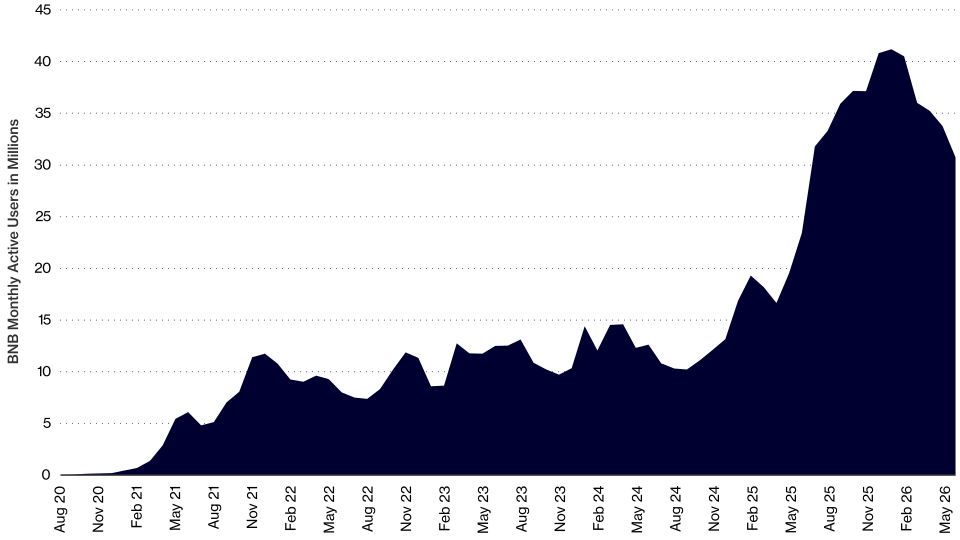
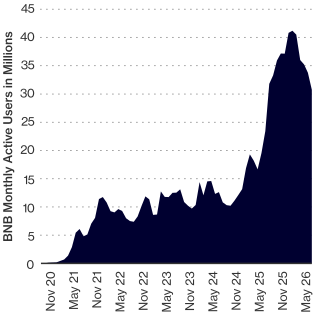
In May 2026, BNB Chain averaged roughly 34 million monthly active users, up +72% y/y. This user base is widely dispersed globally, with significant representation in emerging markets such as Latin America, the Middle East and North Africa, and Asia-Pacific. Typically, BNB Chain is among the top 3 blockchains in monthly active users. Additionally, this user activity is sticky, with roughly 70% of daily activity performed by returning users. While the mean transaction fee was around $0.027 in Q1 2026, the median transaction fee was around $0.0038.
BNB Monthly Active Users +72% Y/Y in May 2026
Source: Artemis XYZ as of 6/12/2026. Past performance is not a guarantee of future results. Not intended as a recommendation to buy or sell any securities named herein.
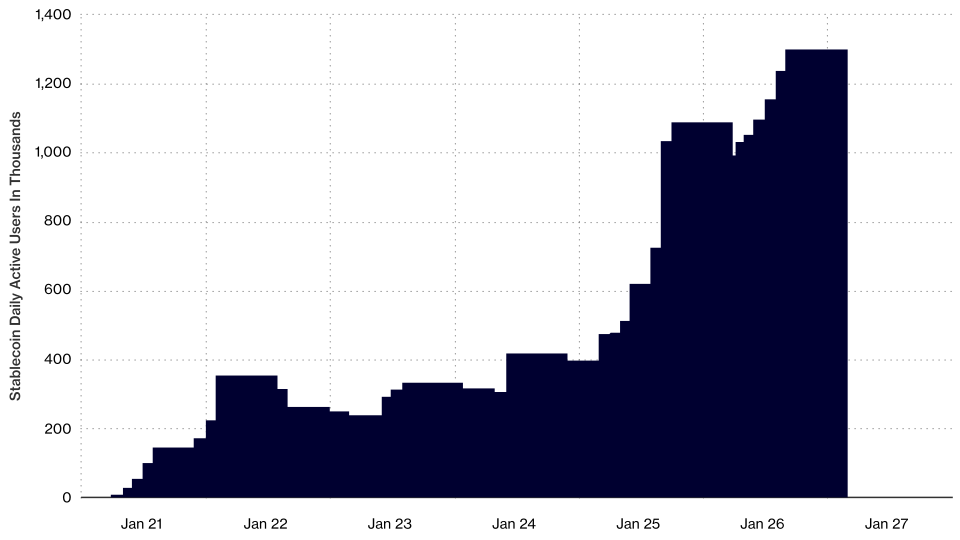
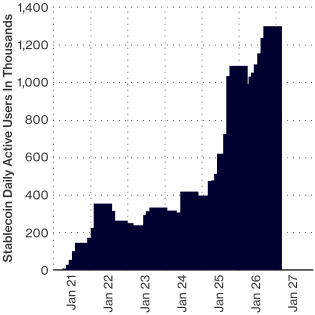
We believe BNB’s stablecoin activity demonstrates that most of that activity is organic and that people are using BNB in everyday financial transactions. Peer-to-peer stablecoin send volume reached about $127 billion in May 2026, moved by more than 15 million stablecoin users across roughly 177 million stablecoin transactions over the month. BNB has 69.7M stablecoin holders, and the chain accounts for 32% of all peer-to-peer stablecoin transactions across all blockchains (Artemis XYZ as of 6/12/2026).
"BNB Chain accounts for 32% of all stablecoin transactions across all blockchains."
Stablecoin supply on BNB Chain is around $17.2 billion, up 64% y/y, with Tether (USDT), USD Coin (USDC), and First Digital USD (FDUSD) all expanding their footprints. For context, that supply was under $300 million at the end of 2020, so it has grown close to 50x in roughly 5 years. BNB Chain has been the fastest-growing stablecoin network among the majors over that stretch.
BNB Chain Stablecoin Daily Active Users +33% YTD
Source: Artemis XYZ as of 6/12/2026. Past performance is not a guarantee of future results. Not intended as a recommendation to buy or sell any securities named herein.
Real-World Assets (RWAs) on BNB Chain
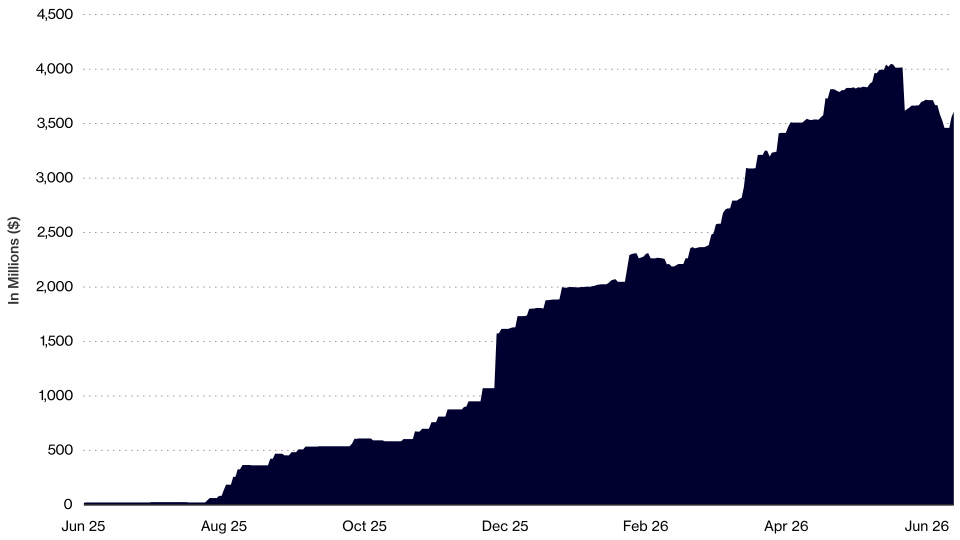
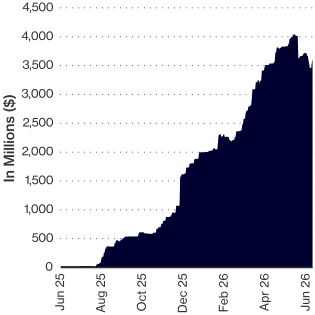
Beyond stablecoins, the chain has become a repository for tokenized real-world assets (RWAs). RWA value on BNB Chain stands at about $3.89 billion, the second-highest of any blockchain, and it has grown roughly 182x y/y (RWA.xyz as of 6/12/26). That includes tokenized money market funds and Treasuries, the most conservative end of the tokenization story. It also includes tokenized equities, which saw around $900 million in trading volume in May 2026 against roughly $857 million in assets, with tokenized Circle (CRCL, $103M), Micron (MU, $53M), and Nvidia (NVDA, $32M) among the names trading on BNB.
BNB’s Real World Asset AUM +81% YTD
Source: RWA XYZ as of 6/10/2026. Past performance is not a guarantee of future results. Not intended as a recommendation to buy or sell any securities named herein.
What Apps Run on BNB Chain?
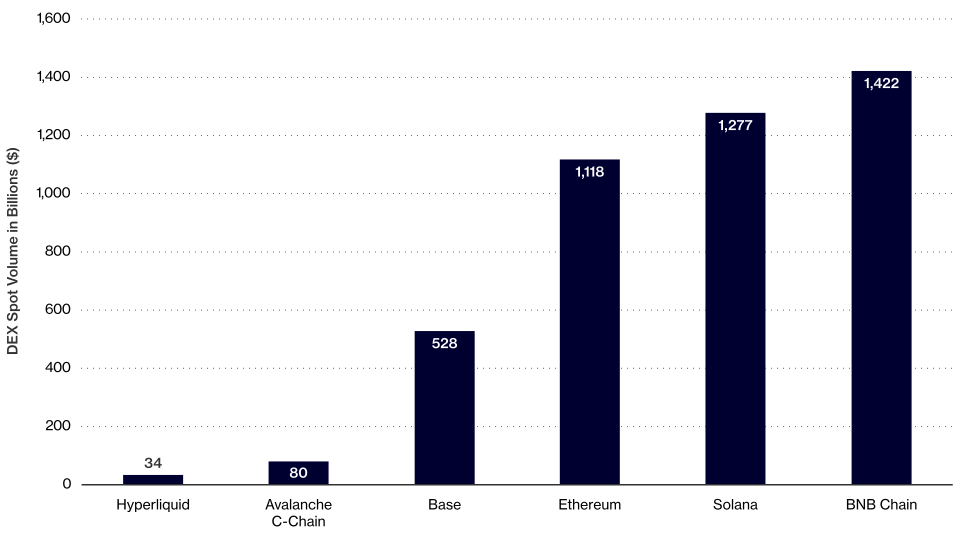
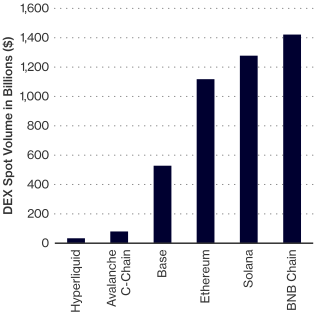
More than 2,000 active applications run on BNB Chain, and they offer services similar to what is found on Solana, Ethereum, and other L1 blockchains. These application types include decentralized trading of spot crypto and perps (perpetual futures) as well as borrow/lend activity. Decentralized exchange (DEX) volume ran to roughly $1.4 trillion in 2025 (highest among all blockchains) and about $337 billion so far in 2026 (second highest). Prediction markets have cleared more than $17.9 billion in volume in 2026. Meanwhile, lending and borrowing markets hold around $1.7 billion in value.
A few applications are worth naming, because they show the range of BNB. PancakeSwap is the largest decentralized exchange on BNB Chain and one of the largest anywhere, and it does the bulk of that DEX volume. Venus Protocol is the main money market, where users supply assets to earn yield and borrow against collateral, which is most of that $1.7 billion in lending value. Lista DAO handles liquid staking, letting users stake BNB while keeping a tradable claim they can use elsewhere in decentralized finance (DeFi). Layered on top is a steady stream of consumer activity, from meme and launchpad trading to the prediction markets noted above, which is where a lot of the transaction count comes from.
BNB Led DEX Spot Volume in 2025
Source: Artemis XYZ as of 6/10/2026. Past performance is not a guarantee of future results. Not intended as a recommendation to buy or sell any securities named herein.
BNB Chain Uptime and Reliability
Reliability is easy to overlook until it fails, and not all blockchains have remained operational at all times. BNB Chain ran with zero downtime across 2025 and thus far in 2026. This resilience has remained intact through 4 major upgrades on a live network. This means that while BNB’s software was updated, users could still perform financial transactions. The network’s throughput peaked at 8,384 transactions per second on December 10, 2025. Block times run under a second, around 0.45 seconds, and the network has handled as many as 33 million transactions in a single day at its intraday peak.
How Much Revenue Does BNB Chain Generate?
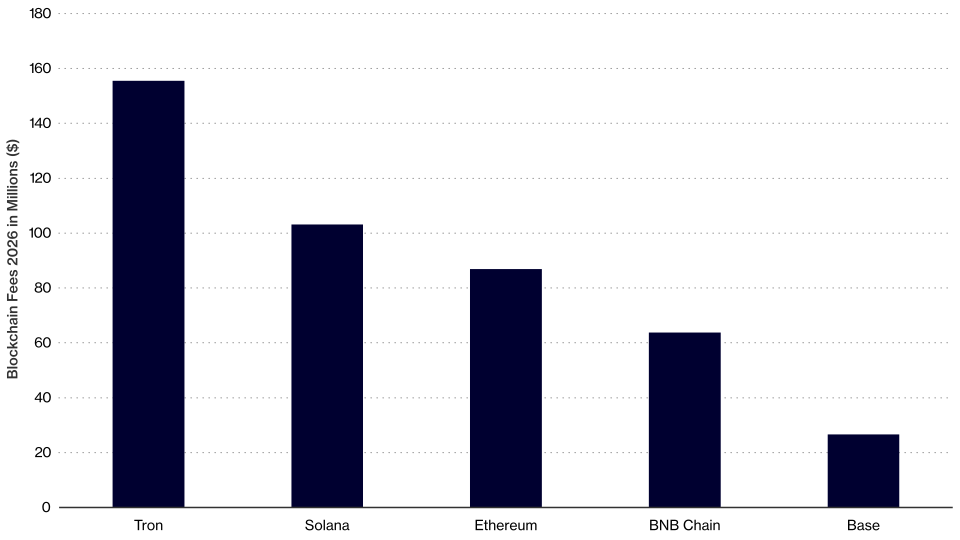
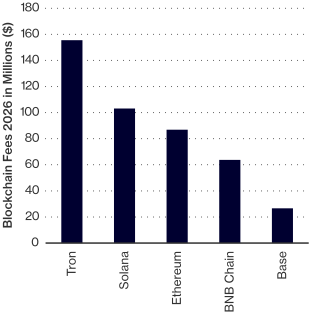
BNB Ranks 4th in Blockchain Fees in 2026
Source: Artemis XYZ as of 6/12/2026. Past performance is not a guarantee of future results. Not intended as a recommendation to buy or sell any securities named herein.
Activity on BNB translates into revenue for BNB’s network and demand for the BNB token. BNB Chain generated $259 million in network fees in 2025, up 33% y/y, which made it the 4th-highest fee-generating blockchain globally that year. It has earned about $63 million in network fees in 2026 to date. Though fees collected by the network YTD 2026 are much lower than they were over the same period in 2025, BNB is still holding its position as the 4th-highest-grossing blockchain in 2026. The applications running on top of BNB have earned substantial topline revenue: roughly $757 million in fees in 2025 and about $192 million so far in 2026.
What Drives BNB Token Value?
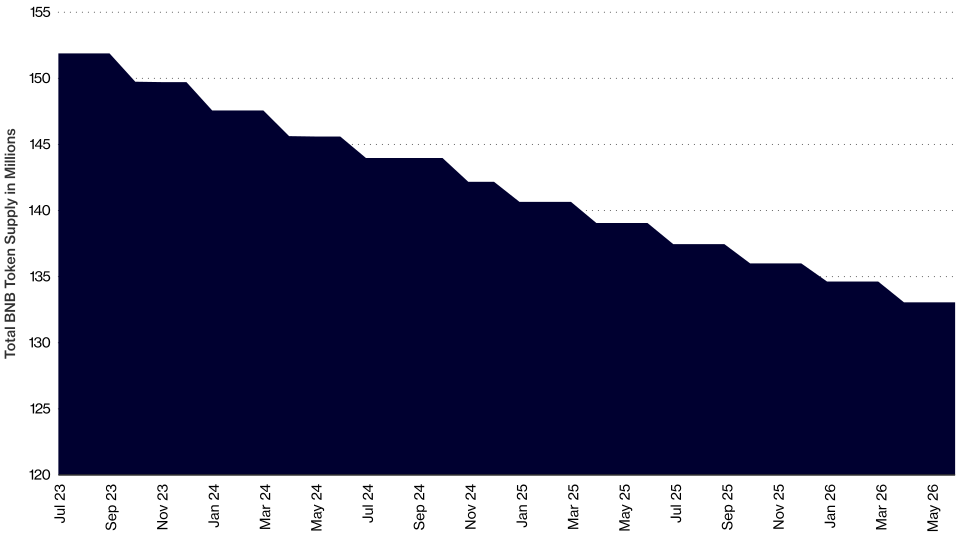
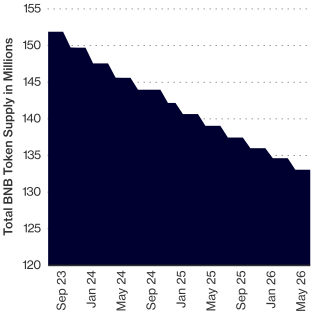
There Have Been 35 BNB Token Burns
Source: Artemis XYZ as of 6/12/2026. Past performance is not a guarantee of future results. Not intended as a recommendation to buy or sell any securities named herein.
BNB is deflationary by design, and this is driven by 2 main mechanisms. The first is a quarterly auto-burn, where the protocol permanently removes tokens from supply based on network functionality and usage. The most recent burn, completed in April 2026, removed about 1.57 million BNB, worth roughly $1.02 billion, and the January 2026 burn removed about 1.37 million BNB, worth roughly $1.28 billion (BNB Foundation as of 1/15/26). The quarterly burn has removed 12% of supply since June 2023, or around 18.8 million BNB tokens. The second mechanism is a real-time burn generated by transactions on BNB, introduced under a democratically passed governance proposal called BEP-95. Total supply is about 134.7 million BNB today and is being steered lower over time.
How BNB Token Value Tracks Network Usage
BNB is a valuable asset that is central to the functioning of the BNB network, and without its economic value, the network would not be operational. To run the network, validators who process BNB transactions must stake BNB, and only the top 21 validators by stake amount win the right to operate the BNB network. These validators are tied to the economics of BNB by their captive stake and are paid for their validator duties only in BNB tokens. As a result, they have a strong incentive to perform their duties effectively to ensure BNB runs efficiently. Because they are paid for their services in BNB tokens, they also have a long-term interest in ensuring the BNB token maintains its value.
The same logic runs through the whole system. Every transaction burns and spends BNB, so a busier network mechanically pulls more BNB into use and out of supply. Usage and token demand are linked rather than coincidental. BNB Chain is a cheap, fast, 24/7 financial marketplace to launch a financial application and reach a large existing user base. As more of those applications launch and attract users, activity on the chain rises. Rising activity means more fees and more burning, both of which accrue to the BNB token. The token effectively tracks the growth of the marketplace it powers.
"The token effectively tracks the growth of the marketplace it powers."
What’s Next for BNB Chain: AI and Builder Funding
There are 2 threads worth watching to track BNB’s growth story. The first is artificial intelligence (AI). More than 60 AI projects were deployed on BNB Chain in 2025, and the chain is building infrastructure for autonomous agents that transact onchain directly. BNB is a natural fit for the type of activity we anticipate AI agents will perform. We believe AI agentic commerce will be characterized by large numbers of low-value transactions that require firm guardrails and consistent uptime. BNB’s strong operational track record, its high throughput capacity, and its low fees make it an ideal home for AI agentic commerce.
The second dynamic that will power BNB’s future is the deep pool of funding for builders. In October 2025, BNB Chain launched a $1 billion Builder Fund in partnership with YZi Labs, which provides per-project funding of up to $500,000 through its EASY Residency program, alongside performance-based gas rewards that subsidize apps once they attract real users. There are many blockchains with similar technical capabilities to BNB, but the true differentiator is persistent, long-term funding by committed backers such as YZi Labs. This funding means more developers building more interesting applications. Ultimately, if these apps are successful, their users will perform more transactions, and every transaction requires BNB.
The Bottom Line on BNB Chain and BNB
BNB Chain is a working financial marketplace with real activity behind it. Tens of millions of people use it every month: they move tens of billions of dollars in stablecoins, they trade on the highest-volume DEX of any chain, and they are starting to hold tokenized Treasuries and equities on BNB. That activity is concentrated in fast-growing regions, with significant user bases across Asia, Latin America, and the Middle East. The network earns real fees from all of it, and it has stayed online through every upgrade and every traffic spike.
The token sits at the center of that system, and its value derives from activity on BNB Chain. This is because BNB must be used to pay for network activity, BNB must be stockpiled by validators who secure the network, and BNB shrinks in supply as usage grows. As BNB activity accelerates, it should translate into value for BNB tokenholders, but nothing is certain. In short, BNB has persisted as a winner amid the L1 race because its chain offers its users substantial value, and we believe the BNB token is effective at capturing that value. Going forward, we foresee a strong future for the BNB Chain as well as its token.
Frequently Asked Questions
What is BNB Chain?
BNB Chain is a public blockchain originally launched by Binance in 2020 that anyone can build on and use without permission. Today, it is a decentralised, independent blockchain ecosystem that settles transactions in under a second at a median fee of less than half a cent, and it averaged roughly 34 million monthly active users in May 2026, ranking among the top 3 blockchains by monthly active users.
What makes the BNB token deflationary?
BNB supply is reduced through 2 burn mechanisms: a quarterly auto-burn that permanently removes tokens based on network usage and a real-time burn on every transaction introduced under governance proposal BEP-95. Together, the quarterly burns have removed 12% of supply since June 2023, or around 18.8 million BNB.
How are stablecoins and real-world assets used on BNB Chain?
BNB Chain processed about $127 billion in peer-to-peer stablecoin volume in May 2026 and accounts for roughly 32% of all stablecoin transactions across blockchains. Tokenized real-world assets on the chain total about $3.89 billion, the second-highest of any blockchain, including tokenized Treasuries, money market funds, and equities.
Links to third party websites are provided as a convenience and the inclusion of such links does not imply any endorsement, approval, investigation, verification or monitoring by us of any content or information contained within or accessible from the linked sites. By clicking on the link to a non-VanEck webpage, you acknowledge that you are entering a third-party website subject to its own terms and conditions. VanEck disclaims responsibility for content, legality of access or suitability of the third-party websites.
To receive more Digital Assets insights, sign up in our subscription center.


Important Disclosures
Definitions
BNB is the native token of BNB Chain, used to pay transaction fees, stake with the validators that secure the network, and participate in governance.
Tether (USDT) is a stablecoin, a digital token designed to maintain a value pegged to the U.S. dollar, issued by Tether Limited.
USD Coin (USDC) is a U.S. dollar-pegged stablecoin issued by Circle.
First Digital USD (FDUSD) is a U.S. dollar-pegged stablecoin issued by First Digital.
Real-world assets (RWAs) are tokenized representations of traditional financial assets, such as Treasuries, money market funds, and equities, issued on a blockchain.
Staking is the process by which a holder of BNB locks up or "delegates" tokens to a network validator to help secure the BNB Chain in exchange for potential rewards.
Risk Considerations
This is not an offer to buy or sell, or a recommendation to buy or sell any of the securities, financial instruments or digital assets mentioned herein. The information presented does not involve the rendering of personalized investment, financial, legal, tax advice, or any call to action. Certain statements contained herein may constitute projections, forecasts and other forward-looking statements, which do not reflect actual results, are for illustrative purposes only, are valid as of the date of this communication, and are subject to change without notice. Actual future performance of any assets or industries mentioned are unknown. Information provided by third party sources are believed to be reliable and have not been independently verified for accuracy or completeness and cannot be guaranteed. VanEck does not guarantee the accuracy of third party data. The information herein represents the opinion of the author(s), but not necessarily those of VanEck or its other employees.
Staking Risks: Staking BNB entails a number of risks. BNB that is staked undergoes activation and deactivation (or withdrawal) periods during which it is locked up and inaccessible, meaning staked assets cannot be quickly liquidated, particularly in volatile or stressed market conditions. Validators to which BNB is delegated may behave improperly or suffer performance failures, such as downtime or misconfiguration, and in some cases "slashing" or protocol-imposed penalties may apply. Under the BNB Smart Chain's current protocol, slashing applies primarily to a validator's self-delegated stake and rewards, not to third-party delegated principal, though delegators may lose staking rewards during any penalty or removal period. There is counterparty and operational risk associated with staking service providers, and the custodians facilitating staking, including reliance on their security, compliance, and ability to operate under adverse conditions. Additionally, staking rewards are subject to fees and possible withholding obligations, and the timing, amount, and recognition for tax purposes of staking rewards may be uncertain. Finally, regulatory or legal changes, such as U.S. federal income tax law or securities regulations, could affect whether staking activities or liquid staking tokens may be used, or impose unanticipated costs.
Investments in digital assets and Web3 companies are highly speculative and involve a high degree of risk. These risks include, but are not limited to: the technology is new and many of its uses may be untested; intense competition; slow adoption rates and the potential for product obsolescence; volatility and limited liquidity, including but not limited to, inability to liquidate a position; loss or destruction of key(s) to access accounts or the blockchain; reliance on digital wallets; reliance on unregulated markets and exchanges; reliance on the internet; cybersecurity risks; and the lack of regulation and the potential for new laws and regulation that may be difficult to predict. Moreover, the extent to which Web3 companies or digital assets utilize blockchain technology may vary, and it is possible that even widespread adoption of blockchain technology may not result in a material increase in the value of such companies or digital assets.
Digital asset prices are highly volatile, and the value of digital assets, and Web3 companies, can rise or fall dramatically and quickly.
Digital assets include, but are not limited to, cryptocurrencies, tokens, NFTs, assets stored or created using blockchain technology, and other Web3 products. Web3 companies include but are not limited to, companies that involve the development, innovation, and/or utilization of blockchain, digital assets, or crypto technologies.
All investing is subject to risk, including the possible loss of the money you invest. As with any investment strategy, there is no guarantee that investment objectives will be met and investors may lose money. Diversification does not ensure a profit or protect against a loss in a declining market. Past performance is no guarantee of future performance.
© Van Eck Associates Corporation
Important Disclosures
Definitions
BNB is the native token of BNB Chain, used to pay transaction fees, stake with the validators that secure the network, and participate in governance.
Tether (USDT) is a stablecoin, a digital token designed to maintain a value pegged to the U.S. dollar, issued by Tether Limited.
USD Coin (USDC) is a U.S. dollar-pegged stablecoin issued by Circle.
First Digital USD (FDUSD) is a U.S. dollar-pegged stablecoin issued by First Digital.
Real-world assets (RWAs) are tokenized representations of traditional financial assets, such as Treasuries, money market funds, and equities, issued on a blockchain.
Staking is the process by which a holder of BNB locks up or "delegates" tokens to a network validator to help secure the BNB Chain in exchange for potential rewards.
Risk Considerations
This is not an offer to buy or sell, or a recommendation to buy or sell any of the securities, financial instruments or digital assets mentioned herein. The information presented does not involve the rendering of personalized investment, financial, legal, tax advice, or any call to action. Certain statements contained herein may constitute projections, forecasts and other forward-looking statements, which do not reflect actual results, are for illustrative purposes only, are valid as of the date of this communication, and are subject to change without notice. Actual future performance of any assets or industries mentioned are unknown. Information provided by third party sources are believed to be reliable and have not been independently verified for accuracy or completeness and cannot be guaranteed. VanEck does not guarantee the accuracy of third party data. The information herein represents the opinion of the author(s), but not necessarily those of VanEck or its other employees.
Staking Risks: Staking BNB entails a number of risks. BNB that is staked undergoes activation and deactivation (or withdrawal) periods during which it is locked up and inaccessible, meaning staked assets cannot be quickly liquidated, particularly in volatile or stressed market conditions. Validators to which BNB is delegated may behave improperly or suffer performance failures, such as downtime or misconfiguration, and in some cases "slashing" or protocol-imposed penalties may apply. Under the BNB Smart Chain's current protocol, slashing applies primarily to a validator's self-delegated stake and rewards, not to third-party delegated principal, though delegators may lose staking rewards during any penalty or removal period. There is counterparty and operational risk associated with staking service providers, and the custodians facilitating staking, including reliance on their security, compliance, and ability to operate under adverse conditions. Additionally, staking rewards are subject to fees and possible withholding obligations, and the timing, amount, and recognition for tax purposes of staking rewards may be uncertain. Finally, regulatory or legal changes, such as U.S. federal income tax law or securities regulations, could affect whether staking activities or liquid staking tokens may be used, or impose unanticipated costs.
Investments in digital assets and Web3 companies are highly speculative and involve a high degree of risk. These risks include, but are not limited to: the technology is new and many of its uses may be untested; intense competition; slow adoption rates and the potential for product obsolescence; volatility and limited liquidity, including but not limited to, inability to liquidate a position; loss or destruction of key(s) to access accounts or the blockchain; reliance on digital wallets; reliance on unregulated markets and exchanges; reliance on the internet; cybersecurity risks; and the lack of regulation and the potential for new laws and regulation that may be difficult to predict. Moreover, the extent to which Web3 companies or digital assets utilize blockchain technology may vary, and it is possible that even widespread adoption of blockchain technology may not result in a material increase in the value of such companies or digital assets.
Digital asset prices are highly volatile, and the value of digital assets, and Web3 companies, can rise or fall dramatically and quickly.
Digital assets include, but are not limited to, cryptocurrencies, tokens, NFTs, assets stored or created using blockchain technology, and other Web3 products. Web3 companies include but are not limited to, companies that involve the development, innovation, and/or utilization of blockchain, digital assets, or crypto technologies.
All investing is subject to risk, including the possible loss of the money you invest. As with any investment strategy, there is no guarantee that investment objectives will be met and investors may lose money. Diversification does not ensure a profit or protect against a loss in a declining market. Past performance is no guarantee of future performance.
© Van Eck Associates Corporation