VanEck Mid-February 2026 Bitcoin ChainCheck
February 20, 2026
Read Time 10+ MIN
Please note that VanEck has exposure to bitcoin.
Key takeaways
- Sentiment deteriorates as BTC declines: Bitcoin fell 29% over the last 30 days, pushing NUPL toward the anxiety zone and briefly into fear, while leverage reset and open interest returned to levels last seen in September 2024.
- Mid-cycle holders drive distribution but selling slows: Realized selling remains concentrated in the 1-to-5-year cohorts, though distribution from >1 year coins has slowed meaningfully over the past month.
- Miner margins tighten as hash rate contracts: Hash rate has declined roughly 14% over the past 90 days amid tighter mining economics, a setup that has historically preceded stronger forward BTC returns.
Sentiment Reset and Price Weakness
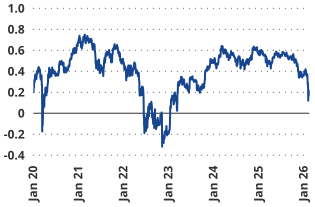
Price action has been nothing short of dismal over the past 30 days, with BTC down (-27% m/m), trading at lower prices (~$67k) than the deepest tariff tantrum troughs (~$76k). 30-day Average NUPL (net unrealized profit/loss) presently reads 0.33, which is off (-43%) y/y, placing it in the “optimism/anxiety” zone. On a daily basis, NUPL breached the “fear” zone, dropping to 0.12 during the dramatic price decline on February 2, 2026. Currently, the 30-day MA (moving average) of Bitcoin addresses that are in profit is (76%) compared to (96%) a year ago. During bear markets, the percentage of addresses in profit has reached as low as (40%), while the most recent bear market bottom was (52%) in December 2022.
Bitcoin Net Unrealized Profit and Loss 30 Day Moving Average

Source: Glassnode as of 2/14/2026. Past performance is not a guarantee of future results. Not intended as a recommendation to buy or sell any securities named herein.
The negative price action has led to speculation fading. Futures annualized basis is now (4.2%), placing it in the 22nd percentile in Bitcoin’s history. Futures open interest, measured in BTC, stands at 362k, slightly below the 3-year average of 366k. When assessed in dollar terms, open interest in Bitcoin is at its lowest levels since September 2024.
Network Activity Remains Elevated
Onchain activity looks healthier than price action suggests. Over the last 30 days, daily transactions are only modestly lower (-1% m/m) but remain elevated in historical context, sitting in the 90th percentile relative to all-time history. Meanwhile, Avg Daily Transfer Volume (USD) rose (+2% m/m) and remains in the 87th percentile. These figures remain elevated due to increased Bitcoin trading volume. At the same time, Daily Inscriptions dropped (-32% m/m), and Avg Daily Fees (USD) declined (-7% m/m) and are down (-62%) y/y, pointing to lower demand for Bitcoin block space and lower network revenues. As a result of elevated network activity, the Active Supply over the last 180 days reached (31%), and while Supply Dormant >3Yr reached (43%), which ranks in the 89th percentile all time.
Where the Selling Is Coming From
In our prior analysis of Bitcoin long-term holders, we focused on the number of tokens that had remained dormant for longer periods. Token dormancy is a useful proxy for investor behavior because it indicates whether older Bitcoin is being stored or sold. If a coin has not moved in 3.5 years, for example, it falls into the 3yr-5yr dormancy band. Once it is transferred to a new address, it moves to the youngest age cohort, and we consider that it was sold to a new owner.
Dormancy balances, however, can shift for mechanical reasons as coins age from one band to the next. To isolate coins actually being spent, we use spent-volume age-band data. SVAB measures the age distribution of coins at the moment they are transferred, providing a clearer view of realized selling pressure by cohort.
Cyclical Selling Concentrated in 1-Year to 5-Year Cohorts Based on Spent Volume Data
| SVAB | 1yr-2yr | 2yr-3yr | 3yr-5yr | 5yr-7yr | 7yr-10yr | >10yr |
| 2012 | 438,875 | 59,164 | 1,151 | 0 | 0 | 0 |
| 2013 | 1,514,798 | 631,846 | 85,416 | 0 | 0 | 0 |
| 2014 | 795,550 | 544,017 | 94,906 | 1,480 | 0 | 0 |
| 2015 | 1,052,489 | 290,445 | 141,679 | 2,323 | 0 | 0 |
| 2016 | 1,263,772 | 710,073 | 354,412 | 64,998 | 0 | 0 |
| 2017 | 2,196,118 | 1,145,497 | 2,235,652 | 523,463 | 72,946 | 0 |
| 2018 | 1,359,986 | 321,913 | 1,124,111 | 253,927 | 26,720 | 0 |
| 2019 | 3,710,141 | 867,428 | 717,879 | 348,344 | 43,438 | 0 |
| 2020 | 4,350,477 | 2,496,133 | 705,187 | 236,285 | 120,677 | 19,116 |
| 2021 | 4,129,873 | 3,044,837 | 3,419,775 | 249,410 | 388,891 | 57,941 |
| 2022 | 4,144,841 | 1,156,913 | 1,521,787 | 572,237 | 211,415 | 51,849 |
| 2023 | 2,626,936 | 1,071,507 | 702,083 | 487,834 | 82,454 | 58,171 |
| 2024 | 3,555,412 | 1,663,498 | 2,872,341 | 1,478,015 | 470,341 | 136,499 |
| 2025 | 3,587,671 | 1,422,846 | 3,306,952 | 704,274 | 512,483 | 298,764 |
| 2026 | 414,110 | 123,462 | 144,641 | 46,879 | 65,855 | 20,473 |
Spent Volume by Age Band. Source: Glassnode as of 2/14/2026. Past performance is not a guarantee of future results. Not intended as a recommendation to buy or sell any securities named herein.
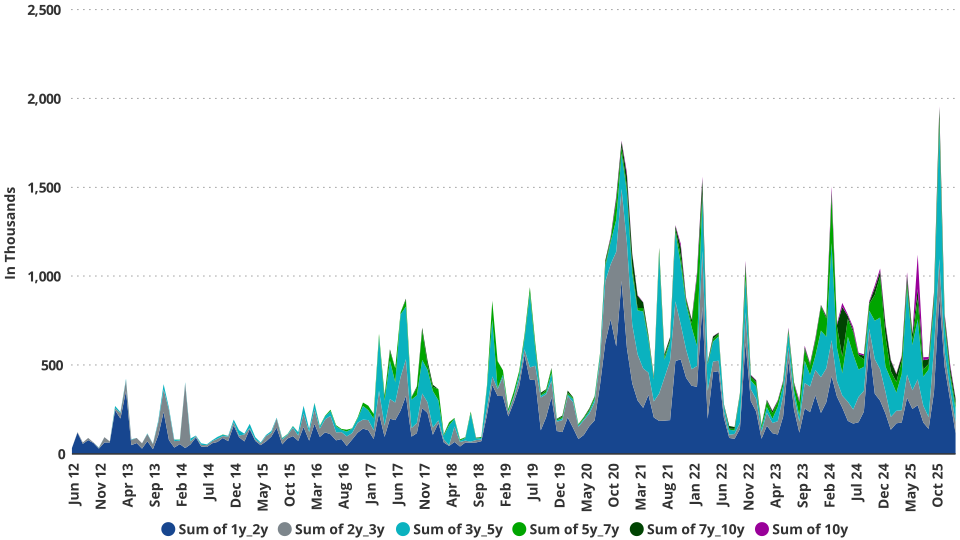
The table above confirms our previous assertion that most of the cyclical selling is occurring in the 1yr-5yr cohorts, while the >5yr cohorts are parting with relatively smaller amounts of their coins. Across most age clusters, we can also see cyclical selling patterns that tend to conform to the “4-year cycle.” Among age groups, the most dramatic swings in transfer volume have occurred in the 3yr-5yr segment. Historically, this cohort has tended to distribute more in the year after the halvening while reducing transfer activity in other years.
In the current cycle, we believe some investors pulled forward sales due to the January 2024 ETP launch and the November 2024 election of Donald Trump. Both events coincided with sharp price appreciation and may have increased the incentive to realize gains sooner than in prior cycles.
Distribution Is Slowing
However, over the past month, selling from older cohorts, >1yr, has fallen significantly to an expected total of 517k BTC in February, which would place it in the 33rd percentile of all time. In the 1yr-2yr band, token sales have dropped the most dramatically, falling to a pace of 190k, which places it in the 9th percentile since January 2020. The key point is not that distribution has ended, but that the most active selling cohorts appear to be stepping back as Bitcoin trades at a lower price. As demonstrated by the 1y-2y cohort, who would have accumulated at an average price of ~$72.7k over their buying period, the lack of selling is likely because many are underwater on their token buys. However, this has not prevented investors from realizing painful losses as sellers have absorbed -$22.5B over the past 30 days, which ranks in the 91st percentile since 2020.
Spent Volume by Age Band Shows Broad Increase in Selling in November 2025
Spent Volume by Age Band. Source: Glassnode as of 2/16/2026. Past performance is not a guarantee of future results. Not intended as a recommendation to buy or sell any securities named herein.
Bitcoin Miners’ Economics Tighten
Hash Rate Declines
Bitcoin miners operate in a challenging environment due to the combination of volatile revenues and costs, a structurally declining block subsidy, and a highly competitive production landscape. Revenue is volatile because it is tied to the Bitcoin price and to a miner’s relative share of the network's hashing power. On the cost side, the main operating input is electricity, and power prices often swing independently of Bitcoin’s price. Halvening cycles reduce the block subsidy over time, so miners are competing for a structurally smaller reward pool unless Bitcoin price or network transaction fees rise enough to offset the decline in block subsidies.
To stay competitive, miners must continuously reinvest in more efficient ASICs and infrastructure. Because network hashing power tends to increase over time, miners also need to expand their hashing power to maintain their share of block rewards. If they do not upgrade, they risk losing share as their machines become uncompetitive. If they do upgrade, they take on significant CAPEX with uncertain payback periods given the volatility of Bitcoin’s price, network difficulty, and power costs.
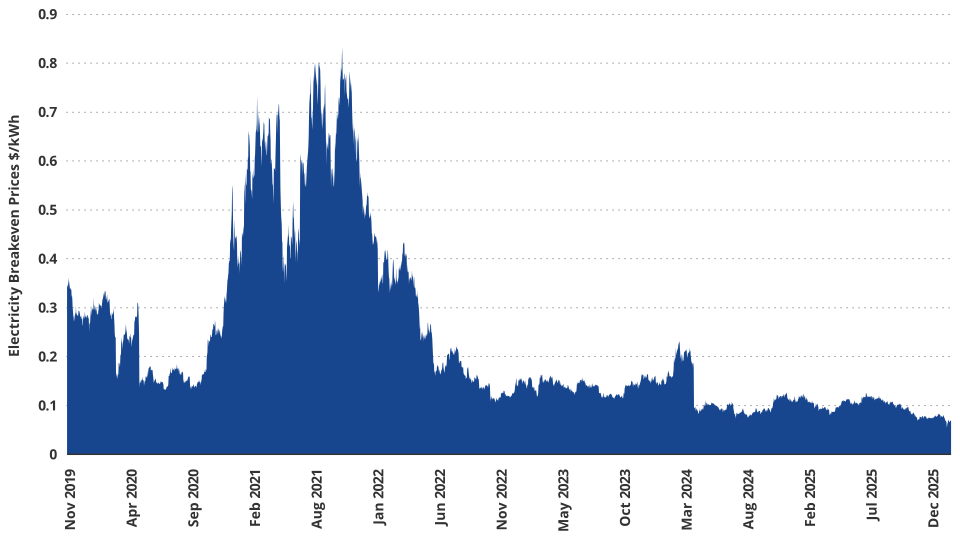
Antminer S19 XP Is Uneconomical to Operate Above $0.07 kWh
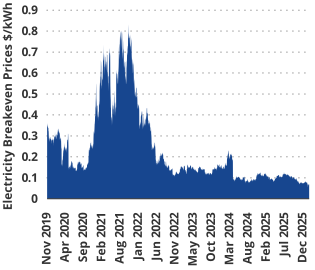
Source: Glassnode, VanEck Research as of 2/16/2026. Past performance is not a guarantee of future results. Not intended as a recommendation to buy or sell any securities named herein.
When Bitcoin’s price falls, miner revenue typically declines almost immediately. Both realized BTC pricing and the hash price (revenue per unit of hashing power) compress, while major variable costs, such as electricity, generally remain unchanged. In downturns, some miners reach a point where the marginal cost of running certain ASICs exceeds the marginal revenue. When that happens, they power down machines that are no longer economical to run.
Hash Rate Contraction and Forward Returns
At current BTC prices, for example, the Antminer S19 XP becomes unprofitable for miners paying more than about $0.07/kWh. Once fixed overhead is included, some operators can be deeply unprofitable on an all-in basis. Riot illustrates this dynamic. For its 3Q2025 earnings report, it cites an estimated cost to mine one bitcoin of roughly $46,000 excluding depreciation, versus about $89,000 including depreciation.
Consistent with these pressures, the Bitcoin network hash rate has declined by roughly (-14%) over the past 90 days. Sustained 90-day hash rate drawdowns are relatively uncommon. We have identified 12 notable periods in which the hash rate fell for over 90 days. The most severe decline of the industrial-scale mining era (post-2013) occurred in summer 2021, when China’s mining ban contributed to an approximate (-40%) drop-in network hash rate.
Finally, as noted in our prior research, these periods of hash rate contraction have historically preceded strong forward BTC returns over the subsequent 90 days. An interesting feature of the latest decline in hash rate is that it may relate to record cold weather across North America. Therefore, we are unsure as to the extent voluntary curtailment, rather than economic rationale, is causing the has rate drops. We will continue to monitor the situation to assess network health.
Bitcoin Network Hash Rate Declines
| # | Start Date | End Date | Duration (Days) | Highest Drop in Hash Rate (%) |
Avg BTC 90-Day Forward Return (%) |
| 1 | 2009-05-09 | 2009-10-21 | 166 | -62.11 | No Price |
| 2 | 2011-10-14 | 2012-01-27 | 106 | -37.50 | 52.73 |
| 3 | 2013-01-21 | 2013-02-16 | 27 | -6.04 | 492.78 |
| 4 | 2018-11-24 | 2019-02-28 | 97 | -26.43 | 42.89 |
| 5 | 2020-05-21 | 2020-06-22 | 33 | -10.94 | 16.90 |
| 6 | 2020-11-15 | 2020-11-21 | 7 | -0.87 | 186.16 |
| 7 | 2020-12-24 | 2020-12-29 | 6 | -1.19 | 111.76 |
| 8 | 2020-12-31 | 2021-01-05 | 6 | -1.15 | 87.01 |
| 9 | 2021-06-09 | 2021-09-20 | 104 | -40.36 | 36.37 |
| 10 | 2022-07-21 | 2022-09-08 | 50 | -9.06 | -17.58 |
| 11 | 2024-06-23 | 2024-08-03 | 42 | -6.59 | 4.69 |
| 12 | 2026-01-11 | 2026-02-16 | 37 | -14.22 | Unknown |
Source: Glassnode as of 2/16/2026. Past performance is not a guarantee of future results. Not intended as a recommendation to buy or sell any securities named herein.
The AI Pivot in Bitcoin Mining
One theme that has continued to disrupt the mining space is miners converting their facilities into AI data centers. Of the Bitcoin miners in our coverage universe, all have allocated some portion of their current or future production facilities to AI. One miner that remains committed to being a pure play is Bitdeer, which is pursuing a limited AI buildout alongside commitments to expand hashing power and mining efficiency through self-produced machines.
On weaker tape, the market is paying for near-term resilience and cash flow visibility, which helps explain why BTC miners credibly converting capacity into AI data center operations are being rewarded. The AI pivot is viewed as a path to higher, more stable future revenue per MW, so miners with believable AI buildouts often trade at higher valuation multiples on their power portfolios. By contrast, a miner that remains more exposed to pure mining economics can underperform AI-evolving peers during BTC drawdowns, even as it improves operationally, because its earnings remain tightly linked to the BTC price and network difficulty. BTDR fits that profile. Its stock has also faced a specific AI overhang tied to its inability to move forward with AI plans at its Clarington, OH facility, but the broader driver of relative weakness is its more concentrated exposure to BTC mining. As a result, BTDR’s equity price is down (-40%) in the past month.
Bitdeer Operational Progress
Operationally, Bitdeer has made meaningful progress. The company substantially increased fleet efficiency from 30.4 J/TH in 4Q2024 to 17.9 J/TH in 4Q2025. Likewise, the company ended January 2026 with over 63 EH/s of self-mining hashing power, up from just 9.2 EH/s in January 2025. Bitdeer management has not disclosed the extent of its hash power expansion through 2026, but we estimate it has around 413 MW where it can deploy its new, proprietary SEALMINER A3 ASICs. If the company can deploy 50k SEALMINERS to this power in 2026, it could add 33 EH/s, bringing its total to 96 EH/s. If this were accomplished, Bitdeer would generate an additional $335M of BTC at current Bitcoin prices and hash rates.
The practical implication is that efficiency gains alone may not be enough to change investor perception in the short run. If BTC remains weak and difficulty stays high, the AI pivoters will continue to outperform. For Bitdeer, it will be important to monitor its progress in deploying new miners’ rigs, how quickly it can deploy new capacity, and whether it can fund expansion without diluting shareholders at unfavorable prices.
Update: On February 19, prior to market open, Bitdeer announced a $300M convertible bond issuance. The stock declined approximately 15% pre-market following the announcement. We hold no position.
Links to third party websites are provided as a convenience and the inclusion of such links does not imply any endorsement, approval, investigation, verification or monitoring by us of any content or information contained within or accessible from the linked sites. By clicking on the link to a non-VanEck webpage, you acknowledge that you are entering a third-party website subject to its own terms and conditions. VanEck disclaims responsibility for content, legality of access or suitability of the third-party websites.
To receive more Digital Assets insights, sign up in our subscription center.


Disclosures
Definitions
Bitcoin (BTC) is a decentralized digital currency without a central bank or single administrator. It can be sent from user to user on the peer-to-peer Bitcoin network without intermediaries.
S&P 500 Index is a stock market index of 500 of the largest companies listed on stock exchanges in the United States.
Risk Considerations
This is not an offer to buy or sell, or a recommendation to buy or sell any of the securities, financial instruments or digital assets mentioned herein. The information presented does not involve the rendering of personalized investment, financial, legal, tax advice, or any call to action. Certain statements contained herein may constitute projections, forecasts and other forward-looking statements, which do not reflect actual results, are for illustrative purposes only, are valid as of the date of this communication, and are subject to change without notice. Actual future performance of any assets or industries mentioned are unknown. Information provided by third party sources are believed to be reliable and have not been independently verified for accuracy or completeness and cannot be guaranteed. VanEck does not guarantee the accuracy of third party data. The information herein represents the opinion of the author(s), but not necessarily those of VanEck or its other employees.
Index performance is not representative of fund performance. It is not possible to invest directly in an index.
Investments in digital assets and Web3 companies are highly speculative and involve a high degree of risk. These risks include, but are not limited to: the technology is new and many of its uses may be untested; intense competition; slow adoption rates and the potential for product obsolescence; volatility and limited liquidity, including but not limited to, inability to liquidate a position; loss or destruction of key(s) to access accounts or the blockchain; reliance on digital wallets; reliance on unregulated markets and exchanges; reliance on the internet; cybersecurity risks; and the lack of regulation and the potential for new laws and regulation that may be difficult to predict. Moreover, the extent to which Web3 companies or digital assets utilize blockchain technology may vary, and it is possible that even widespread adoption of blockchain technology may not result in a material increase in the value of such companies or digital assets.
Digital asset prices are highly volatile, and the value of digital assets, and Web3 companies, can rise or fall dramatically and quickly. If their value goes down, there’s no guarantee that it will rise again. As a result, there is a significant risk of loss of your entire principal investment.
Digital assets are not generally backed or supported by any government or central bank and are not covered by FDIC or SIPC insurance. Accounts at digital asset custodians and exchanges are not protected by SPIC and are not FDIC insured. Furthermore, markets and exchanges for digital assets are not regulated with the same controls or customer protections available in traditional equity, option, futures, or foreign exchange investing.
Digital assets include, but are not limited to, cryptocurrencies, tokens, NFTs, assets stored or created using blockchain technology, and other Web3 products.
Web3 companies include but are not limited to, companies that involve the development, innovation, and/or utilization of blockchain, digital assets, or crypto technologies.
All investing is subject to risk, including the possible loss of the money you invest. As with any investment strategy, there is no guarantee that investment objectives will be met and investors may lose money. Diversification does not ensure a profit or protect against a loss in a declining market. Past performance is no guarantee of future performance.
© Van Eck Associates Corporation.Disclosures
Definitions
Bitcoin (BTC) is a decentralized digital currency without a central bank or single administrator. It can be sent from user to user on the peer-to-peer Bitcoin network without intermediaries.
S&P 500 Index is a stock market index of 500 of the largest companies listed on stock exchanges in the United States.
Risk Considerations
This is not an offer to buy or sell, or a recommendation to buy or sell any of the securities, financial instruments or digital assets mentioned herein. The information presented does not involve the rendering of personalized investment, financial, legal, tax advice, or any call to action. Certain statements contained herein may constitute projections, forecasts and other forward-looking statements, which do not reflect actual results, are for illustrative purposes only, are valid as of the date of this communication, and are subject to change without notice. Actual future performance of any assets or industries mentioned are unknown. Information provided by third party sources are believed to be reliable and have not been independently verified for accuracy or completeness and cannot be guaranteed. VanEck does not guarantee the accuracy of third party data. The information herein represents the opinion of the author(s), but not necessarily those of VanEck or its other employees.
Index performance is not representative of fund performance. It is not possible to invest directly in an index.
Investments in digital assets and Web3 companies are highly speculative and involve a high degree of risk. These risks include, but are not limited to: the technology is new and many of its uses may be untested; intense competition; slow adoption rates and the potential for product obsolescence; volatility and limited liquidity, including but not limited to, inability to liquidate a position; loss or destruction of key(s) to access accounts or the blockchain; reliance on digital wallets; reliance on unregulated markets and exchanges; reliance on the internet; cybersecurity risks; and the lack of regulation and the potential for new laws and regulation that may be difficult to predict. Moreover, the extent to which Web3 companies or digital assets utilize blockchain technology may vary, and it is possible that even widespread adoption of blockchain technology may not result in a material increase in the value of such companies or digital assets.
Digital asset prices are highly volatile, and the value of digital assets, and Web3 companies, can rise or fall dramatically and quickly. If their value goes down, there’s no guarantee that it will rise again. As a result, there is a significant risk of loss of your entire principal investment.
Digital assets are not generally backed or supported by any government or central bank and are not covered by FDIC or SIPC insurance. Accounts at digital asset custodians and exchanges are not protected by SPIC and are not FDIC insured. Furthermore, markets and exchanges for digital assets are not regulated with the same controls or customer protections available in traditional equity, option, futures, or foreign exchange investing.
Digital assets include, but are not limited to, cryptocurrencies, tokens, NFTs, assets stored or created using blockchain technology, and other Web3 products.
Web3 companies include but are not limited to, companies that involve the development, innovation, and/or utilization of blockchain, digital assets, or crypto technologies.
All investing is subject to risk, including the possible loss of the money you invest. As with any investment strategy, there is no guarantee that investment objectives will be met and investors may lose money. Diversification does not ensure a profit or protect against a loss in a declining market. Past performance is no guarantee of future performance.
© Van Eck Associates Corporation.