VanEck Mid-January 2026 Bitcoin ChainCheck
January 22, 2026
Read Time 10+ MIN
Please note that VanEck has exposure to bitcoin.
Key takeaways
- Bitcoin bounces back with low volatility: Bitcoin returned +12% over the last 30 days while volatility fell significantly.
- Miners pivot to AI as hash rate falls: Mining activity trended lower with difficulty down (-2%) and hash rate dropping (-6%). This decline is partly due to miners powering down rigs to service the exploding demand for AI data centers.
- DAT consolidation heats up: Digital Asset Treasuries (DATs) are facing mNAV discounts, prompting a wave of potential mergers and acquisitions. We highlight the recent Strive Inc./Semler Scientific merger and identify Bitcoin Group, Empery Digital, and Sequans as potential acquisition targets.
Bitcoin was a strong performer over the last 30 days, returning (+12%) as trailing 30-day volatility fell (-29%) to (Vol = 27). Bitcoin’s lack of energy over the past 30 days sapped volatility, bringing it to levels just below the 13th percentile over the past year. After what many would describe as “tax loss harvesting,” driving early December sales, which actually seemed to start in October this year, Bitcoin prices melted up through the first half of January.
We attribute Bitcoin’s buoyancy to a host of factors, including softer inflation readings, Fed independence fears, CLARITY ACT optimism, and generally oversold conditions. This optimism catalyzed ETP inflows of $440M over the past 30 days, compared with outflows of -$1.3B over the prior 30-day period. In fact, between 1/12/2026 and 1/14/2026, BTC ETP inflows were +$1.66B.
As measured by 30-day correlation, Bitcoin became untethered from the S&P500, reaching 0.18, which corresponds to the 9th percentile over the past year. This is the lowest correlation reading for BTC/SP500 since October 2025. Meanwhile, BTC moved more in lockstep with gold, with the 30-day correlation reaching 0.28, which ranks a tad above the 80th percentile over the last year.
The positive price action in Bitcoin over the past 30 days translated into (+7%) growth in open interest in BTC to reach $32.4B. Though BTC open interest measured in BTC was actually down (-2.3%) since December 15, demand for speculation crept back into the markets as Bitcoin 90-day perp funding reached (4.8%), increasing from (3.7%) in mid-December.
Bitcoin Perp Funding has Trended Down Since October 2025
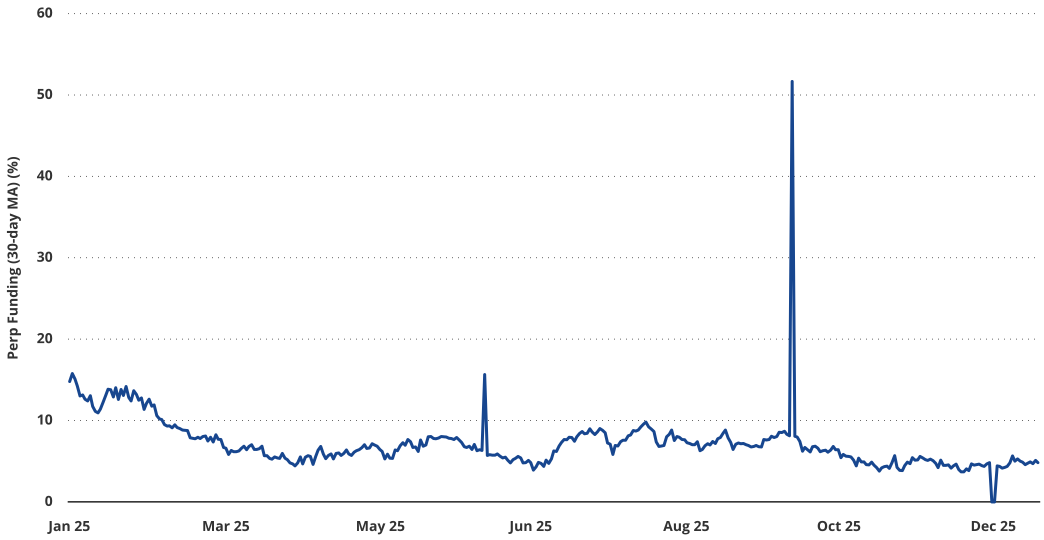
Source: Glassnode as of 1/15/2026. Past performance is not a guarantee of future results. Not intended as a recommendation to buy or sell any securities named herein.
Onchain metrics were negative for Bitcoin, with most network health KPIs deteriorating, while other onchain metrics suggest that supply dynamics are improving. Some of the more concerning 30-day changes include daily network revenues (-15%), active addresses (-6%), new addresses (-4%), and active supply (+7%). These readings indicate that Bitcoin blockspace demand has fallen with fewer new and existing users transferring value on the network. At the same time, the increase in active supply indicates that the breadth of Bitcoin holders churning their positions has increased.
Miners Pivot to AI as Hash Rate Declines
Bitcoin Hash Rate Suffers Longest Sustained Drop Since Spring 2024
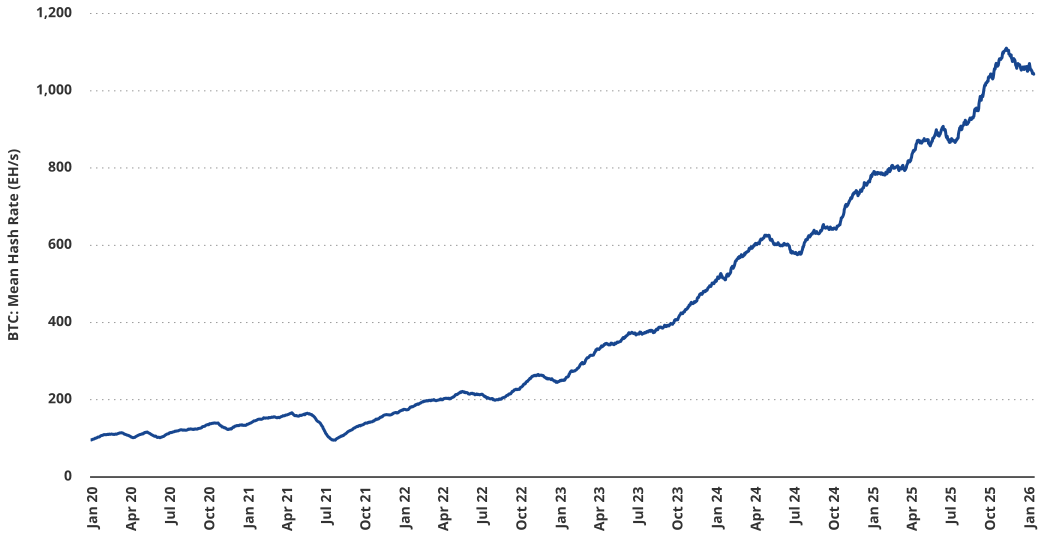
Source: Glassnode as of 1/15/2026. Past performance is not a guarantee of future results. Not intended as a recommendation to buy or sell any securities named herein.
Mining activity also continued to trend lower, with the 30-day average difficulty down (-2%) from 646 to 635, mirroring the drop in estimated global miner power consumption (-2%) from 206 TWh to 203 TWh. The 30-day moving-average hash rate is down (-6%) since its peak in mid-November 2025. The concurrent drop in difficulty, estimated power consumption, and hash rate suggests that miners are simply turning off their mining rigs. We partly attribute this dynamic to seasonal winter curtailment with entities like Riot earning $6.2M in power credits, up (+113%) from November 2025 and (+520%) from December 2024.
However, we believe the larger, more systematic factor driving the reduction in hash rate stems from deteriorating economics for Bitcoin mining, as AI data center power demand explodes. We expect AI data center demand to persist over the coming years, with a (+24%) CAGR through 2030, and expect Bitcoin miners to increasingly devote power resources to servicing the buildout of artificial intelligence. As Ben Gagnon, CEO of Bitcoin miner Bitfarms, notes in a recent Wired interview, “It’s that HPC creates so much more value per unit of energy and does so predictably for years into the future that the company can’t justify further investment into bitcoin mining.”
Bitcoin holder dynamics offered a few bright spots that should provide investors with some comfort. Onchain transfer volume fell (-11%), while miner transfer volume to exchanges declined (-6%). Lower onchain transfer volume suggests reduced “churn” because less BTC is changing hands even as holder churn expands. We view the overall drop in BTC churn outweigh the breadth changes cited above.
Bitcoin Long-Term Holder Resilience
BTC Supply Dormant >3 Yrs. Average Since 2020: ~38%
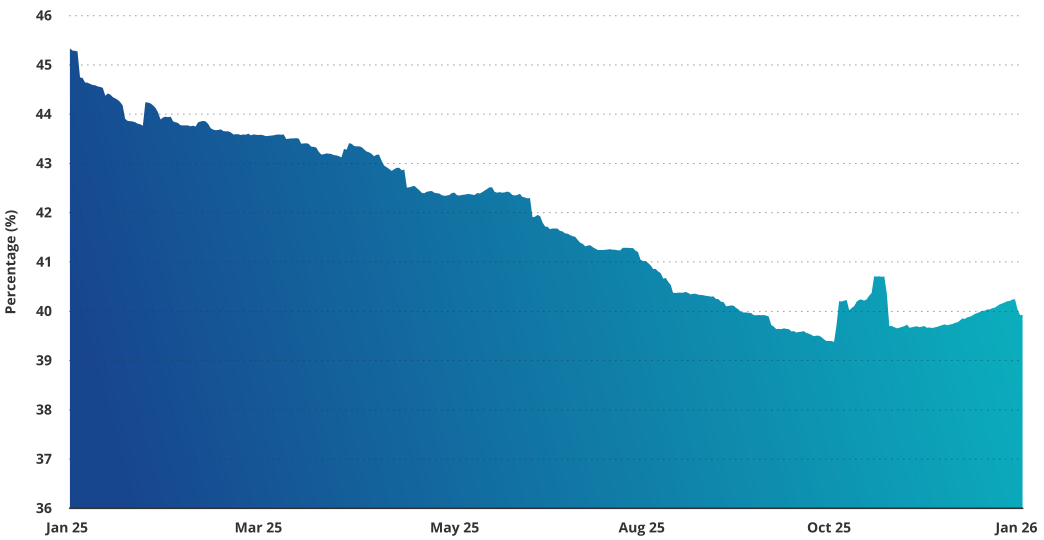
Source: Glassnode as of 1/15/2026. Past performance is not a guarantee of future results. Not intended as a recommendation to buy or sell any securities named herein.
Over the last 30 days, we have observed positive net changes in Bitcoin positioning across most long-term holder cohorts. In our December ChainCheck, we note massive reductions in BTC dormancy amongst the 1-2yr, 2-3yr, and 3-5yr cohorts of (-900bps), (-1250bps), and (-550bps) m/m, respectively, whereas 5yr+ cohorts increased balances. Due to the medium-term sellers, the net effect was a total reduction in dormant supply of (-380bps) m/m in December.
By contrast, in January, we saw growth or deceleration in losses amongst the 1-2yr/2-3yr/3-5yr holder bands of (+205bps), (-174bps), and (-213bps) respectively. Additionally, BTC supply inactive >5 years ago was up (+176bps) over the past 30 days, with +95.5K BTC aging into these supply cohorts. From the trough on December 15, 2025, through January 14, 2026, the share of BTC not moved in over a year increased by (+69bps). Stepping back, middle-term holders are still hemorrhaging supply, but longer-term holders appear to be standing pat.
Bitcoin Digital Asset Treasury Mergers and Acquisitions
mNAVs De-Rated Prior to Bitcoin Price Declines
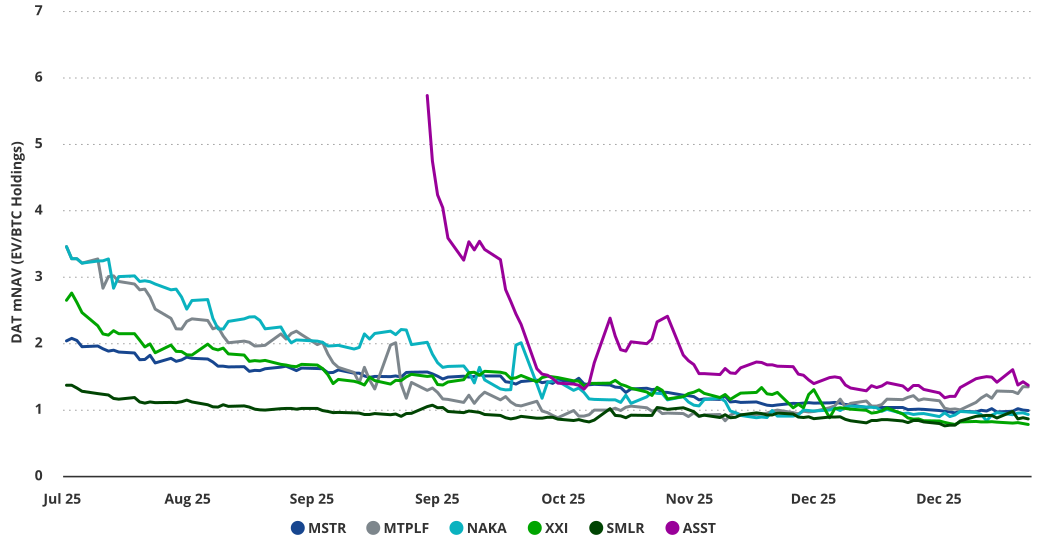
Source: Artemis XYZ, Bloomberg, VanEck Research as of 1/15/2026. Past performance is not a guarantee of future results. Not intended as a recommendation to buy or sell any securities named herein.
One of the most substantial challenges we believe Bitcoin faces is the potential liquidation of Bitcoin holdings by digital asset treasury companies (DATs). DATs use financial alchemy to buy more BTC in a strategy that gives shareholders recursive exposure to Bitcoin’s price movements. These companies’ primary KPI is to increase the amount of BTC held per share, which is achieved by issuing debt and equity securities to fund Bitcoin purchases. The best indicator of a DAT’s health is its mNAV (enterprise value/value of Bitcoin holdings), as this metric signals the DAT’s ability to continue purchasing Bitcoin through financing.
Trying to replicate the success of Strategy, many DATs formed in the spring and summer of 2025, and we estimate that the current number of “true” DATs holding more than 1k BTC to be 26. These DATs have gobbled up more than 867k BTC (4.3%) of the floating BTC supply, worth around $82.5B. However, since the mass entry of new BTC DATs, many DATs have seen their mNAVs falter. Of the 26 with more than 1k BTC, only 6 have mNAV > 1.0x. We believe this discount phenomenon is a substantial factor weighing on Bitcoin’s price due to the uncertainty around these entities persisting as going concerns. If these companies were forced to wind down, the result would be a surge in Bitcoin sales.
Thus, until these companies attain a healthy financial outlook, many investors fear a looming storm of Bitcoin being market-sold by the living estates of these companies. As these companies’ financial health pictures are recursive to the price of Bitcoin, if BTC goes up, it allows these companies to not only finance new Bitcoin purchases (pushing up BTC price), but also extend their operating runway. However, if Bitcoin prices continue their decline, the result could trigger reflexive selling of Bitcoin as DATs are dissolved in bankruptcy.
Options Open Interest ($M): MSTR vs. Mag7 and Indices
| Asset | Total Open Interest ($M) | Put Open Interest ($M) | Call Open Interest ($M) |
| MSTR | 52,462 | 23,240 | 29,222 |
| Magnificent 7 | |||
| GOOG | 183,133 | 83,956 | 99,178 |
| META | 177,105 | 65,658 | 111,448 |
| NVDA | 345,324 | 162,983 | 182,341 |
| TSLA | 328,103 | 147,499 | 180,604 |
| AMZN | 110,647 | 46,825 | 63,822 |
| MSFT | 117,045 | 46,679 | 70,367 |
| AAPL | 141,244 | 57,628 | 83,616 |
| Indices | |||
| GLD | 235,429 | 76,486 | 158,942 |
| VNQ | 433 | 288 | 145 |
| IBIT | 36,898 | 13,475 | 23,423 |
| QQQ | 580,155 | 351,856 | 228,299 |
| BND | 17 | 6 | 11 |
| SPY | 1,177,213 | 827,230 | 349,983 |
Source: Strategy as of 1/16/2026. Past performance is not a guarantee of future results. Not intended as a recommendation to buy or sell any securities named herein.
However, there is another option for DATs, and that is consolidation. We have seen the beginning stages of the DAT merger activity, and we believe this trend will accelerate. Given the advantages offered to larger DATs, we expect only a few dominant DATs. This is because DATs must rely on liquidity in their debt, equity, and capital markets to absorb financing for Bitcoin purchases. The best liquidity is available to the biggest players. For example, although MSTR’s market cap is only 1/60th the average size of Mag7 stocks, its options open interest has at times exceeded that of Mag7 stocks. Therefore, MSTR has a tremendous financial advantage over competitors who cannot efficiently tap the financial markets. Over time, this dynamic should lead to persistent mNAV premiums for larger players compared to smaller ones.
As a result, we forecast that the best outcome for Bitcoin would be for the larger Bitcoin DATs to buy the smaller ones when those smaller entities trade at a discount. This dynamic would benefit both parties. While the shareholders of the acquirer would get access to cheaper Bitcoin than market-priced BTC to boost BTC per share, the owners of the acquiree would be able to recoup the discounted valuation of Bitcoin by getting a boosted mNAV. Of course, there is uncertainty over the definition of “fair tradeoff” for each party. However, the recently completed merger between Strive Inc. and Semler Scientific provides some insights.
Case Study: The Strive Inc. & Semler Scientific Merger
On September 22, 2025, around Bitcoin’s 2025 price peak, Strive Inc. (ASST) made Semler Scientific (SMLR) a lucrative merger offer: 21.05 ASST shares for 1 SMLR share. Initially, the deal was valued at $1.42B, representing a 210% premium to SMLR’s enterprise value. While the mNAV of SMLR was low (0.90), the premium implied by the deal was equivalent to buying BTC at ~190% of its then-market price. However, this excessive value was likely an overstatement, as ASST was trading at a very high mNAV of ~4x. Therefore, it was expected that the deal’s premium would decline as ASST’s mNAV declined to reflect the deal-related share dilution.
By New Year’s Eve 2025, Bitcoin had posted a few months of negative price action, falling (-20%) since the September deal date. Most of the DATs performed even worse. ASST shares fell (-73%) from the day before the merger announcement from $2.75 to $0.74, and mNAV dropped to 1.2x. SMLR shares were down (-49%), and mNAV deteriorated to 0.77x. As a result, the premium for the deal shrank to only (+1.6%) over market prices at that point in time.
Under those conditions, SMLR holders would be getting a modest mNAV lift to around 0.78x. Meanwhile, ASST holders would be improving their Bitcoin share exposure from 8.5 BTC per million shares to 10.4 BTC per million shares. However, on January 16, 2026, the deal closed with SMLR mNAV at 0.87. On the flip side, SMLR shareholders lost BTC per share exposure, moving from 332 BTC/m shares to 219 BTC/m shares. Meanwhile, ASST holders gave up mNAV, which moved from 1.37x to 1.06x the day after the merger. Thus, we can see the trade-offs each party was willing to make to get the deal done.
Potential Acquisition Targets: BTC Holdings and Valuation Metrics
| Company | BTC | EV ($M) | mNAV (EV) | Domicile |
| Bitcoin Group SE | 3,605 | 181 | 0.53 | Germany |
| Empery Digital | 4,081 | 273 | 0.7 | US |
| Sequans Communications | 2,264 | 111 | 0.52 | France |
Source: Bitcoin Treasuries Net as of 1/16/2026. Past performance is not a guarantee of future results. Not intended as a recommendation to buy or sell any securities named herein.
Looking ahead, we see great potential for the intrepid DAT to acquire another “Bitcoin company.” To us, three entities stand out: Bitcoin Group, Empery Digital, and Sequans Communications. Each of these companies has an mNAV below 1.0x while holding enough BTC to make the legal acquisition of each worthwhile. Of the bunch, we believe that the most likely acquiree is Empery Digital.
Bitcoin Group, based in Germany, has always been one of the most enigmatic crypto companies we cover. The stock trades at one of the steepest discounts in the peer group, even though the business appears profitable. The company reported earnings of €1.8 million in 2024. Bitcoin Group operates a crypto trading platform, Bitcoin.de, and a crypto custody business. The main hurdle is that the company owns and operates a regulated financial services entity in the EU, which makes it harder for someone to acquire it quickly or easily. An acquirer would need regulatory approval and a great deal of patience. Also, Bitcoin Group has an anchor shareholder, Priority AG, which holds>25% of the voting rights. However, given its juicy discount, it can be enticing to a sophisticated bidder who can navigate the pitfalls.
Empery Digital is nominally a “powersports/off-road vehicle” business. In practice, that operating unit is immaterial, generating only about $200k of earnings in 3Q2025. The more compelling feature is the sizable mNAV discount, but any prospective buyer has to contend with meaningful governance and anti-takeover friction.
Stockholders have limited ability to quickly change the board. Directors can be removed or replaced only at a duly scheduled meeting, and shareholders cannot call special meetings, sharply constraining rapid board turnover. That makes a proxy contest harder to run and harder to win on a tight timeline. On top of that, if an acquirer crosses 15%, Delaware law can restrict certain business combination activity for three years, effectively delaying a merger path. The board also has the ability to issue preferred shares, which could be used to dilute or otherwise deter an unsolicited bid.
That said, a patient DAT-style acquirer could simply wait for the next annual meeting in May 2026. If the mNAV discount persists, the run-up to that meeting could get interesting. Overall, Empery looks like a better candidate than Bitcoin Group given the more familiar jurisdiction, but any M&A path is more likely to be a process than an imminent event.
The first issue with Sequans is structural complexity. The company is based in France, but it owns subsidiaries across multiple jurisdictions, including the UK, US, Singapore, Israel, and Finland. Any buyer is stepping into a multi-country setup with more moving parts and more opportunities for process risk to surface.
Sequans also has a real operating business. It is a fabless semiconductor company that was profitable in 2024, reporting about $57 million in net income. That matters because an acquirer cannot treat this as a simple balance-sheet buy. The operating business would need to be valued on its own and either managed long-term or separated, which likely pushes you toward a more complex structure like a carve-out or spin or forces the buyer to run a business they may not know well.
On the takeover side, France adds another hurdle. Under French takeover rules, crossing roughly 30% ownership can trigger a mandatory tender offer. That makes it difficult to build a stake quietly and then move fast, and it can turn the process into something slower and more procedural. The board also has tools that can make life harder for an outside buyer, including the ability to issue shares in ways that dilute a potential acquirer or favor friendly parties. Similar to Empery, board and shareholder actions run on set meeting timelines, which adds time and market risk.
Finally, because this is a semiconductor business, it can draw government scrutiny. French authorities can review and potentially restrict foreign buyers, which adds another layer of uncertainty on top of everything else. Given the many challenges confronting potential buyers, Sequans is the least attractive of the small group.
Bitcoin ChainCheck Monthly Dashboard and Highlights
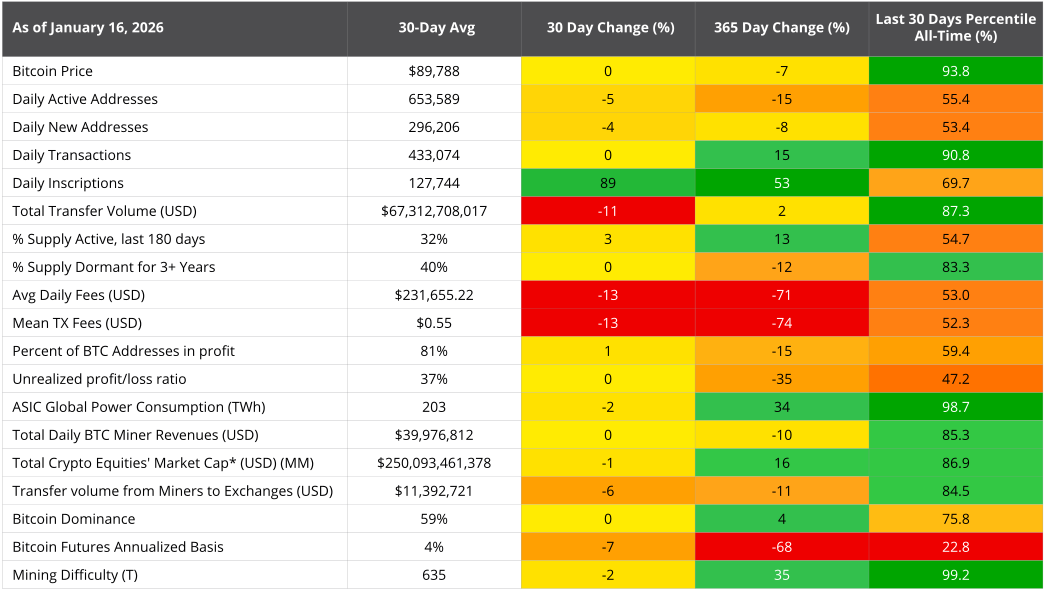
1 30 day change & 365 day change are relative to the 30-day avg, not absolute.
Source: Glassnode as of 1/16/2026. Past performance is not a guarantee of future results. Not intended as a recommendation to buy or sell any securities named herein.
Links to third party websites are provided as a convenience and the inclusion of such links does not imply any endorsement, approval, investigation, verification or monitoring by us of any content or information contained within or accessible from the linked sites. By clicking on the link to a non-VanEck webpage, you acknowledge that you are entering a third-party website subject to its own terms and conditions. VanEck disclaims responsibility for content, legality of access or suitability of the third-party websites.
To receive more Digital Assets insights, sign up in our subscription center.


DISCLOSURES
Definitions
Bitcoin (BTC) is a decentralized digital currency without a central bank or single administrator. It can be sent from user to user on the peer-to-peer Bitcoin network without intermediaries.
S&P 500 Index is a stock market index of 500 of the largest companies listed on stock exchanges in the United States.
Magnificent 7 is a group of high-performing and influential U.S. technology stocks that includes Alphabet, Amazon, Apple, Meta Platforms, Microsoft, NVIDIA, and Tesla.
GLD is an exchange-traded fund that tracks the price of gold bullion, offering investors a way to access the gold market without holding physical gold.
VNQ is an exchange-traded fund that tracks the performance of publicly traded equity REITs and other real estate-related investments in the United States.
IBIT is an exchange-traded product that seeks to reflect the performance of the price of bitcoin.
QQQ is an exchange-traded fund that tracks the Nasdaq-100 Index, which includes 100 of the largest non-financial companies listed on the Nasdaq stock exchange.
BND is an exchange-traded fund that tracks the performance of the broad, investment-grade U.S. bond market, providing exposure to taxable investment-grade bonds.
SPY is an exchange-traded fund that tracks the S&P 500 Index, a stock market index of 500 of the largest companies listed on stock exchanges in the United States.
Risk Considerations
This is not an offer to buy or sell, or a recommendation to buy or sell any of the securities, financial instruments or digital assets mentioned herein. The information presented does not involve the rendering of personalized investment, financial, legal, tax advice, or any call to action. Certain statements contained herein may constitute projections, forecasts and other forward-looking statements, which do not reflect actual results, are for illustrative purposes only, are valid as of the date of this communication, and are subject to change without notice. Actual future performance of any assets or industries mentioned are unknown. Information provided by third party sources are believed to be reliable and have not been independently verified for accuracy or completeness and cannot be guaranteed. VanEck does not guarantee the accuracy of third party data. The information herein represents the opinion of the author(s), but not necessarily those of VanEck or its other employees.
Index performance is not representative of fund performance. It is not possible to invest directly in an index.
Investments in digital assets and Web3 companies are highly speculative and involve a high degree of risk. These risks include, but are not limited to: the technology is new and many of its uses may be untested; intense competition; slow adoption rates and the potential for product obsolescence; volatility and limited liquidity, including but not limited to, inability to liquidate a position; loss or destruction of key(s) to access accounts or the blockchain; reliance on digital wallets; reliance on unregulated markets and exchanges; reliance on the internet; cybersecurity risks; and the lack of regulation and the potential for new laws and regulation that may be difficult to predict. Moreover, the extent to which Web3 companies or digital assets utilize blockchain technology may vary, and it is possible that even widespread adoption of blockchain technology may not result in a material increase in the value of such companies or digital assets.
Digital asset prices are highly volatile, and the value of digital assets, and Web3 companies, can rise or fall dramatically and quickly. If their value goes down, there’s no guarantee that it will rise again. As a result, there is a significant risk of loss of your entire principal investment.
Digital assets are not generally backed or supported by any government or central bank and are not covered by FDIC or SIPC insurance. Accounts at digital asset custodians and exchanges are not protected by SPIC and are not FDIC insured. Furthermore, markets and exchanges for digital assets are not regulated with the same controls or customer protections available in traditional equity, option, futures, or foreign exchange investing.
Digital assets include, but are not limited to, cryptocurrencies, tokens, NFTs, assets stored or created using blockchain technology, and other Web3 products.
Web3 companies include but are not limited to, companies that involve the development, innovation, and/or utilization of blockchain, digital assets, or crypto technologies.
All investing is subject to risk, including the possible loss of the money you invest. As with any investment strategy, there is no guarantee that investment objectives will be met and investors may lose money. Diversification does not ensure a profit or protect against a loss in a declining market. Past performance is no guarantee of future performance.
© Van Eck Associates Corporation.
DISCLOSURES
Definitions
Bitcoin (BTC) is a decentralized digital currency without a central bank or single administrator. It can be sent from user to user on the peer-to-peer Bitcoin network without intermediaries.
S&P 500 Index is a stock market index of 500 of the largest companies listed on stock exchanges in the United States.
Magnificent 7 is a group of high-performing and influential U.S. technology stocks that includes Alphabet, Amazon, Apple, Meta Platforms, Microsoft, NVIDIA, and Tesla.
GLD is an exchange-traded fund that tracks the price of gold bullion, offering investors a way to access the gold market without holding physical gold.
VNQ is an exchange-traded fund that tracks the performance of publicly traded equity REITs and other real estate-related investments in the United States.
IBIT is an exchange-traded product that seeks to reflect the performance of the price of bitcoin.
QQQ is an exchange-traded fund that tracks the Nasdaq-100 Index, which includes 100 of the largest non-financial companies listed on the Nasdaq stock exchange.
BND is an exchange-traded fund that tracks the performance of the broad, investment-grade U.S. bond market, providing exposure to taxable investment-grade bonds.
SPY is an exchange-traded fund that tracks the S&P 500 Index, a stock market index of 500 of the largest companies listed on stock exchanges in the United States.
Risk Considerations
This is not an offer to buy or sell, or a recommendation to buy or sell any of the securities, financial instruments or digital assets mentioned herein. The information presented does not involve the rendering of personalized investment, financial, legal, tax advice, or any call to action. Certain statements contained herein may constitute projections, forecasts and other forward-looking statements, which do not reflect actual results, are for illustrative purposes only, are valid as of the date of this communication, and are subject to change without notice. Actual future performance of any assets or industries mentioned are unknown. Information provided by third party sources are believed to be reliable and have not been independently verified for accuracy or completeness and cannot be guaranteed. VanEck does not guarantee the accuracy of third party data. The information herein represents the opinion of the author(s), but not necessarily those of VanEck or its other employees.
Index performance is not representative of fund performance. It is not possible to invest directly in an index.
Investments in digital assets and Web3 companies are highly speculative and involve a high degree of risk. These risks include, but are not limited to: the technology is new and many of its uses may be untested; intense competition; slow adoption rates and the potential for product obsolescence; volatility and limited liquidity, including but not limited to, inability to liquidate a position; loss or destruction of key(s) to access accounts or the blockchain; reliance on digital wallets; reliance on unregulated markets and exchanges; reliance on the internet; cybersecurity risks; and the lack of regulation and the potential for new laws and regulation that may be difficult to predict. Moreover, the extent to which Web3 companies or digital assets utilize blockchain technology may vary, and it is possible that even widespread adoption of blockchain technology may not result in a material increase in the value of such companies or digital assets.
Digital asset prices are highly volatile, and the value of digital assets, and Web3 companies, can rise or fall dramatically and quickly. If their value goes down, there’s no guarantee that it will rise again. As a result, there is a significant risk of loss of your entire principal investment.
Digital assets are not generally backed or supported by any government or central bank and are not covered by FDIC or SIPC insurance. Accounts at digital asset custodians and exchanges are not protected by SPIC and are not FDIC insured. Furthermore, markets and exchanges for digital assets are not regulated with the same controls or customer protections available in traditional equity, option, futures, or foreign exchange investing.
Digital assets include, but are not limited to, cryptocurrencies, tokens, NFTs, assets stored or created using blockchain technology, and other Web3 products.
Web3 companies include but are not limited to, companies that involve the development, innovation, and/or utilization of blockchain, digital assets, or crypto technologies.
All investing is subject to risk, including the possible loss of the money you invest. As with any investment strategy, there is no guarantee that investment objectives will be met and investors may lose money. Diversification does not ensure a profit or protect against a loss in a declining market. Past performance is no guarantee of future performance.
© Van Eck Associates Corporation.