VanEck Mid-June 2026 Bitcoin ChainCheck
June 18, 2026
Read Time 10+ MIN
Please note that VanEck has exposure to bitcoin.
Key takeaways
- Bitcoin sells off as ETP outflows mount: bitcoin’s 30-day average price slipped to ~$70,321 (-10.3% m/m) while US spot ETPs shed a cumulative ~$5.0B, with 19 of the last 22 sessions in net outflow.
- Holders are capitulating, not taking profit: realized losses jumped +78% m/m to $714M as realized profit collapsed -57% to $194M, pulling the realized profit/loss ratio below 1.0 and pointing to below-normal forward returns.
- Bitcoin Miners lean on sales and AI to fund operations: May miner revenue fell -26% y/y to ~$1.12B, holding near the 37th percentile of its since-2023 range as IREN and TeraWulf expand AI and HPC capacity.
Bitcoin Sells Off in June 2026 Despite a Late-Month Bounce
Bitcoin (BTC) reversed sharply lower over the past 30 days, with spot closing June 14 at $65,705 and the 30-day moving-average price slipping to ~$70,321 ( -10.3% m/m). The selloff was front-loaded: after peaking near $82,186 on May 10, spot bottomed at $60,861 on June 6 before a modest recovery into mid-month ahead of the June 14 Iran deal. The BTC ETF complex was a key driver, with net flows turning persistently negative as 19 of the last 22 trading days were marked by outflows for a cumulative ~$5.0B exit.
Aggregate ETF balances fell to $78.8B as of June 11, down ~27% from $107.5B a month earlier and off the $109.0B peak on May 5, reflecting both sustained redemptions and the lower mark on remaining holdings. Trading volumes stayed elevated, averaging ~$1.37B per day over the period as macro uncertainty spiked early activity, before cooling to ~$1.15B per day over the last five sessions.
The weak tape pulled onchain profitability lower across several metrics. NUPL (net unrealized profit/loss) fell to 0.20 (30-day average 0.25 versus 0.33 the prior month, -24.6% m/m), roughly the 18th percentile of the last four years and below both the 1-year average of 0.40 and the 4-year average of 0.37. The latest reading pushes the BTC price into the "Hope/Fear" band. The share of supply in profit slid from 64% to 54%, far under its ~81% 4-year average and in just the 9th to 12th percentile historically. Supply held in loss is now near a 4-year high at the 95th percentile, more than two standard deviations above the mean.
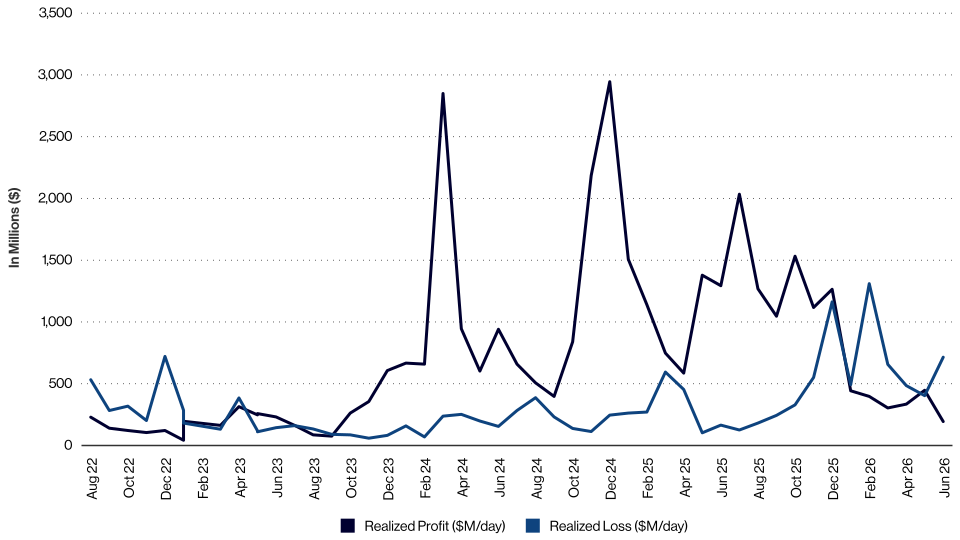
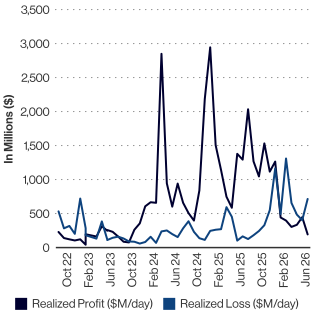
Realized Losses Exceed Realized Profits by $54B in 2026
Source: Glassnode as of 6/15/2026. Past performance is not a guarantee of future results. Not intended as a recommendation to buy or sell any securities named herein.
Crucially, holders are not taking profit but instead capitulating to sell their coins at a loss. Daily realized profit collapsed -57% m/m to a 30-day average of $194M (13th percentile of the past four years) versus $447M the prior period, while realized losses jumped +78% to $714M from $402M. The realized profit/loss ratio (RPLR) fell below 1.0, dropping from 1.11 in the previous 30-day period to 0.27 in the last 30 days, meaning more value is being locked in at a loss than at a gain. Stepping back, the average ratio of the past two years is 2.2x. Unrealized losses as a share of market cap nearly doubled, up +88% m/m to roughly 15% and now at the 79th percentile, confirming a broad, recent drawdown that pushed a large cohort of coins underwater.
On a 30-day-average basis, the realized profit/loss ratio (RPLR) works as a short-term regime signal. When it sits below 1, with losses outweighing gains, BTC has gone on to deliver below-normal returns over the following one to six months, and that underperformance holds up as statistically significant. Higher readings track at or above normal, though the profit-heavy extreme is no better than average, and the apparent two to three year mean-reversion is too thin on independent cycles to trust. With RPLR 30 Day MA at 0.28 on June 14th , the tape is loss-leaning and historically points to sub-par returns over the next quarter or two. Though weaker statistically, returns over the next year or more tend to be above average.
Median Forward Return By 30-Day Ma RPLR Regime
| RPLR regime | Days (n) | 1-month | 3-month | 6-month | 12-month | 24-month | 36-month |
| <0.5 (loss-dominated) | 1039 | +2.9% | +4.7% | +36.5% | +102.7% | +484.7% | +1188.4% |
| 0.5–1 | 845 | +1.3% | +3.3% | (6.4%) | +40.6% | +141.9% | +399.9% |
| 1–2 | 1049 | +4.2% | +17.0% | +38.6% | +95.2% | +222.2% | +186.6% |
| 2–5 | 1546 | +3.3% | +15.3% | +49.5% | +156.1% | +264.9% | +295.1% |
| >5 (profit-dominated) | 1331 | +7.0% | +44.3% | +42.7% | +77.5% | +83.0% | +129.2% |
| All days (normal) | 5810 | +3.6% | +14.3% | +38.1% | +95.2% | +225.9% | +399.9% |
Source: Glassnode as of 6/15/2026. Past performance is not a guarantee of future results. Not intended as a recommendation to buy or sell any securities named herein.
Options Market Turns Defensive as Put Premiums Climb
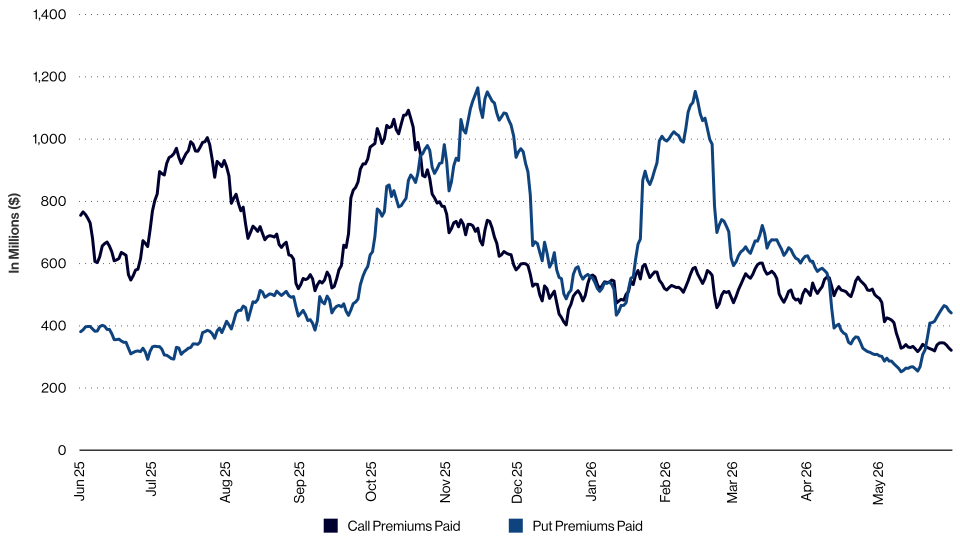
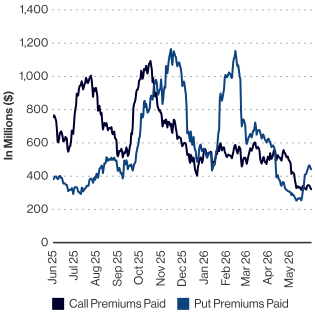
BTC Put Premiums Paid +46% m/m, +14% y/y; Call/Put Ratio Flipped to 0.73 (10th Percentile)
Source: Glassnode as of 6/15/2026. Past performance is not a guarantee of future results. Not intended as a recommendation to buy or sell any securities named herein.
The options complex flipped sharply defensive over the last 30 days as BTC's ~10% slide pulled hedging demand back into downside protection. Put premiums paid surged +46% m/m to $441.3M while call premiums fell -34% to $321.3M, swinging the Call/Put premium ratio from 1.61 to 0.73 (10th all-time percentile). Put premium paid now sits at the 82nd percentile which is a near mirror image of last month's call-led positioning. Open interest eased modestly but stayed structurally high, with total open interest (OI) down -3.4% m/m to $34.2B and still at the 84th percentile.
Implied volatility remains historically cheap outright, yet the buying is currently concentrated on the put side. 1-month call implied volatility (IV) barely moved at 36.6% ( 4th percentile in BTC's history) and remains pinned near multi-year lows. Meanwhile, 1-month Put IV rose +2.3 percentage points to 46.5%. The result is steepening skew: the 1-month put/call differential widened to +9.9 percentage points from +7.0 a month earlier (80th percentile).
What Onchain Data Says About Bitcoin Holder Behavior
| Relative Turnover (% of Supply/Median Turnover as a % of Supply) | |||||||
| Period End | Start Date | 1y_2y | 2y_3y | 3y_5y | 5y_7y | 7y_10y | more_10y |
| 2026-06-14 | 2026-05-16 | 1.18x | 1.83x | 0.93x | 0.71x | 1.35x | 1.76x |
| 2026-05-15 | 2026-04-16 | 0.77x | 0.79x | 0.68x | 1.11x | 1.26x | 1.03x |
| 2026-04-15 | 2026-03-17 | 0.95x | 0.97x | 0.61x | 2.18x | 0.68x | 0.51x |
| 2026-03-16 | 2026-02-15 | 1.01x | 1.38x | 1.33x | 2.16x | 1.15x | 1.18x |
| 2026-02-14 | 2026-01-16 | 0.93x | 1.03x | 0.85x | 0.78x | 0.88x | 0.51x |
| 2026-01-15 | 2025-12-17 | 1.47x | 2.74x | 1.54x | 0.87x | 1.51x | 1.20x |
| 2025-12-16 | 2025-11-17 | 1.28x | 1.62x | 1.19x | 1.00x | 1.42x | 0.91x |
| 2025-11-16 | 2025-10-18 | 0.76x | 1.31x | 0.93x | 0.77x | 0.72x | 1.00x |
| 2025-10-17 | 2025-09-18 | 0.70x | 1.25x | 1.30x | 1.64x | 1.34x | 1.04x |
| 2025-09-17 | 2025-08-19 | 0.76x | 0.84x | 1.35x | 0.94x | 1.99x | 1.56x |
| 2025-08-18 | 2025-07-20 | 1.09x | 1.09x | 1.13x | 2.18x | 1.49x | 14.26x |
| 2025-07-19 | 2025-06-20 | 1.23x | 0.73x | 0.72x | 0.89x | 1.01x | 0.54x |
Source: Glassnode as of 6/15/2026. Past performance is not a guarantee of future results. Not intended as a recommendation to buy or sell any securities named herein.
Token transfer volumes or “token spend” cooled m/m but was still elevated compared to last year’s totals. Over the 30 days ending on June 14, 2026, spent volume eased -5.2% m/m to 22.2M BTC while holding +21.6% y/y. The pullback was sharper among older coins, with spend from BTC held longer than a year down -10.8% m/m to 1.55M BTC.
Turnover, measured as 30-day spend divided by coins held, cooled across most aged cohorts m/m and fell hardest in 2y-3y (-51%), with 7y-10y and 10y+ both lighter by roughly -6%. The lone exception was 5y-7y, which firmed +7% m/m. The y/y spend volume is elevated on the longer end and led by 10y+ (+194%), 2y-3y ( +39%), 3y-5y (+34%) and 7y-10y (+26%), even as 1y-2y (-22%) and 5y-7y (-38%) cooled.
The more interesting story is in the aging. Total holdings aged over a year sat near 12.31M BTC, or 61.4% of circulating supply, up +2.3% m/m but effectively flat y/y (-0.4%). Coins maturing into older cohorts were led by 1y-2y (+9.9% m/m, fed by a 6m-12m maturing wave that added +31% m/m) and 5y-7y (+4.9%), while 2y-3y and 3y-5y slipped -10bps and -2.3% m/m. The standout is 3y-5y, where holdings have fallen -30.7% y/y and now sit -22.7% below the cohort's 4-year moving average. What matters is the composition of that decline rather than the headline figure: over the trailing year the band took in 6.41M BTC crossing the 3-year line, lost 3.99M aging up into 5y-7y, and shed 3.31M to transfers, so of every coin that left, roughly 55% matured higher while only 45% was actually spent.
| Cohort | Balance 1 Year Ago | Balance Today | Balance change (Δ) | Aged In | Aged Out | Spent Volume (Transferred) | Aged-out % of outflow | Transferred % of outflow |
| 1y-2y | 1,961,064 | 2,572,092 | 611,028 | 19,138,265 | 9,644,615 | 8,882,622 | 52.1% | 47.9% |
| 2y-3y | 1,440,152 | 1,119,005 | (321,147) | 9,644,615 | 6,412,362 | 3,553,400 | 64.3% | 35.7% |
| 3y-5y | 2,861,174 | 1,968,482 | (892,692) | 6,412,362 | 3,991,721 | 3,313,333 | 54.6% | 45.4% |
| 5y-7y | 1,087,347 | 1,454,142 | 366,796 | 3,991,721 | 2,204,887 | 1,420,039 | 60.8% | 39.2% |
| 7y-10y | 1,600,733 | 1,674,990 | 74,257 | 2,204,887 | 872,702 | 1,257,927 | 41.0% | 59.0% |
| 10y+ | 3,398,564 | 3,524,392 | 125,829 | 872,702 | 0 | 746,874 | 0.0% | 100.0% |
Source: Glassnode as of 6/15/2026. Past performance is not a guarantee of future results. Not intended as a recommendation to buy or sell any securities named herein.
Bitcoin Miners Under Pressure as Daily Revenue Stays Depressed
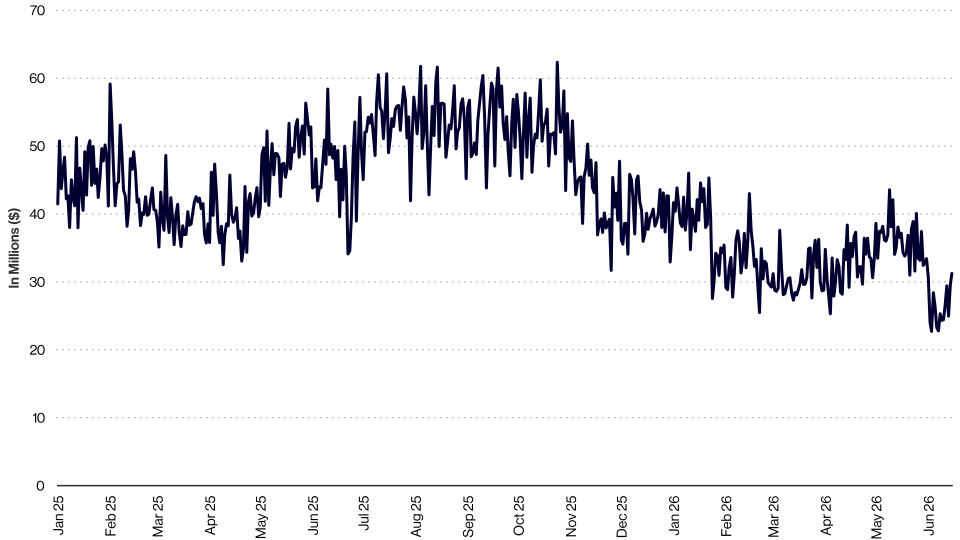
Daily Miner Revenues -26% y/y
Source: Glassnode as of 6/15/2026. Past performance is not a guarantee of future results. Not intended as a recommendation to buy or sell any securities named herein.
Aggregate onchain miner balances have ground lower as total BTC held in miner addresses sits near 1.78M BTC. While this figure is roughly flat y/y and m/m, it is down from about 1.83M in early 2023, leaving the current level around the 37th percentile of its since-2023 range. Going against the grain of Bitcoin miners selling BTC to fund AI buildouts, Marathon bought 1,000 BTC worth $66M on June 16, 2026 after selling 20,880 BTC in Q1 at an average price of $70.1K. Still, the data suggests that most miners are selling newly mined BTC to pay for operations amid the price slump.
May 2026 miner revenue of about $1.12B was down roughly -26% y/y (April was down about -18% y/y), and on a daily basis current revenue sits at only the 17th percentile of the last twelve months and the 37th percentile since 2023. The combination of slowly bleeding balances and revenue stuck in the lower third of its recent range underlines why miners are leaning on BTC sales and AI/HPC diversification to support cash flow.
Miners Pivot to AI: IREN and TeraWulf Expand Compute Capacity
- On May 26 IREN signed a $1.6B purchase agreement with Dell for Blackwell systems to service its $3.4B managed AI cloud contract, with commissioning targeted for early 2027 at its Childress, Texas campus and management guiding annualized run-rate revenue from roughly $3.7B to $4.4B.
- On May 26 TeraWulf added the 285-acre Muskie Data Campus in eastern Kentucky, a site it expects to support more than 1GW of AI and HPC load.
Frequently Asked Questions
Why did bitcoin sell off in the first half of June 2026?
Bitcoin’s 30-day average price slipped to roughly $70,321, down -10.3% m/m, as US spot bitcoin ETFs recorded a cumulative ~$5.0B in net outflows across 19 of the last 22 trading sessions. The pressure was concentrated in spot products rather than derivatives, which points to investors trimming exposure rather than simply hedging.
What does the realized profit/loss ratio (RPLR) tell investors?
The RPLR compares the dollar value of coins moved at a gain versus those moved at a loss over a given period. As realized losses rose and realized profit fell, the ratio dropped below 1.0, a level that has historically coincided with capitulation rather than profit-taking and has been associated with below-normal forward returns over the following one to six months.
Why are bitcoin miners selling BTC and expanding into AI?
With May 2026 miner revenue down -26% y/y to about $1.12B and daily revenue near the 37th percentile of its since-2023 range, many miners are selling newly mined BTC to cover operating costs during the price slump. Several operators, such as IREN and TeraWulf, are also repurposing power and data-center capacity for AI and high-performance computing to diversify cash flow.
To receive more Digital Assets insights, sign up in our subscription center.


Important Disclosures
Definitions
Bitcoin (BTC): a decentralized digital currency that operates on a peer-to-peer network without a central authority, with transactions recorded on a public blockchain.
Net Unrealized Profit/Loss (NUPL): an onchain metric that estimates the aggregate paper profit or loss across all bitcoin holders by comparing the current price to the price at which coins last moved.
Realized Profit/Loss Ratio (RPLR): a measure comparing the total value of coins sold at a profit to those sold at a loss over a given period; readings below 1.0 indicate that realized losses exceed realized profits.
Index performance is not representative of fund performance. It is not possible to invest directly in an index.
Risk Considerations
This is not an offer to buy or sell, or a recommendation to buy or sell any of the securities, financial instruments or digital assets mentioned herein. The information presented does not involve the rendering of personalized investment, financial, legal, tax advice, or any call to action. Certain statements contained herein may constitute projections, forecasts and other forward-looking statements, which do not reflect actual results, are for illustrative purposes only, are valid as of the date of this communication, and are subject to change without notice. Actual future performance of any assets or industries mentioned are unknown. Information provided by third party sources are believed to be reliable and have not been independently verified for accuracy or completeness and cannot be guaranteed.
Investments in digital assets and Web3 companies are highly speculative and involve a high degree of risk. These risks include, but are not limited to: the technology is new and many of its uses may be untested; intense competition; slow adoption rates and the potential for product obsolescence; volatility and limited liquidity, including but not limited to, inability to liquidate a position; loss or destruction of key(s) to access accounts or the blockchain; reliance on digital wallets; reliance on unregulated markets and exchanges; reliance on the internet; cybersecurity risks; and the lack of regulation and the potential for new laws and regulation that may be difficult to predict. Moreover, the extent to which Web3 companies or digital assets utilize blockchain technology may vary, and it is possible that even widespread adoption of blockchain technology may not result in a material increase in the value of such companies or digital assets.
Digital asset prices are highly volatile, and the value of digital assets, and Web3 companies, can rise or fall dramatically and quickly. If their value goes down, there’s no guarantee that it will rise again. As a result, there is a significant risk of loss of your entire principal investment.
Digital assets are not covered by FDIC or SIPC insurance.
Digital assets are digital representations of value that function as mediums of exchange, units of account, or stores of value, but they do not have legal tender status. Digital assets are sometimes exchanged for U.S. dollars or other currencies around the world, but they are generally not backed or supported by any government or central bank.
Web3 companies include but are not limited to, companies that involve the development, innovation, and/or utilization of blockchain, digital assets, or crypto technologies.
All investing is subject to risk, including the possible loss of the money you invest. As with any investment strategy, there is no guarantee that investment objectives will be met and investors may lose money. Diversification does not ensure a profit or protect against a loss in a declining market. Past performance is no guarantee of future performance.
© Van Eck Associates Corporation
Important Disclosures
Definitions
Bitcoin (BTC): a decentralized digital currency that operates on a peer-to-peer network without a central authority, with transactions recorded on a public blockchain.
Net Unrealized Profit/Loss (NUPL): an onchain metric that estimates the aggregate paper profit or loss across all bitcoin holders by comparing the current price to the price at which coins last moved.
Realized Profit/Loss Ratio (RPLR): a measure comparing the total value of coins sold at a profit to those sold at a loss over a given period; readings below 1.0 indicate that realized losses exceed realized profits.
Index performance is not representative of fund performance. It is not possible to invest directly in an index.
Risk Considerations
This is not an offer to buy or sell, or a recommendation to buy or sell any of the securities, financial instruments or digital assets mentioned herein. The information presented does not involve the rendering of personalized investment, financial, legal, tax advice, or any call to action. Certain statements contained herein may constitute projections, forecasts and other forward-looking statements, which do not reflect actual results, are for illustrative purposes only, are valid as of the date of this communication, and are subject to change without notice. Actual future performance of any assets or industries mentioned are unknown. Information provided by third party sources are believed to be reliable and have not been independently verified for accuracy or completeness and cannot be guaranteed.
Investments in digital assets and Web3 companies are highly speculative and involve a high degree of risk. These risks include, but are not limited to: the technology is new and many of its uses may be untested; intense competition; slow adoption rates and the potential for product obsolescence; volatility and limited liquidity, including but not limited to, inability to liquidate a position; loss or destruction of key(s) to access accounts or the blockchain; reliance on digital wallets; reliance on unregulated markets and exchanges; reliance on the internet; cybersecurity risks; and the lack of regulation and the potential for new laws and regulation that may be difficult to predict. Moreover, the extent to which Web3 companies or digital assets utilize blockchain technology may vary, and it is possible that even widespread adoption of blockchain technology may not result in a material increase in the value of such companies or digital assets.
Digital asset prices are highly volatile, and the value of digital assets, and Web3 companies, can rise or fall dramatically and quickly. If their value goes down, there’s no guarantee that it will rise again. As a result, there is a significant risk of loss of your entire principal investment.
Digital assets are not covered by FDIC or SIPC insurance.
Digital assets are digital representations of value that function as mediums of exchange, units of account, or stores of value, but they do not have legal tender status. Digital assets are sometimes exchanged for U.S. dollars or other currencies around the world, but they are generally not backed or supported by any government or central bank.
Web3 companies include but are not limited to, companies that involve the development, innovation, and/or utilization of blockchain, digital assets, or crypto technologies.
All investing is subject to risk, including the possible loss of the money you invest. As with any investment strategy, there is no guarantee that investment objectives will be met and investors may lose money. Diversification does not ensure a profit or protect against a loss in a declining market. Past performance is no guarantee of future performance.
© Van Eck Associates Corporation