Beyond TIPS: The Case for EM Inflation-Linked Bonds
November 03, 2026
Read Time 7 MIN
Key Takeaways
- ILBs adjust principal with local inflation, so the real yield is known at purchase if held to maturity.
- EM ILBs have historically paid higher real yields than U.S. TIPS, reflecting structural features of EM economies.
- A central bank credibility premium and a higher neutral rate help explain why EM real yields have stayed elevated.
- Historically low correlation to the dollar and other inflation hedges points to potential diversification benefits.
Inflation has proven to be a global phenomenon over the last six years. Though the effects are felt at the gas pump and the supermarket, the drivers of higher prices often occur far away and impact the entire world. Supply shocks from the global pandemic, conflicts in commodity producing regions, extreme weather events and expansionary fiscal policy across developed markets have all contributed to higher prices around the world. We believe these types of drivers will continue and that inflationary pressures will persist, requiring investors to focus on inflation-adjusted returns.
For income-focused investors this poses a particular challenge, as most bonds pay a fixed coupon whose value is eroded as inflation increases. A portfolio that includes emerging markets (EM) inflation linked bonds (ILBs) provides a potential solution that recognizes the global nature of inflation and can generate significant income. The VanEck EM Focus Inflation Bond ETF (EMIL) offers access to this asset class in a single fund.
How Do Inflation Linked Bonds Work?
An ILB’s principal rises with local inflation, and the bond pays a fixed interest rate, or a real coupon, on that principal. For example, consider an ILB with a 3% real coupon. If inflation is 3%, the principal amount increases from 100 to 103 and the coupon is paid on 103 (3% of 103 = 3.09). For more on how ILBs work, read A Guide to Inflation Linked Bonds. For illustrative purposes only. Not a projection of future results.
To compare ILBs with other bonds, investors can add local inflation to the real yield, which gives a “nominal equivalent” yield. On this basis, EM-focused ILBs currently yield more than the other fixed income sectors, as shown below, reflecting a combination of high real rates and local inflation. EM ILBs also carry currency risk as well as other risks associated with emerging markets. However, we believe the case for EM debt is currently strong, supported by responsible policies and strong fundamentals, as we have written about here: The Case for Emerging Markets Debt.
EM ILBs Offer Higher Yields vs. Other Fixed Income Sectors
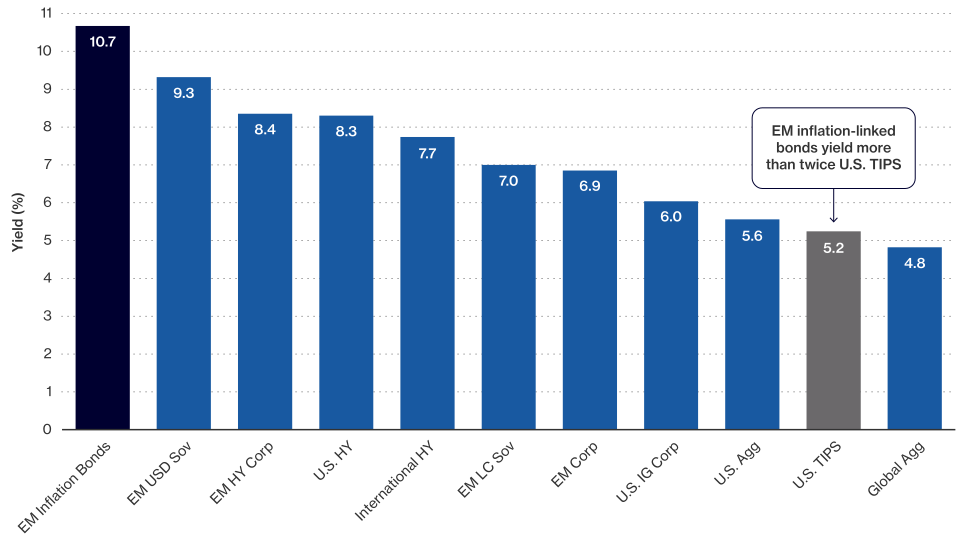

Source: FTSE, J.P. Morgan, ICE Data Indices, LLC. Data as of 9/30/2026. EM Inflation Bonds and US TIPS yield represents a nominal equivalent yield based on current inflation and real yield; other asset class yields are yield to worst. EM Inflation Bonds are represented by the FTSE Emerging Markets Focused International Inflation-Linked Securities Index. EM USD Sov is represented by the JPM EMBI Global Diversified Index. EM HY Corp is represented by the ICE BofA Diversified HY US Emerging Markets Corporate Plus Index. US HY is represented by the ICE BofA US High Yield Index. International High Yield is represented by the ICE BofA Global Ex-US Issuers High Yield Constrained Index. EM LC Sov is represented by the J.P. Morgan GBIEM Global Diversified Index. EM Corp is represented by the ICE BofA EM Diversified Corporate Index. US IG Corp is represented by the ICE BofA US Corporate Index. US Agg is represented by the ICE BofA US Broad Market Index. US TIPS is represented by the FTSE US TIPS Index. Global Agg is represented by the ICE BofA Global Broad Market Plus Index. Past performance is no guarantee of future results. Index performance is not representative of fund performance. It is not possible to invest directly in an index.
A conventional fixed-coupon, or “nominal”, bond works differently because its return is stated before inflation. Assume the same issuer sells a nominal bond at 5%, which prices in expected inflation of about 2%. If realized inflation is 3%, the investor earns only about 1.9% after inflation (1.05 / 1.03 − 1 = 1.9%), versus 3% on the ILB. For illustrative purposes only. Not a projection of future results. With continued inflationary pressure, ILBs can help hedge these upside surprises because the real yield is set at purchase, whereas a nominal bond specifies a pre-inflation return.
Why Look Outside the U.S. for Inflation Hedges?
Many U.S. investors look to Treasury Inflation Protected Securities, or TIPS, to lock in inflation adjusted income. TIPS can be part of a diversified solution, but real yields have historically been significantly higher in emerging markets than in the U.S. At nearly $2.7 trillion in size, the non-U.S. ILB market is significantly larger than the U.S. TIPS market. In particular, EM sovereign ILBs have historically paid a higher real yield than TIPS, and we believe investors looking to hedge inflation risks should not overlook this asset class.
Structurally Higher Real Yields in EM vs. U.S. TIPS

Source: FTSE as of 9/30/2026. EM reflects the real yield of the FTSE Emerging Markets Inflation-Linked Securities Index; U.S. reflects the real yield of FTSE US Inflation-Linked Securities Index. Past performance is no guarantee of future results. Index performance is not representative of fund performance. It is not possible to invest directly in an index.
EM ILBs currently offer a real yield of 5.8%, compared to 2.7% on U.S. TIPS, despite the recent run-up in U.S. real rates. Over the past decade, EM ILBs have provided an average real yield pickup of 3.5 points over U.S. TIPS, indicating structurally higher real rates in EM. There are several reasons for this.
First, investors in emerging markets demand a “credibility premium”, or extra yield to compensate for a shorter policy track record. Crises from the 1980s to the early 2000s tested the independence of emerging market central banks, and their track record of credible policy remains shorter than that of developed markets. As a result, EM central banks have had to prove their commitment to fighting inflation, often raising policy rates ahead of inflation threats and keeping them higher for longer.
During the COVID-19 pandemic, for example, many EM central banks hiked early while several developed market central banks fell behind the curve. Developed markets have historically had more leeway to keep rates low, whereas EM central banks must maintain relatively high real rates to protect currency stability, despite the independence and vigilance they have demonstrated. We believe the premium is structural and will persist as long as EM institutional frameworks remain relatively younger and more volatile than those in developed markets (DM). ILB investors may capture this premium directly through a higher real yield.
Second, the “neutral” rate of interest, or “r*”, which is the theoretical real policy rate consistent with stable inflation and output at potential, is generally assumed to be higher in emerging markets than in developed markets. Higher potential growth, scarcer capital and younger demographics result in higher household demand relative to savings, and we do not expect these differences to converge in the near or medium term. A higher real term premium may also be plausible in EM, given greater policy uncertainty and smaller domestic investor bases for government debt. EM real yields therefore reflect a structurally higher, though unobservable r*, plus the credibility premium and a term premium.
Recommended subscription
EMIL | VanEck EM Focus Inflation Bond ETF
How EM ILBs Fit Within a Portfolio
In addition to providing investors with a hedge against global inflation and exposure to higher real yields outside the U.S., EM-focused ILBs provide a diversified return stream that is distinct from other global fixed income, including other segments of emerging markets debt. Because the bonds are denominated in the local currencies of the issuer, correlation to the U.S. dollar has historically been strongly negative (-0.55 over the past decade based on monthly returns, as of 9/30/2026) and low versus U.S. core fixed income (0.26 against the U.S. broad market and 0.08 against U.S. Treasuries).
Correlations are also low against other inflation hedges, such as U.S. TIPS (0.29), gold (0.35) and commodities (0.42), suggesting diversification potential for EM ILBs in a broader portfolio focused on attractive real returns1. Unlike gold and commodities, EM ILBs may generate income.
Further, EM-focused ILBs can provide differentiated performance versus nominal EM local sovereign bonds in some periods of EM currency weakness. When EM currency depreciates because of a significant increase in inflation, as in 2022, higher principal adjustments help cushion the currency impact, alongside high real rates.
For example, between January 2021 and October 2022, nominal EM local currency sovereign bonds declined 26%, and EM ILBs declined 7%2. Although there are compositional differences between these markets, as not every country that issues nominal bonds issues ILBs, the divergence is clear. Because EM currency weakness can itself drive inflation, we believe this is an attractive feature. When EM currency depreciates for other reasons, such as macroeconomic concerns, capital flight, a political crisis or a global growth shock, ILBs may not outperform to the same extent. For example, in periods of EM currency weakness before the 2022 drawdown, EM ILBs performed more in line with nominal peers.
The investment case for EM-focused ILBs does not depend on inflation staying high. The real yield premium reflects persistent differences in neutral rates, term premia and institutional credibility between EM and DM, and has historically been present across a range of inflation environments. Current inflationary conditions may enhance near term returns, but we believe the durability of the case rests on structural factors independent of the inflation cycle.
How Can Investors Access EM ILBs?
The VanEck EM Focus Inflation Bond ETF (EMIL) tracks the FTSE Emerging Markets Focused International Inflation-Linked Securities Index. The index is comprised of non-U.S. inflation linked bonds and is designed to concentrate at least 65% of its holdings in ILBs of emerging markets issuers.

Important Disclosure
1Source: Morningstar Direct as of 9/30/2026. EM ILB represented by FTSE Emerging Markets Inflation-Linked Securities Index; U.S. dollar represented by the U.S. Dollar Index; U.S. core fixed income represented by ICE BofA US Broad Market Index; U.S. Treasuries represented by ICE BofA US Treasury Index; U.S. TIPS represented by ICE BofA US Treasury Inflation Linked Bond Index; gold represented by LBMA Gold Price; commodities represented by Bloomberg Commodity Index.
2Source: Morningstar Direct as of 9/30/2026. Nominal EM local bonds represented by J.P. Morgan GBI-EM Global Diversified Index; EM ILBs represented by FTSE Emerging Markets Inflation-Linked Securities Index
Index Definitions
FTSE EM Inflation-Linked Securities Index measures the returns of inflation-linked bonds with fixed-rate coupon payments that are linked to an inflation index.
FTSE Emerging Markets Focused International Inflation-Linked Securities Index: measures the performance of a diversified basket of inflation-linked bonds issued outside the United States, and is designed to concentrate at least 65% in emerging markets issuers.
FTSE US Inflation-Linked Securities Index (USILSI): measures the returns of Treasury Inflation-Protected Securities (TIPS) with fixed-rate coupon payments that are linked to the CPI, published by the US Department of Labor, Bureau of Labor Statistics.
ICE BofA Diversified High Yield US Emerging Markets Corporate Plus Index: is comprised of U.S. dollar-denominated bonds issued by non-sovereign emerging markets issuers that are rated below investment grade and that are issued in the major domestic and Eurobond markets.
ICE BofA Emerging Markets Diversified Corporate Index tracks the performance of US dollar denominated emerging markets corporate senior and secured debt publicly issued in the US domestic and eurobond markets.
ICE BofA Global Broad Market Plus Index: tracks the performance of investment grade debt publicly issued in the major domestic and eurobond markets, including sovereign, quasi-government, corporate, securitized and collateralized securities.
ICE BofA Global Ex-US Issuers High Yield Constrained Index tracks the performance of USD, CAD, GBP and EUR denominated below investment grade corporate debt publicly issued by non-US corporations in the major domestic or eurobond markets.
ICE BofA US High Yield Index is comprised of below-investment grade corporate bonds (based on an average of Moody's, S&P and Fitch) denominated in U.S. dollars. The country of risk of qualifying issuers must be an FX-G10 member, a Western European nation, or a territory of the U.S. or a Western European nation.
ICE BofA US Corporate Bond Index: tracks the performance of US dollar denominated investment grade rated corporate debt publicly issued in the US domestic market.
ICE BofA US Broad Market Index: tracks the performance of US dollar denominated investment grade debt publicly issued in the US domestic market, including US Treasury, quasi-government, corporate, securitized and collateralized securities.
J.P. Morgan EMBI Global Diversified Index: is comprised of U.S. dollar-denominated Brady bonds, Eurobonds, and traded loans issued by emerging markets sovereign and quasi-sovereign entities. The index weighting methodology limits the weight of countries with larger debt stocks.
J.P. Morgan GBI-EM Global Diversified Index: tracks local currency denominated EM government debt. The index weighting methodology limits the weight of countries with larger debt stocks.
LBMA Gold Price: The LBMA Gold Price is the twice-daily benchmark price for gold set through an electronic auction in London.
Bloomberg Commodity Index is a broadly diversified financial benchmark that tracks the performance of a basket of physical commodity futures contracts.
Risk Considerations
This is not an offer to buy or sell, or a recommendation to buy or sell any of the securities, financial instruments or digital assets mentioned herein. The information presented does not involve the rendering of personalized investment, financial, legal, tax advice, or any call to action. Certain statements contained herein may constitute projections, forecasts and other forward-looking statements, which do not reflect actual results, are for illustrative purposes only, are valid as of the date of this communication, and are subject to change without notice. Actual future performance of any assets or industries mentioned are unknown. Information provided by third party sources are believed to be reliable and have not been independently verified for accuracy or completeness and cannot be guaranteed. VanEck does not guarantee the accuracy of third party data. The information herein represents the opinion of the author(s), but not necessarily those of VanEck or its other employees.
Index returns are not Fund returns and do not reflect any management fees or brokerage expenses. Certain indices may take into account withholding taxes. Investors cannot invest directly in the Index. Returns for actual Fund investors may differ from what is shown because of differences in timing, the amount invested and fees and expenses. Index returns assume that dividends have been reinvested.
An investment in the VanEck EM Focus Inflation Bond ETF may be subject to risks which include, among others, risks related to inflation-linked bonds, debt securities, credit, foreign securities, emerging market issuers, high yield securities, foreign currency, interest rate, sovereign bond, liquidity, restricted securities, market, sampling, operational, index tracking, authorized participant concentration, new fund, no guarantee of active trading market, trading issues, passive management, fund shares trading, premium/discount and liquidity of fund shares, non-diversified, index-related concentration, and cash transactions risks, all of which may adversely affect the Fund. Emerging market issuers and foreign securities may be subject to securities markets, political and economic, investment and repatriation restrictions, different rules and regulations, less publicly available financial information, foreign currency and exchange rates, operational and settlement, and corporate and securities laws risks. Special risk considerations apply to investing in Brazilian, European, Latin American, and Mexican issuers.
Investing involves substantial risk and high volatility, including possible loss of principal. An investor should consider the investment objective, risks, charges and expenses of the Fund carefully before investing. To obtain a prospectus and summary prospectus, which contains this and other information, call 800.826.2333 or visit vaneck.com. Please read the prospectus and summary prospectus carefully before investing.
© Van Eck Securities Corporation, Distributor, a wholly owned subsidiary of Van Eck Associates Corporation.
Related Funds
Important Disclosure
1Source: Morningstar Direct as of 9/30/2026. EM ILB represented by FTSE Emerging Markets Inflation-Linked Securities Index; U.S. dollar represented by the U.S. Dollar Index; U.S. core fixed income represented by ICE BofA US Broad Market Index; U.S. Treasuries represented by ICE BofA US Treasury Index; U.S. TIPS represented by ICE BofA US Treasury Inflation Linked Bond Index; gold represented by LBMA Gold Price; commodities represented by Bloomberg Commodity Index.
2Source: Morningstar Direct as of 9/30/2026. Nominal EM local bonds represented by J.P. Morgan GBI-EM Global Diversified Index; EM ILBs represented by FTSE Emerging Markets Inflation-Linked Securities Index
Index Definitions
FTSE EM Inflation-Linked Securities Index measures the returns of inflation-linked bonds with fixed-rate coupon payments that are linked to an inflation index.
FTSE Emerging Markets Focused International Inflation-Linked Securities Index: measures the performance of a diversified basket of inflation-linked bonds issued outside the United States, and is designed to concentrate at least 65% in emerging markets issuers.
FTSE US Inflation-Linked Securities Index (USILSI): measures the returns of Treasury Inflation-Protected Securities (TIPS) with fixed-rate coupon payments that are linked to the CPI, published by the US Department of Labor, Bureau of Labor Statistics.
ICE BofA Diversified High Yield US Emerging Markets Corporate Plus Index: is comprised of U.S. dollar-denominated bonds issued by non-sovereign emerging markets issuers that are rated below investment grade and that are issued in the major domestic and Eurobond markets.
ICE BofA Emerging Markets Diversified Corporate Index tracks the performance of US dollar denominated emerging markets corporate senior and secured debt publicly issued in the US domestic and eurobond markets.
ICE BofA Global Broad Market Plus Index: tracks the performance of investment grade debt publicly issued in the major domestic and eurobond markets, including sovereign, quasi-government, corporate, securitized and collateralized securities.
ICE BofA Global Ex-US Issuers High Yield Constrained Index tracks the performance of USD, CAD, GBP and EUR denominated below investment grade corporate debt publicly issued by non-US corporations in the major domestic or eurobond markets.
ICE BofA US High Yield Index is comprised of below-investment grade corporate bonds (based on an average of Moody's, S&P and Fitch) denominated in U.S. dollars. The country of risk of qualifying issuers must be an FX-G10 member, a Western European nation, or a territory of the U.S. or a Western European nation.
ICE BofA US Corporate Bond Index: tracks the performance of US dollar denominated investment grade rated corporate debt publicly issued in the US domestic market.
ICE BofA US Broad Market Index: tracks the performance of US dollar denominated investment grade debt publicly issued in the US domestic market, including US Treasury, quasi-government, corporate, securitized and collateralized securities.
J.P. Morgan EMBI Global Diversified Index: is comprised of U.S. dollar-denominated Brady bonds, Eurobonds, and traded loans issued by emerging markets sovereign and quasi-sovereign entities. The index weighting methodology limits the weight of countries with larger debt stocks.
J.P. Morgan GBI-EM Global Diversified Index: tracks local currency denominated EM government debt. The index weighting methodology limits the weight of countries with larger debt stocks.
LBMA Gold Price: The LBMA Gold Price is the twice-daily benchmark price for gold set through an electronic auction in London.
Bloomberg Commodity Index is a broadly diversified financial benchmark that tracks the performance of a basket of physical commodity futures contracts.
Risk Considerations
This is not an offer to buy or sell, or a recommendation to buy or sell any of the securities, financial instruments or digital assets mentioned herein. The information presented does not involve the rendering of personalized investment, financial, legal, tax advice, or any call to action. Certain statements contained herein may constitute projections, forecasts and other forward-looking statements, which do not reflect actual results, are for illustrative purposes only, are valid as of the date of this communication, and are subject to change without notice. Actual future performance of any assets or industries mentioned are unknown. Information provided by third party sources are believed to be reliable and have not been independently verified for accuracy or completeness and cannot be guaranteed. VanEck does not guarantee the accuracy of third party data. The information herein represents the opinion of the author(s), but not necessarily those of VanEck or its other employees.
Index returns are not Fund returns and do not reflect any management fees or brokerage expenses. Certain indices may take into account withholding taxes. Investors cannot invest directly in the Index. Returns for actual Fund investors may differ from what is shown because of differences in timing, the amount invested and fees and expenses. Index returns assume that dividends have been reinvested.
An investment in the VanEck EM Focus Inflation Bond ETF may be subject to risks which include, among others, risks related to inflation-linked bonds, debt securities, credit, foreign securities, emerging market issuers, high yield securities, foreign currency, interest rate, sovereign bond, liquidity, restricted securities, market, sampling, operational, index tracking, authorized participant concentration, new fund, no guarantee of active trading market, trading issues, passive management, fund shares trading, premium/discount and liquidity of fund shares, non-diversified, index-related concentration, and cash transactions risks, all of which may adversely affect the Fund. Emerging market issuers and foreign securities may be subject to securities markets, political and economic, investment and repatriation restrictions, different rules and regulations, less publicly available financial information, foreign currency and exchange rates, operational and settlement, and corporate and securities laws risks. Special risk considerations apply to investing in Brazilian, European, Latin American, and Mexican issuers.
Investing involves substantial risk and high volatility, including possible loss of principal. An investor should consider the investment objective, risks, charges and expenses of the Fund carefully before investing. To obtain a prospectus and summary prospectus, which contains this and other information, call 800.826.2333 or visit vaneck.com. Please read the prospectus and summary prospectus carefully before investing.
© Van Eck Securities Corporation, Distributor, a wholly owned subsidiary of Van Eck Associates Corporation.