EM Bonds Outshine DM as Fundamentals Drive Stability
December 10, 2025
Read Time 7 MIN
Key Takeaways:
- EMBX continued to outperform in 2025, supported by strong country selection and disciplined positioning.
- EM assets acted like defensive havens despite global equity volatility, with Korea exemplifying EM “graduates” showing resilience.
- Fiscal dominance remains a DM problem, as Japan’s market dynamics diverge sharply from stronger-positioned EM countries.
The VanEck Emerging Markets Bond ETF (EMBX) was up 0.79% in November, compared to 0.83% for its benchmark. Year to date, EMBX is up 17.38%, compared to 15.47% for its benchmark, the 50% J.P. Morgan Government Bond Index - Emerging Markets Global Diversified (GBI-EM) and 50% J.P. Morgan Emerging Markets Bond Index (EMBI) and 8.09% and 8.95% for the Global Agg and 10-Year Treasuries, respectively. In the past five years, EMBX has returned 4.3% per year, compared to 1.76% for its benchmark, and negative -2.29% and negative -2.31% per year for the Global Agg and 10-Year Treasuries, respectively. South Africa continued to outperform, Chile benefited from market-friendly elections, while small exposures in “frontier” Zambia local currency and Bolivia hard-currency rounded out these winners. Our underweight in Poland local led underperformers, and Uganda local also generated some underperformance. We pulled in our horns even more in November, after very strong performance. Local currency exposure is now even lower at 40%. We have no meaningful overweights in majors outside of Chile in local currency, and don’t own India local currency. Carry is 6.4%, yield to worst (YTW) is 7.4% and duration is 5.5, right near benchmark duration.
Average Annual Total Returns* (%) (In USD)
| Month End As of November 30, 2025 | 1 Mo | 3 Mo | YTD | 1 Yr | 3 Yrs | 5 Yrs | 10 Yrs |
| EMBX (NAV) | 0.79 | 3.44 | 17.38 | 15.48 | 11.39 | 4.26 | 5.13 |
| EMBX (Share Price) | 0.99 | 3.63 | 17.60 | 15.69 | 11.46 | 4.29 | 5.15 |
| 50% GBI-EM/50% EMBI | 0.83 | 3.76 | 15.47 | 13.55 | 10.11 | 1.80 | 3.89 |
| Nikkei 225 Average JPY | -5.50 | -- | 28.97 | 28.84 | 19.35 | 6.91 | 9.33 |
| KOSPI 200 KRW | -7.38 | -- | 74.49 | 61.48 | 15.67 | 3.79 | 5.97 |
| Quarter End As of September 30, 2025 | 1 Mo | 3 Mo | YTD | 1 Yr | 3 Yrs | 5 Yrs | 10 Yrs |
| EMBX (NAV) | 1.70 | 4.40 | 15.41 | 9.72 | 13.39 | 4.87 | 5.27 |
| EMBX (Share Price) | 1.70 | 4.40 | 15.41 | 9.72 | 13.39 | 4.87 | 5.27 |
| 50% GBI-EM/50% EMBI | 1.59 | 3.78 | 13.05 | 7.98 | 11.82 | 2.34 | 3.93 |
* Returns less than one year are not annualized.
The performance data quoted represents past performance. Past performance is not a guarantee of future results. Investment return and principal value of an investment will fluctuate so that an investor's shares, when redeemed, may be worth more or less than their original cost. Performance may be lower or higher than performance data quoted. Please call 800.826.2333 or visit vaneck.com for performance current to the most recent month ended.
Prior to 10/06/2025, the Fund operated as the VanEck Emerging Markets Bond mutual fund; performance shown before that date is that fund’s NAV performance (Class I, unadjusted for today’s ETF expenses).
The "Net Asset Value" (NAV) of a Fund is determined at the close of each business day, and represents the dollar value of one share of the fund; it is calculated by taking the total assets of the fund, subtracting total liabilities, and dividing by the total number of shares outstanding. The NAV is not necessarily the same as the ETF 's intraday trading value. Investors should not expect to buy or sell shares at NAV.
EMBX Total Expense Ratio – 0.76%. Van Eck Associates Corporation (the “Adviser”) will pay all expenses of the Fund, except for the fee payment under the investment management agreement, acquired fund fees and expenses, interest expense, offering costs, trading expenses, taxes and extraordinary expenses. Notwithstanding the foregoing, the Adviser has agreed to pay the offering costs until at least May 1, 2027. “Other Expenses” have been restated to reflect current fees.
EMBX | VanEck Emerging Markets Bond ETF
Emerging markets keep running the table. Despite a spike in global equity volatility associated with the AI/tech narrative challenge, EM bonds keep chugging along like defensive assets. The Kospi was an epicenter of the volatility spike, yet the Korean won (KRW) and Korean govvies rallied, and for good reasons – Korea is an EM “graduate”, like many others, particularly in Asia. EMBX has exposure to Korean government bonds and given the spike weaker in the Japanese yen (JPY) and Japanese government bonds (JGBs), we thought it might be worth a brief mention. Perhaps it’s an indulgence on the part of your PM, who has ingrained in him great worry (always good in bonds) over any developments in funding markets, particularly Japan’s. Japan was and remains an important source of “carry trade” funding. And this is always the moment where we remind investors that Japan is a poster child for our thesis of “fiscal dominance” in the DM – it makes sense for Japanese investors faced with rising interest rates and a weakening currency to seek safer harbors offshore, whether it is US tech stocks or South African government bonds. Anyhoo, when funding currencies flip, a balance sheet stock becomes a flow very quickly, thus the worry. But, Korea is one of our favorite “graduates”, characterized by net creditor status, in US dollar (USD) terms, strong positive net international investment position (NIIP), good fiscal policy, and a central bank focused on inflation. It, too, therefore, owns and funds a lot of offshore assets, but is not subject to fiscal dominance. So, how did it fare in this vol spike that your indulgent PM worried about? It fared well, due to large current account surpluses, and this despite penned-up USD selling on the part of exporters. Equally importantly the bias towards offshore assets on the part of onshore savers is a structural feature and one that is now well-established and managed. The demand for offshore assets is supported by policymakers accommodating savers in a demographic decline (you kind-of have to own companies offshore in that situation). The National Pension System (NPS) actively manages hedging policies on FX (there’s a tactical and a strategic hedge bucket, but we won’t get into that here). The bottom line is that because NPS’ foreign assets are now on the order of the country’s FX reserves, even a 10% hedge implies the capacity to supply roughly USD 30–50 billion to the FX market via derivatives or asset sales when activated, which is large relative to average daily USD/KRW turnover. You see the results of these initial conditions in the exhibit below. KRW vol spiked lower recently, due to NPS action.
Exhibit 1 – KRW Vol at Lows Despite Kospi Vol at Highs

Source: Bloomberg, as of December 3, 2025.
Is it JPY, JGB, or JOL (Japan out of luck)? Japan is the poster child for DM fiscal dominance and has an important stock of offshore assets we care about in its “carry trade”. The key meaning is that Japan is problematic, period; there’s no evidence of contagion, if anything many Asian bond markets are behaving like flight-to-quality assets, as they should. It’s only an overly worried or indulgent PM invoking risks to a “graduate” EM like Korea, when both rates and the exchange rate are weakening in Japan. And the exhibit below shows that Japan is behaving differently, however subtly, relative to Korea. In the chart below you will see that JPY vol has not had the secular decline that characterized KRW vol. Moreover, JPY vol rose a bit recently on just a very minor uptick in Nikkei vol. Thanks for your indulgence. Fiscal dominance characterizes DMs, not EMs, and the recent bout of global risk off supports this once again.
Exhibit 2 – JPY Volatility Remained Low Despite Spikes in the Nikkei
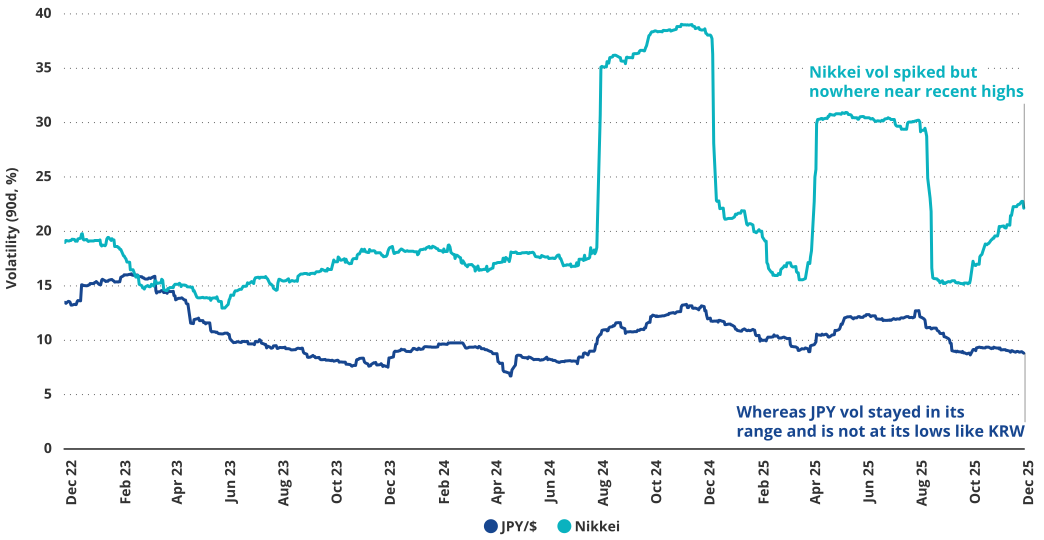
Source: Bloomberg, as of December 3, 2025.
Recommended subscription
Exposure Types and Significant Changes
The changes to our top positions are summarized below. Our largest positions in November were Brazil, Malaysia, South Africa, Thailand, and Chile:
- We increased our local currency exposure in the Czech Republic. Czech local bonds continue to look attractive vs. fundamentals and might benefit from the peak U.S. Dollar bullishness. In addition, the new government is not making any suspicious moves on the fiscal front. In terms of our investment process, this improved the policy and technical test scores for the country.
- We also increased our hard currency sovereign exposure in India, Malaysia, the Philippines, Peru, Morocco, Saudi Arabia, the United Arab Emirates, and Poland. The move reflected our intention to piggyback on global duration (which strengthened the technical test scores for the countries in question), but in some cases (Poland, Malaysia) the shift also reflected our year-end de-risking from local bonds (which posted significant year-to-date total returns).
- Finally, we increased our hard currency sovereign exposure in Laos and Bolivia. The bond in Laos was an attractively priced new issue, whereas Bolivian sovereign bonds continue to benefit from the market-friendly results of the presidential election, which improved the policy/politics test score for the country.
- We reduced our local currency exposure in Mexico, Brazil, Turkey, Uganda, and South Africa. The year-end de-risking (due to tighter liquidity) is a key reason here, especially in less liquid names like Uganda, where the impact of global moves can be amplified. Additional country-specific factors included (1) the worsening political test score in Mexico on the back of mass protests against the deteriorating domestic security situation; (2) less attractive valuations in Brazil; and (3) a limited room for rate cuts in Turkey due to rising inflation expectations (which worsened the policy test score).
- We also reduced our hard currency sovereign exposure in Argentina, Cote d’Ivoire, and Ecuador. We took profits in Argentina after the midterms rally, as there are unresolved issues related to the accumulation of international reserves and the exchange rate mechanism, which worsen the policy test score for the country. Cote d’Ivoire’s very tight spreads and less attractive valuations made it vulnerable to spillovers from a potential debt restructuring situation in Senegal, worsening the technical test score for the country. The referendum’s failure in Ecuador raised doubts about President Noboa’s ability to advance reforms, worsening the policy/politics test score for the country.
- Finally, we reduced our hard currency corporate exposure in Singapore and Hong Kong. Our focus in Singapore was on a high-yield corporate bond (with some ties to real estate in the region), which can get affected by the year-end’s tight liquidity. Regarding Hong Kong, we decided to take profits due the company’s exchange of outstanding perpetual securities.
To receive more Emerging Markets Bonds insights, sign up in our subscription center.

This is not an offer to buy or sell, or a recommendation to buy or sell any of the securities, financial instruments or digital assets mentioned herein. The information presented does not involve the rendering of personalized investment, financial, legal, tax advice, or any call to action. Certain statements contained herein may constitute projections, forecasts and other forward-looking statements, which do not reflect actual results, are for illustrative purposes only, are valid as of the date of this communication, and are subject to change without notice. Actual future performance of any assets or industries mentioned are unknown. Information provided by third party sources are believed to be reliable and have not been independently verified for accuracy or completeness and cannot be guaranteed. VanEck does not guarantee the accuracy of third party data. The information herein represents the opinion of the author(s), but not necessarily those of VanEck or its other employees.
Duration measures a bond's sensitivity to interest rate changes that reflects the change in a bond's price given a change in yield. This duration measure is appropriate for bonds with embedded options. Carry is the benefit or cost for owning an asset. Yield to worst is a measure of the lowest possible yield that can be received on a bond with an early retirement provision. Averages are market weighted. The yields presented do not represent the performance of the Fund. These statistics do not take into account fees and expenses associated with investments of the Fund.
All indices are unmanaged and include the reinvestment of all dividends, but do not reflect the payment of transaction costs, advisory fees or expenses that are associated with an investment in the Fund. Certain indices may take into account withholding taxes. An index's performance is not illustrative of the Fund's performance. Indices are not securities in which investments can be made.
The Fund's benchmark index (50% GBI-EM/50% EMBI) is a blended index consisting of 50% J.P. Morgan Government Bond Index-Emerging Markets (GBI-EM) Global Diversified and 50% J.P. Morgan Emerging Markets Bond Index (EMBI). The J.P. Morgan GBI-EM Global Diversified tracks local currency bonds issued by Emerging Markets governments. The J.P. Morgan EMBI Global Diversified tracks returns for actively traded external debt instruments in emerging markets, and is also J.P. Morgan's most liquid U.S. dollar emerging markets debt benchmark.
The Bloomberg Global Aggregate Index measures the performance of global investment grade fixed income securities.
The FTSE Treasury Benchmark 10 year measures the return of the 10 year U.S. Treasury.
Information has been obtained from sources believed to be reliable but J.P. Morgan does not warrant its completeness or accuracy. The Index is used with permission. The index may not be copied, used or distributed without J.P. Morgan's written approval. Copyright 2025, J.P. Morgan Chase & Co. All rights reserved.
An investment in the VanEck Emerging Markets Bond ETF may be subject to risks which include, among others, risks related to active management, credit, credit-linked notes, currency management strategies, derivatives, emerging market issuers, ESG investing, foreign currency, foreign securities, hedging, high portfolio turnover, high yield securities, interest rate, market, non-diversified, operational, restricted securities, investing in other funds, sovereign bond, special risk considerations of investing in African, Asian, and Latin American issuers, authorized participant concentration, no guarantee of active trading market, trading issues, fund shares trading, premium/discount and liquidity of fund shares, and cash transactions risks, all of which may adversely affect the Fund. Emerging market issuers and foreign securities may be subject to securities markets, political and economic, investment and repatriation restrictions, different rules and regulations, less publicly available financial information, foreign currency and exchange rates, operational and settlement, and corporate and securities laws risks.
Investing involves substantial risk and high volatility, including possible loss of principal. An investor should consider the investment objective, risks, charges and expenses of a Fund carefully before investing. To obtain a prospectus and summary prospectus, which contain this and other information, call 800.826.2333 or visit vaneck.com. Please read the prospectus and summary prospectus carefully before investing.
© Van Eck Securities Corporation, Distributor, a wholly-owned subsidiary of Van Eck Associates Corporation.
Related Funds
This is not an offer to buy or sell, or a recommendation to buy or sell any of the securities, financial instruments or digital assets mentioned herein. The information presented does not involve the rendering of personalized investment, financial, legal, tax advice, or any call to action. Certain statements contained herein may constitute projections, forecasts and other forward-looking statements, which do not reflect actual results, are for illustrative purposes only, are valid as of the date of this communication, and are subject to change without notice. Actual future performance of any assets or industries mentioned are unknown. Information provided by third party sources are believed to be reliable and have not been independently verified for accuracy or completeness and cannot be guaranteed. VanEck does not guarantee the accuracy of third party data. The information herein represents the opinion of the author(s), but not necessarily those of VanEck or its other employees.
Duration measures a bond's sensitivity to interest rate changes that reflects the change in a bond's price given a change in yield. This duration measure is appropriate for bonds with embedded options. Carry is the benefit or cost for owning an asset. Yield to worst is a measure of the lowest possible yield that can be received on a bond with an early retirement provision. Averages are market weighted. The yields presented do not represent the performance of the Fund. These statistics do not take into account fees and expenses associated with investments of the Fund.
All indices are unmanaged and include the reinvestment of all dividends, but do not reflect the payment of transaction costs, advisory fees or expenses that are associated with an investment in the Fund. Certain indices may take into account withholding taxes. An index's performance is not illustrative of the Fund's performance. Indices are not securities in which investments can be made.
The Fund's benchmark index (50% GBI-EM/50% EMBI) is a blended index consisting of 50% J.P. Morgan Government Bond Index-Emerging Markets (GBI-EM) Global Diversified and 50% J.P. Morgan Emerging Markets Bond Index (EMBI). The J.P. Morgan GBI-EM Global Diversified tracks local currency bonds issued by Emerging Markets governments. The J.P. Morgan EMBI Global Diversified tracks returns for actively traded external debt instruments in emerging markets, and is also J.P. Morgan's most liquid U.S. dollar emerging markets debt benchmark.
The Bloomberg Global Aggregate Index measures the performance of global investment grade fixed income securities.
The FTSE Treasury Benchmark 10 year measures the return of the 10 year U.S. Treasury.
Information has been obtained from sources believed to be reliable but J.P. Morgan does not warrant its completeness or accuracy. The Index is used with permission. The index may not be copied, used or distributed without J.P. Morgan's written approval. Copyright 2025, J.P. Morgan Chase & Co. All rights reserved.
An investment in the VanEck Emerging Markets Bond ETF may be subject to risks which include, among others, risks related to active management, credit, credit-linked notes, currency management strategies, derivatives, emerging market issuers, ESG investing, foreign currency, foreign securities, hedging, high portfolio turnover, high yield securities, interest rate, market, non-diversified, operational, restricted securities, investing in other funds, sovereign bond, special risk considerations of investing in African, Asian, and Latin American issuers, authorized participant concentration, no guarantee of active trading market, trading issues, fund shares trading, premium/discount and liquidity of fund shares, and cash transactions risks, all of which may adversely affect the Fund. Emerging market issuers and foreign securities may be subject to securities markets, political and economic, investment and repatriation restrictions, different rules and regulations, less publicly available financial information, foreign currency and exchange rates, operational and settlement, and corporate and securities laws risks.
Investing involves substantial risk and high volatility, including possible loss of principal. An investor should consider the investment objective, risks, charges and expenses of a Fund carefully before investing. To obtain a prospectus and summary prospectus, which contain this and other information, call 800.826.2333 or visit vaneck.com. Please read the prospectus and summary prospectus carefully before investing.
© Van Eck Securities Corporation, Distributor, a wholly-owned subsidiary of Van Eck Associates Corporation.