EMBX: Better Tracks, Better Destinations in EM
June 09, 2026
Read Time 6 min
Key Takeaways
- EM bonds kept outperforming despite, or because of, geopolitical risk: low government debt and commodity exports continue to favor EM bonds over DM alternatives.
- EM is not a monolith. The team actively avoids vulnerable importers like Thailand, Philippines, and India while concentrating in commodity exporters where the macro tailwinds are strongest.
- EM markets are showing meaningful political idiosyncrasy, with market-friendly outcomes in Colombia, Hungary, Argentina, Ecuador, and Chile insulating portfolios from broader geopolitical noise and creating opportunities for active selection.
EMBX: Better Tracks, Better Destinations in EM
Performance Update
The VanEck Emerging Markets Bond ETF (EMBX) was up 0.77% in May, compared to 0.92% for its benchmark, the 50% J.P. Morgan Government Bond Index - Emerging Markets Global Diversified (GBI-EM) and 50% J.P. Morgan Emerging Markets Bond Index (EMBI) and up 0.20% for the Global Agg and essentially flat at -0.01% for US Treasuries. Year to date, EMBX is up 3.47%, compared to up 1.96% for its benchmark, and up 0.16% for the Global Agg and -0.33% for US Treasuries. Indonesia local (not owning it), Chile local (overweight), and Peru (overweight) contributed to outperformance. Colombia (overweight) was a loser in May, due to adverse polling that was subsequently reversed in early June (Colombia remains a big outperformer for EMBX YTD). Local currency exposure is stable at 44%, Carry is 6.49%, YTW is 7.01% and duration is 5.65.
Average Annual Total Returns* (%)
| Month End As of 05/31/2026 | 1 MO | 3 MO | YTD | 1 YR | 3 YR | 5 YR | 10 YR | LIFE 07/09/12 |
| EMBX (NAV) | 0.77 | 0.05 | 3.48 | 15.62 | 10.99 | 4.38 | 5.34 | 3.71 |
| EMBX (Market Price) | 0.62 | -0.07 | 3.65 | 15.68 | 11.01 | 4.39 | 5.35 | 3.72 |
| 50% GBI-EM/50% EMBI | 0.93 | -0.80 | 1.96 | 12.17 | 9.67 | 2.26 | 3.67 | 2.75 |
Average Annual Total Returns* (%)
| Quarter End As of 03/31/2026 | 1 MO | 3 MO | YTD | 1 YR | 3 YR | 5 YR | 10 YR | LIFE 07/09/12 |
| EMBX (NAV) | -4.18 | -0.89 | -0.89 | 14.20 | 9.28 | 4.43 | 4.95 | 3.43 |
| EMBX (Market Price) | -3.78 | -0.20 | -0.20 | 14.87 | 9.49 | 4.55 | 5.02 | 3.48 |
| 50% GBI-EM/50% EMBI | -4.41 | -1.75 | -1.75 | 11.11 | 8.19 | 2.31 | 3.22 | 2.50 |
*Returns less than one year are not annualized.
The performance data quoted represents past performance. Past performance is not a guarantee of future results. Investment return and principal value of an investment will fluctuate so that an investor's shares, when redeemed, may be worth more or less than their original cost. Performance may be lower or higher than performance data quoted. Please call 800.826.2333 or visit vaneck.com for performance current to the most recent month ended.
Prior to 10/06/2025, the Fund operated as the VanEck Emerging Markets Bond mutual fund; performance shown before that date is that fund’s NAV performance (Class I, unadjusted for today’s ETF expenses).
EMBX Gross Expense Ratio – 0.76%
EM Bonds Remain Winners Despite Geopolitical Risk
EM bonds remain winners despite, or because of, great ongoing geopolitical risk. Emerging markets (EM) have many commodities exporters, as well as goods exporters, developed markets (DM) have mostly importers. This is a very enduring trend, one we first outlined over 13 years ago. Namely, EMs are on the winning side of what DMs are on the losing side of. EMs generally have low levels of government debt, and are also generally commodities or goods exporters, many of which have greater importance and levels as they replace Russia as a key commodities supplier. We’ve written about many examples of this, for example the positive terms-of-trade shocks this is generating for both Asian importers like India (though not enough for us to favor Indian local markets) as well as simple commodities exporters like those in Latin America and sub-Saharan Africa. DM is generally specializing in twin deficits and political division, it seems. We won’t add tons of details to this section, as we’ve written white papers on the actual outperformance of EM bonds over DM bonds, on risk-adjusted bases, and numerous pieces on “fiscal dominance”. This month, just look again at how our EM bond benchmark keeps outperforming DM’s Global Agg and US Treasuries, and hopefully also look again at how EMBX outperformed its benchmark. This is not a new story, it is just an un-appreciated one. Perhaps the best example of this remains the performance of future-reserve-currency China’s CGB performance versus US Treasury performance this year, which we produce in the exhibit below.
Exhibit 1 – China’s Treasuries Outperform US Treasuries
USTs vs CGBs during Iran War

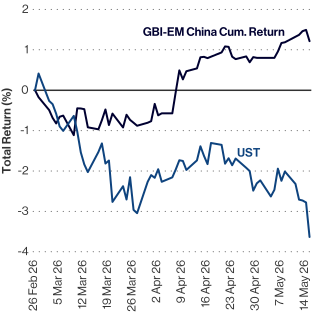
Source: JP Morgan, Bloomberg. Data as of May 2026. U.S. Treasuries are represented by the FTSE 10-Year US Treasuries Index. CGBs are represented by the J.P. Morgan GBI-EM China Dollar Unhedged Index. Past performance is no guarantee of future results. Index performance is not representative of strategy performance. It is not possible to invest directly in an index.
Political Idiosyncrasy in EM
EMs exhibited great idiosyncrasy in a market that is very highly correlated. Hungary, Colombia, and Peru, for example, saw market-friendly political outcomes that insulated their markets from being simple functions of Iran headlines. We showed Hungary’s performance following its election in our last monthly (and we closed our overweight in Hungary following this outperformance). So, we’ll show the next election-dominated story, Colombia. To tell our little story about it, Colombia local was a portfolio stalwart for much of the year. This is based on the positive terms-of-trade shock due to higher oil prices, as well as the odds of a market-friendly outcome in presidential elections (the second round of which is next month). Now, in May, all the market received was adverse polling showing strength for the market-unfavorable candidate into the first round of elections, though this was due to local laws that had the effect of discounting conservative pollsters. The law was suspended in early June, market-supportive polls started coming out, and the first-round election happened showing the market-favored candidate, de la Espriella, winning. The market for some reason treated this result as a great surprise, which is the only surprise to us. Colombia remains a top YTD outperformer, but not in May. Just the usual drama right before an election that is likely to add to the market-friendly moves we’ve seen already in Argentina, Hungary, Ecuador, Chile, and potentially in Peru (more on that in our next monthly, hopefully!)
Exhibit 2 – Colombia’s Market-Friendly Candidate Surges
Colombia Elections - Polymarket Odds

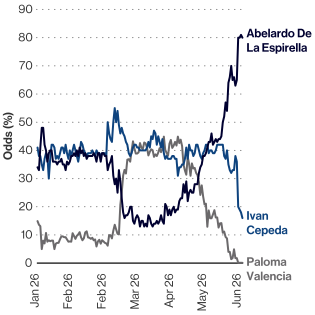
Source: Bloomberg. Data as of May 2026. For illustrative purposes only. References to specific political outcomes and securities are not recommendations to buy or sell any security. Past performance is not a guarantee of future results.
Stagflation Risks in DM and an EM to Avoid
DMs remain under stagflationary risks, but the US is arguably a winner among DMs, so don’t be surprised by USD strength against the major currencies, as we argued in our IMF takeaways from April. The US is possibly enjoying a positive terms-of-trade shock along with many EMs. Growth certainly seems robust, as does the job market, so much so that the market is almost pricing in a full 25 basis point policy rate hike…and stocks remain near highs! In the garden of central banking, though, the ECB will discover every single rake to step on, and this is coming in June. With France in technical recession and great economic and other uncertainty, they (and the UK) will be hiking rates. Watch their currency to see the market verdict…these could be recession-triggering hikes, unlike those in the US. A key hinge. We’ve published so much on “fiscal dominance” and how DMs suffer (and the large DM current account deficits are predicted and a good economic proxy for “dissaving”), we’ll instead show a chart on an EM we don’t like – Thailand. Not all EMs are in great shape and as we argued in our IMF piece, Thailand, Philippines, India are vulnerable south Asian importers; don’t hate EM, just avoid some. Thailand’s current account surplus flipped to serious deficit as depicted in the chart below. Our response was to simply be underweight because EM remains rich in winners whereas DM has mostly stagflationary losers.
Exhibit 3 – Big Hit to Thai Current Account
Thailand BOP Current Account Balance
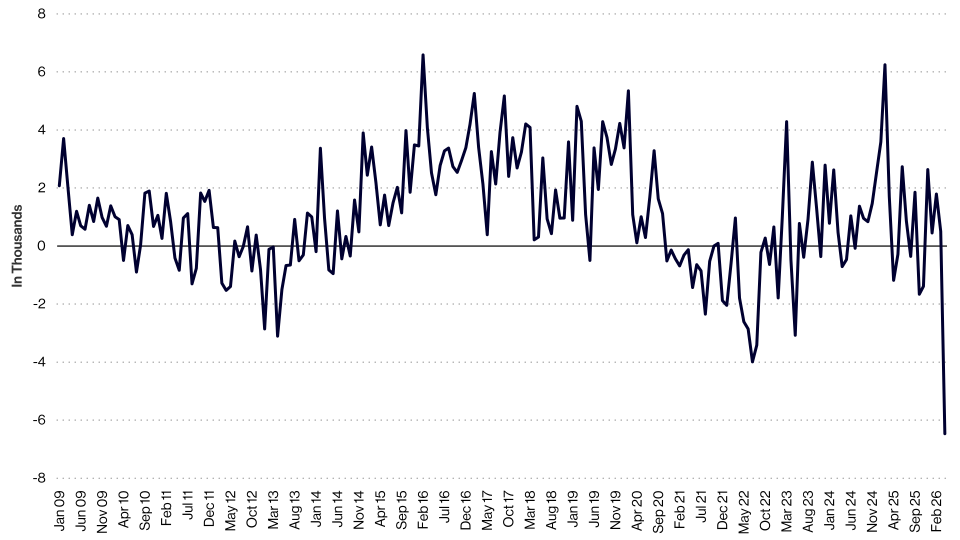

Source: Bloomberg. Data as of May 2026. For illustrative purposes only. Past performance is no guarantee of future results.
Recommended subscription
Exposure Types and Significant Changes
The changes to our top positions are summarized below. Our largest positions in May were South Africa, Malaysia, Mexico, Brazil and Chile:
- We increased our local currency exposure in Mexico and Peru. The Mexican central bank ended its easing cycle, putting to rest the fear that it will fall behind the curve, undermining the peso and local duration. In terms of our investment process, this strengthened the policy test score for the country. The presidential runoff polls in Peru remain tight, but local duration cheapened during the Iran war, and local bonds can be expected to benefit from the Middle East normalization and lower oil prices, which improved the technical test score for the country.
- We also increased our local currency exposure in Poland and Thailand. Poland’s central bank is not in a hurry to cut rates, despite a downside inflation surprise in May, but lower oil prices is a boon for the economy. In terms of our investment process, this translates into stronger policy and technical test scores for the country. Thailand should be expected to be among key beneficiaries from the Middle East ceasefire and lower oil prices, which improve its technical test score.
- Finally, we increased our local currency and hard currency sovereign exposure in South Africa. The central bank’s decision to go for the pre-emptive 25bps rate hike added support for local duration, while sovereign bonds should benefit from better terms of trade under the Middle East ceasefire scenario. In terms of our investment process, this strengthened both the policy and technical test scores for the country.
- We reduced our local currency exposure in Colombia and the Philippines. We took precautionary steps (along with some profits) in Colombia in the run up to the 1st round of the presidential elections, as political noise went up and the policy test score for the country deteriorated at that point. In the Philippines, a sharp increase in inflation raised concerns that the central bank might need to raise the policy rate in order to offset the impact of the Middle East-related energy crisis, which worsened the Philippine technical test score.
- We also reduced our hard currency sovereign exposure in Bolivia and local currency exposure in Hungary. We took profits in Bolivia following the post-election rally and against the backdrop of stronger domestic political noise and confusion about the size of the IMF package. These factors worsened the technical and policy test scores for Bolivia. We also decided to take election-related profits in Hungary as positioning became stretched – weakening the technical test score - and the next strong catalyst has not yet materialized.
- Finally, we reduced our local currency and hard currency sovereign exposure in Brazil, as the election landscape became more complicated following corruption allegations against the key opposition candidate, while the easing room for the central bank became smaller on the back of weakening fiscal discipline and unmoored inflation expectations. These developments worsened Brazil’s policy test score.
To receive more Emerging Markets Bonds insights, sign up in our subscription center.

Disclosures
This is not an offer to buy or sell, or a recommendation to buy or sell any of the securities, financial instruments or digital assets mentioned herein. The information presented does not involve the rendering of personalized investment, financial, legal, tax advice, or any call to action. Certain statements contained herein may constitute projections, forecasts and other forward-looking statements, which do not reflect actual results, are for illustrative purposes only, are valid as of the date of this communication, and are subject to change without notice. Actual future performance of any assets or industries mentioned are unknown. Information provided by third party sources are believed to be reliable and have not been independently verified for accuracy or completeness and cannot be guaranteed. VanEck does not guarantee the accuracy of third party data. The information herein represents the opinion of the author(s), but not necessarily those of VanEck or its other employees.
Duration measures a bond’s sensitivity to interest rate changes that reflects the change in a bond’s price given a change in yield. This duration measure is appropriate for bonds with embedded options. Carry is the benefit or cost for owning an asset. Yield to worst is a measure of the lowest possible yield that can be received on a bond with an early retirement provision. Averages are market weighted. The yields presented do not represent the performance of the Fund. These statistics do not take into account fees and expenses associated with investments of the Fund.
30-Day SEC Yield is a standard yield calculation developed by the Securities and Exchange Commission that allows for fairer comparisons among funds. It is based on the most recent 30-day period. This yield figure reflects the interest earned during the period after deducting the Fund’s expenses for the period. It does not reflect the yield an investor would have received if they had held the Fund over the last twelve months assuming the most recent NAV.
All indices are unmanaged and include the reinvestment of all dividends, but do not reflect the payment of transaction costs, advisory fees or expenses that are associated with an investment in the Fund. Certain indices may take into account withholding taxes. An index’s performance is not illustrative of the Fund’s performance. Indices are not securities in which investments can be made.
The Fund’s benchmark index (50% GBI-EM/50% EMBI) is a blended index consisting of 50% J.P. Morgan Government Bond Index-Emerging Markets (GBI-EM) Global Diversified and 50% J.P. Morgan Emerging Markets Bond Index (EMBI). The J.P. Morgan GBI-EM Global Diversified tracks local currency bonds issued by Emerging Markets governments. The J.P. Morgan EMBI Global Diversified tracks returns for actively traded external debt instruments in emerging markets, and is also J.P. Morgan’s most liquid U.S. dollar emerging markets debt benchmark.
The Bloomberg Global Aggregate Index measures the performance of global investment grade fixed income securities.
The FTSE 10-Year US Treasuries Index measures the return of the 10-year U.S. Treasury.
An investment in the VanEck Emerging Markets Bond ETF may be subject to risks which include, among others, risks related to active management, credit, credit-linked notes, currency management strategies, derivatives, emerging market issuers, ESG investing, foreign currency, foreign securities, hedging, high portfolio turnover, high yield securities, interest rate, market, non-diversified, operational, restricted securities, investing in other funds, sovereign bond, special risk considerations of investing in African, Asian, and Latin American issuers, authorized participant concentration, no guarantee of active trading market, trading issues, fund shares trading, premium/discount and liquidity of fund shares, and cash transactions risks, all of which may adversely affect the Fund. Emerging market issuers and foreign securities may be subject to securities markets, political and economic, investment and repatriation restrictions, different rules and regulations, less publicly available financial information, foreign currency and exchange rates, operational and settlement, and corporate and securities laws risks.
Investing involves substantial risk and high volatility, including possible loss of principal. An investor should consider the investment objective, risks, charges and expenses of a Fund carefully before investing. To obtain a prospectus and summary prospectus, which contain this and other information, call 800.826.2333 or visit vaneck.com. Please read the prospectus and summary prospectus carefully before investing.
© Van Eck Securities Corporation, Distributor, a wholly-owned subsidiary of Van Eck Associates Corporation.
Related Funds
Disclosures
This is not an offer to buy or sell, or a recommendation to buy or sell any of the securities, financial instruments or digital assets mentioned herein. The information presented does not involve the rendering of personalized investment, financial, legal, tax advice, or any call to action. Certain statements contained herein may constitute projections, forecasts and other forward-looking statements, which do not reflect actual results, are for illustrative purposes only, are valid as of the date of this communication, and are subject to change without notice. Actual future performance of any assets or industries mentioned are unknown. Information provided by third party sources are believed to be reliable and have not been independently verified for accuracy or completeness and cannot be guaranteed. VanEck does not guarantee the accuracy of third party data. The information herein represents the opinion of the author(s), but not necessarily those of VanEck or its other employees.
Duration measures a bond’s sensitivity to interest rate changes that reflects the change in a bond’s price given a change in yield. This duration measure is appropriate for bonds with embedded options. Carry is the benefit or cost for owning an asset. Yield to worst is a measure of the lowest possible yield that can be received on a bond with an early retirement provision. Averages are market weighted. The yields presented do not represent the performance of the Fund. These statistics do not take into account fees and expenses associated with investments of the Fund.
30-Day SEC Yield is a standard yield calculation developed by the Securities and Exchange Commission that allows for fairer comparisons among funds. It is based on the most recent 30-day period. This yield figure reflects the interest earned during the period after deducting the Fund’s expenses for the period. It does not reflect the yield an investor would have received if they had held the Fund over the last twelve months assuming the most recent NAV.
All indices are unmanaged and include the reinvestment of all dividends, but do not reflect the payment of transaction costs, advisory fees or expenses that are associated with an investment in the Fund. Certain indices may take into account withholding taxes. An index’s performance is not illustrative of the Fund’s performance. Indices are not securities in which investments can be made.
The Fund’s benchmark index (50% GBI-EM/50% EMBI) is a blended index consisting of 50% J.P. Morgan Government Bond Index-Emerging Markets (GBI-EM) Global Diversified and 50% J.P. Morgan Emerging Markets Bond Index (EMBI). The J.P. Morgan GBI-EM Global Diversified tracks local currency bonds issued by Emerging Markets governments. The J.P. Morgan EMBI Global Diversified tracks returns for actively traded external debt instruments in emerging markets, and is also J.P. Morgan’s most liquid U.S. dollar emerging markets debt benchmark.
The Bloomberg Global Aggregate Index measures the performance of global investment grade fixed income securities.
The FTSE 10-Year US Treasuries Index measures the return of the 10-year U.S. Treasury.
An investment in the VanEck Emerging Markets Bond ETF may be subject to risks which include, among others, risks related to active management, credit, credit-linked notes, currency management strategies, derivatives, emerging market issuers, ESG investing, foreign currency, foreign securities, hedging, high portfolio turnover, high yield securities, interest rate, market, non-diversified, operational, restricted securities, investing in other funds, sovereign bond, special risk considerations of investing in African, Asian, and Latin American issuers, authorized participant concentration, no guarantee of active trading market, trading issues, fund shares trading, premium/discount and liquidity of fund shares, and cash transactions risks, all of which may adversely affect the Fund. Emerging market issuers and foreign securities may be subject to securities markets, political and economic, investment and repatriation restrictions, different rules and regulations, less publicly available financial information, foreign currency and exchange rates, operational and settlement, and corporate and securities laws risks.
Investing involves substantial risk and high volatility, including possible loss of principal. An investor should consider the investment objective, risks, charges and expenses of a Fund carefully before investing. To obtain a prospectus and summary prospectus, which contain this and other information, call 800.826.2333 or visit vaneck.com. Please read the prospectus and summary prospectus carefully before investing.
© Van Eck Securities Corporation, Distributor, a wholly-owned subsidiary of Van Eck Associates Corporation.