EMBX: EM Bloom in the Doom
May 13, 2026
Read Time 9 MIN
Key Takeaways:
- The VanEck Emerging Markets Bond ETF (EMBX) was up 3.61% in April, compared to 2.82% for its benchmark, and up 1.06% for the Bloomberg Global Agg and down -0.21% for Treasuries. YTD the fund is up 2.69%, compared to up 1.03% for its benchmark, and down -0.04% for the Global Agg and down -0.31% for Treasuries.
- We’ve continued to reduce risk, but for mostly idiosyncratic reasons. Hungary was a large overweight and we took profits on the market-friendly election outcome, for example. Our small but impactful Venezuela exposure rallied to less compelling levels, so we closed, etc.
- Local currency exposure is lower at 44%, Carry is 6.69%, YTW is 7.22% and duration is 5.54.
EMBX: EM Bloom in the Doom
Average Annual Total Returns* (%)
| Month End As of 04/30/2026 | 1 MO | 3 MO | YTD | 1 YR | 3 YR | 5 YR | 10 YR | LIFE 07/09/12 |
| EMBX (NAV) | 3.61 | 0.47 | 2.69 | 16.83 | 10.29 | 4.53 | 5.20 | 3.68 |
| EMBX (Market Price) | 3.21 | 0.76 | 3.00 | 17.06 | 10.37 | 4.57 | 5.22 | 3.69 |
| 50% GBI-EM/50% EMBI | 2.82 | -0.40 | 1.03 | 12.55 | 8.94 | 2.43 | 3.28 | 2.69 |
Average Annual Total Returns* (%)
| Quarter End As of 03/31/2026 | 1 MO | 3 MO | YTD | 1 YR | 3 YR | 5 YR | 10 YR | LIFE 07/09/12 |
| EMBX (NAV) | -4.18 | -0.89 | -0.89 | 14.20 | 9.28 | 4.43 | 4.95 | 3.43 |
| EMBX (Market Price) | -3.78 | -0.20 | -0.20 | 14.87 | 9.49 | 4.55 | 5.02 | 3.48 |
| 50% GBI-EM/50% EMBI | -4.41 | -1.75 | -1.75 | 11.11 | 8.19 | 2.31 | 3.22 | 2.50 |
*Returns less than one year are not annualized.
The performance data quoted represents past performance. Past performance is not a guarantee of future results. Investment return and principal value of an investment will fluctuate so that an investor's shares, when redeemed, may be worth more or less than their original cost. Performance may be lower or higher than performance data quoted. Please call 800.826.2333 or visit vaneck.com for performance current to the most recent month ended.
Prior to 10/06/2025, the Fund operated as the VanEck Emerging Markets Bond mutual fund; performance shown before that date is that fund’s NAV performance (Class I, unadjusted for today’s ETF expenses).
EMBX Gross Expense Ratio – 0.76%
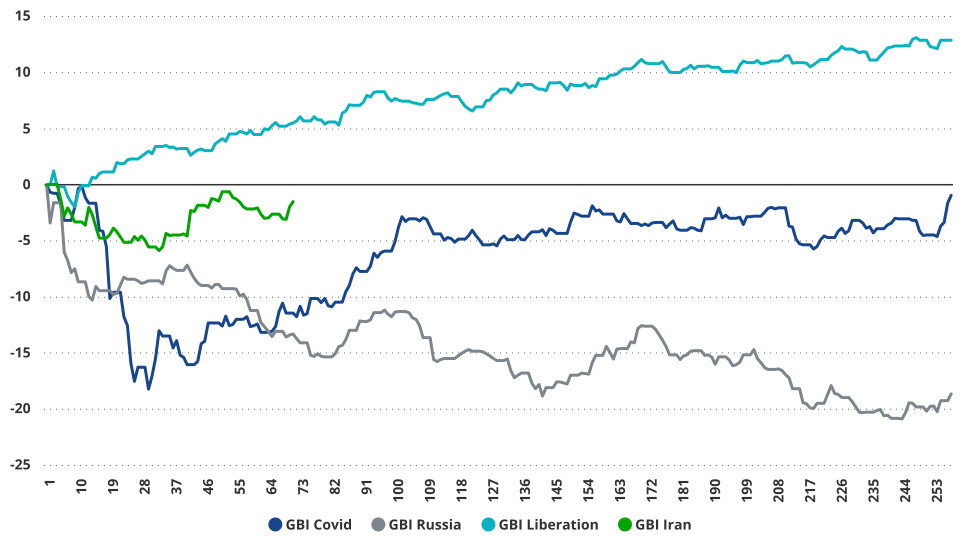
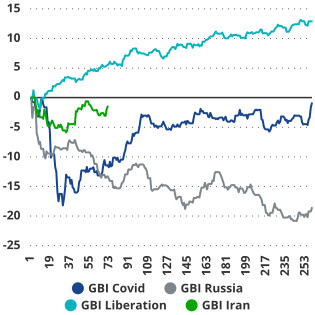
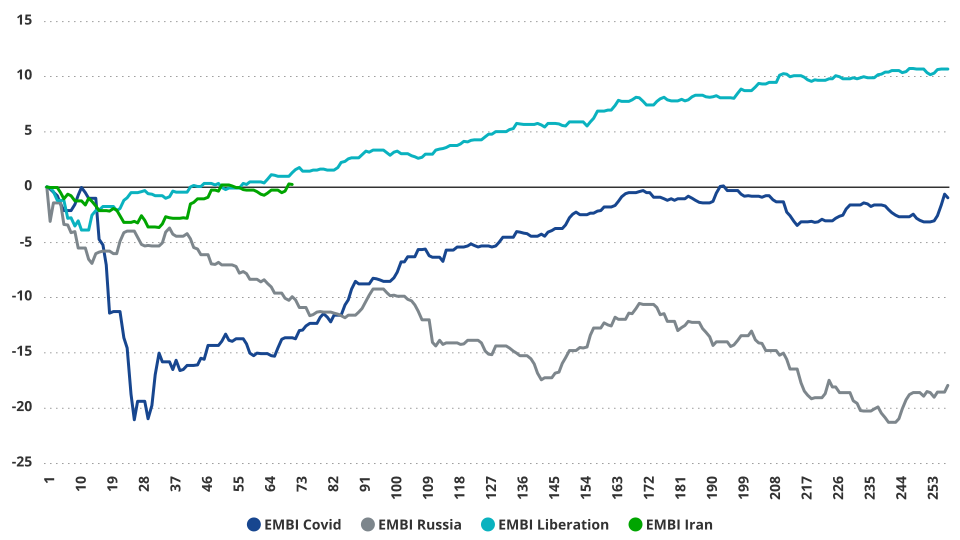
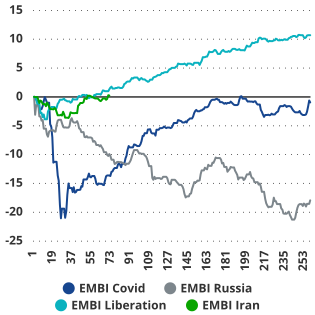
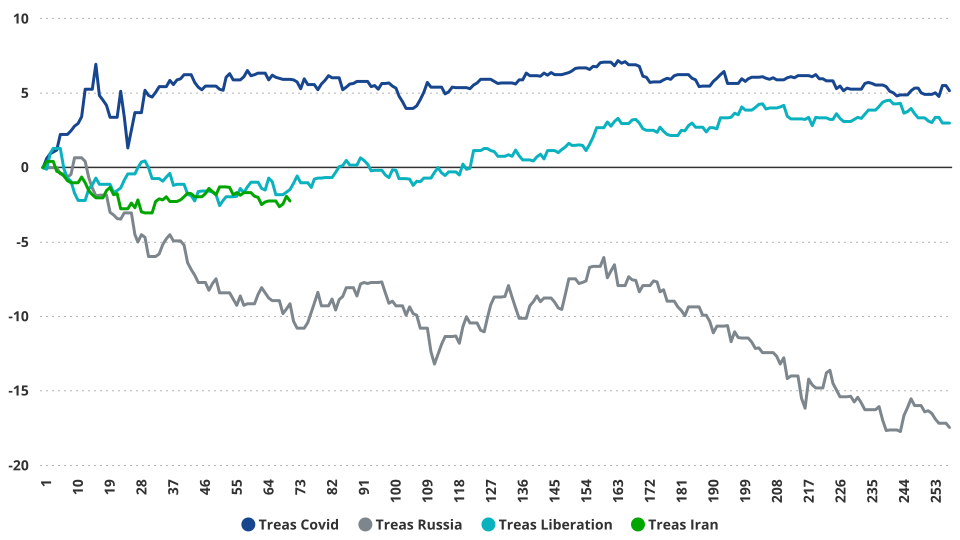
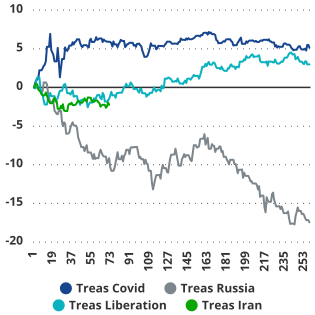
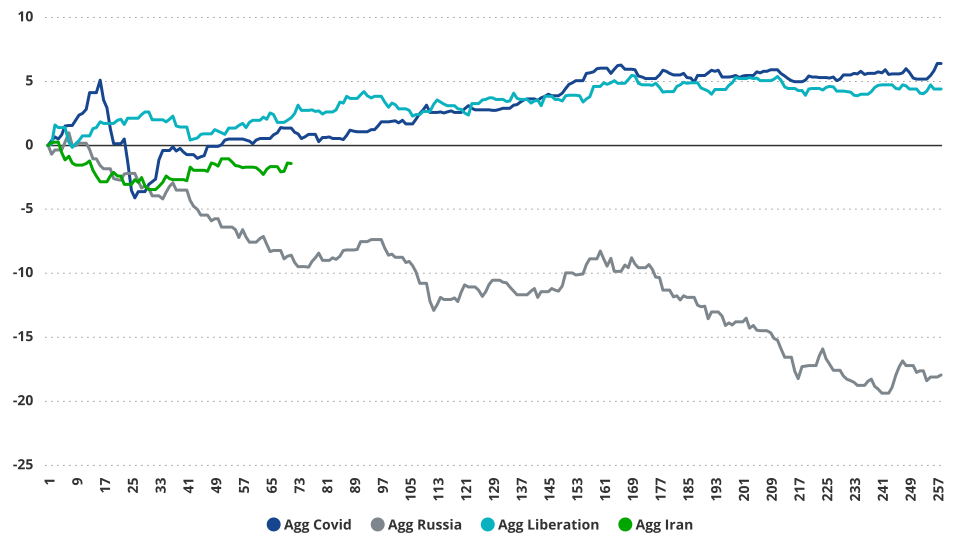
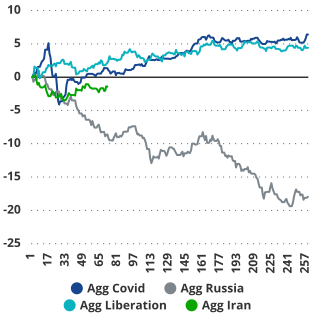
EM bonds continue to perform well during the most challenging geopolitical environment of our lifetimes. Yet again, emerging markets (EM) bonds are outperforming the Global Agg and US Treasuries. Our framing has been that EMs have many strong balance sheets, DMs have none. And EMs have many net exporters, DMs have one - the USA. Complicated charts alert! What we show below is that EM bonds are again concluding “meh” to a major risk event, while DM bonds are getting affected. Exhibit 1 shows EM local-currency and hard-currency bonds chugging along in the Iran war crisis, compared to other crises (Ukraine war, liberation day, Covid). Exhibit 2 shows DM was harder hit relative to its reactions in these same crises. The market is judging that DM should be discounting something worse than EM. We pound this point with Exhibit 3. This shows EMBX, its benchmark, and the Global Agg and US Treasuries over the past 5 years. Our benchmark outperforms the Global Agg and US Treasuries all the time, and we’ll leave it to you to conclude on EMBX relative to our benchmark. (The backward-look on EM via the efficient frontier tells you to have way more than almost anyone has; see our white papers.)
Exhibit 1 – EM Local and Hard Yawning Compared to Previous Crises
EMLC (Local) Total Return (%) and Global Calamities
EMB (Sovereign) Total Return (%) and Global Calamities
Source: Morningstar, JP Morgan, ICE. Data as of May 2026. EMLC (Local) represented by the J.P. Morgan GBI-EM Global Diversified Index; EMB (Sovereign) represented by the J.P. Morgan EMBI Global Diversified Index. Past performance is no guarantee of future results.
Exhibit 2 – DM Bonds More Hit By Iran
US Treasuries Total Return (%) and Global Calamities
Global Agg Total Return (%) and Global Calamities
Source: Morningstar, JP Morgan, ICE. Data as of May 2026. For illustrative purposes only. Past performance is no guarantee of future results.
Exhibit 3 – VanEck EM Bond ETF > EM Bonds > Agg > Treasuries
| As of 4/30/2026 | MTD | YTD | 2025 | 2024 | 2023 | 2022 | 2021 | 5 Years |
| VanEck Emerging Markets Bond ETF | 3.61 | 2.69 | 19.05 | 3.09 | 10.97 | -7.22 | -4.30 | 4.53 |
| 50% JPM GBI-EM GD and 50% JPM EMBI GD | 2.82 | 1.03 | 16.79 | 2.01 | 11.92 | -14.75 | -5.32 | 2.41 |
| JPM GBI-EM Global Diversified TR USD | 2.77 | 0.46 | 19.26 | -2.38 | 12.70 | -11.69 | -8.75 | 2.17 |
| JPM EMBI Global Diversified TR USD | 2.86 | 1.57 | 14.30 | 6.54 | 11.09 | -17.78 | -1.80 | 2.60 |
| ICE BofA Gbl Brd Mkt TR USD | 1.06 | -0.04 | 8.08 | -2.08 | 5.56 | -16.87 | -5.24 | -1.81 |
| FTSE Treasury Benchmark 10 Yr USD | -0.20 | -0.49 | 8.14 | -1.67 | 3.54 | -16.65 | -3.51 | -1.29 |
Source: Morningstar. Data as of April 2026. Past performance is no guarantee of future results. Index performance is not representative of fund performance. It is not possible to invest directly in an index. Fund performance current to the most recent month end is available by visiting vaneck.com or by calling 800.826.2333.
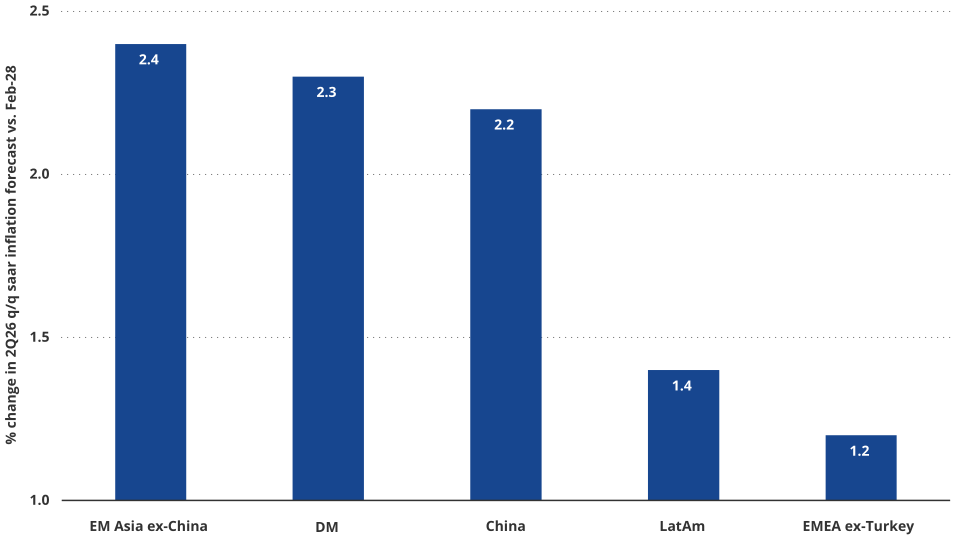
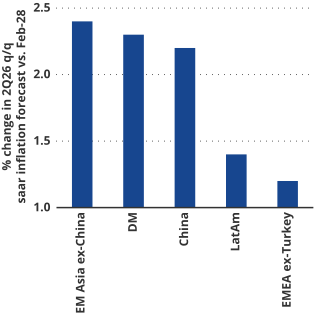
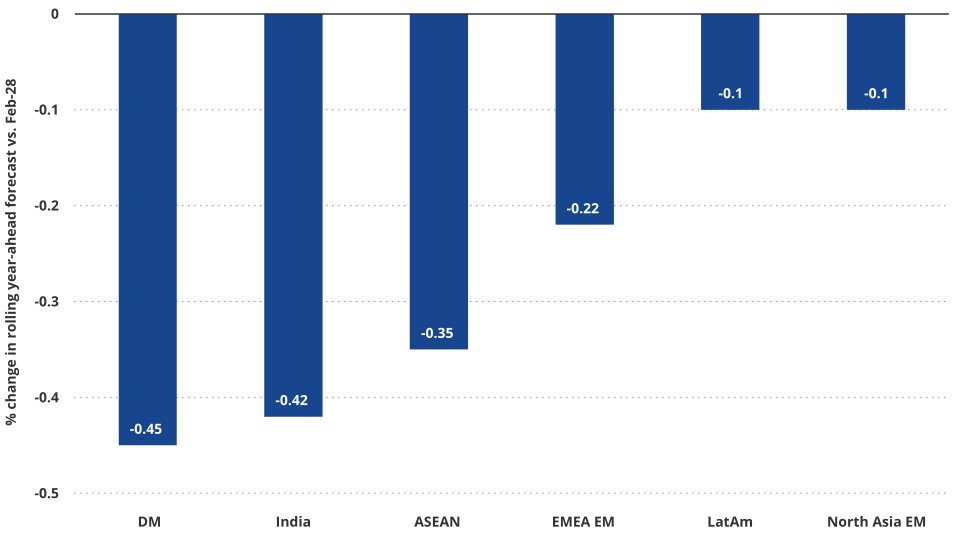
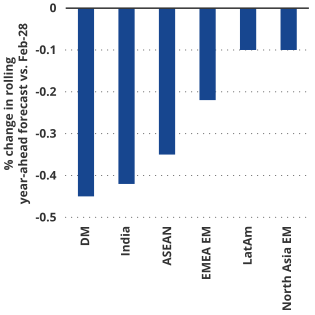
EM economies are largely experiencing less inflationary and growth problems from the war than DM economies. EM central banks are also more hawkish than DM central banks. We’ve long described EMs as not subject to fiscal dominance, and they keep acting that way with risks to hawkishness from most EM central banks, so this does not surprise us at all. Here’s a graph to make it more real. It shows that EM is suffering less in inflation and growth terms, but even better, it’s a description of our views/positioning, in a way, which we described in more detail in our recent IMF takeaways. The ideas are:
- EM suffering less than DM.
- Latam and EMEA and SSA especially (Latam and SSA have been stalwarts for us).
- North Asia is ok because NIIP (we wrote a whole piece on this!…”The Curiously Unpopular Case for CNY Appreciation”).
- South Asia is not in a good position (we have zero or underweight exposures to the south Asian importers such as India, Indonesia, Thailand, Philippines).
Exhibit 4 – EM>DM, Exporters > Importers
Inflation Revisions Post Iran Shock
GDP Forecast Revisions Post Iran Shock
Source: International Monetary Fund; J.P. Morgan. Data as of April 2026. For illustrative purposes only.
EM bonds are “in”, and it’s a bit too much…but just a bit. We argue that “de-dollarization” is too consensus right now in our IMF takeaways and that this makes us only bullish USD against the majors (JPY, GBP, EUR). Although EM has many winners against USD including exporters, many of these are frothy. The backward look on carry/vol says nobody has enough EM debt exposure. And, we’ve been publishing charts showing EMFX volatility is lower than DMFX volatility…and EM local bond volatility is lower than DM bond volatility. If you can ignore nearly double the carry and lower volatility, maybe abandon finance as a discipline. Also, some major color points such as:
- Chinese Government Bonds (CGBs) are up and US Treasuries are down during war.
- Asia “divides” between exporting/strong USD position “North” (China, Korea, Taiwan, Malaysia, Singapore) and importing/weak USD position “South” (India, Indonesia, Philippines, Thailand, Pakistan).
- Democratic Republic Congo issues oversubscribed inaugural bond in midst of war.
- All our investor discussions continue or accelerate (instead of being postponed which is low-deviation “normal”).
- Bolivia (stalwart holding) exhibits market access with bond issuance second week of May.
EMBX | VanEck Emerging Markets Bond ETF
Exposure Types and Significant Changes
The changes to our top positions are summarized below. Our largest positions in April were Brazil, Malaysia, South Africa, Colombia, and Chile
- We increased our hard currency sovereign exposure in Oman, Morocco, Kazakhstan, and Serbia. Oman is the least exposed to the region’s geopolitical noise, and Morocco’s exposure to the war is partly offset by several structural advantages, including being a major exporter of phosphatic fertilizers and the fact that the Gulf is not the main energy source for the country. This improved the policy/politics and economic test scores for both countries. Serbia can benefit from correlations with Europe/Euro, which strengthened the technical test score. And Kazakhstan is the largest oil producer in Central Asia, which gives a boost to its technical and policy/politics test scores.
- We also increased our local currency exposure in Singapore, Czech Republic, Malaysia, and Brazil. Singapore and Malaysia are safe Asian credits, with limited headwinds from the Middle East conflicts. Czech Republic’s correlation with Europe/Euro is a major positive against the backdrop of no serious domestic risks. In terms of our investment process, this improved the technical test scores for these countries. Brazil benefits from more market-friendly election polls and the central bank’s cautious policy stance. Brazil’s growth, external balance, and budget revenue are also positively correlated with higher oil prices. These factors strengthen the policy and technical test scores for the country.
- We increased our hard currency sovereign exposure in the Democratic Republic of the Congo and hard currency corporate exposure in Turkey. The former was an attractively priced new issue, and the latter cheapened a lot during the initial stage of the Iran war, with the improved technical test score.
- We reduced our local currency exposure in Thailand, South Korea, South Africa, Poland, and Hungary. Poland is becoming a fiscally problematic credit, which worsens its economic and policy test scores. The other three countries have significant exposure to the Middle East conflict: Thailand is a net oil importer, and its tourism revenue can be hurt by flights’ rerouting. South Korea depends on LNG imports from the Gulf. And South Africa is vulnerable to higher energy prices and trade disruptions. These factors worsened technical and economic test scores for these countries. Hungary staged a massive rally going into the elections, and it is prudent to take profits since the market-friendly outcome had materialized.
- We also reduced our hard currency sovereign exposure in Venezuela, Kenya, Uruguay, and Angola. We took profits in Venezuela, as price action is now running ahead of fundamentals. Further, Venezuela’s assets are likely to get hit in the case of a ceasefire/lower oil prices, whereas Machado's return might create additional domestic political noise. These factors worsened the technical and policy/politics test scores for the country. Kenya’s status as a net oil importer worsened its economic and technical test scores. Angola benefitted from the Iran-war related spike in the price of oil (being a net exporter), but the sovereign spread is now the tightest since 2018, which worsened valuations and the technical test score for the country.
- Finally, we reduced our local currency exposure in Mexico, Colombia, and Chile. We took profits in Mexico, as bonds are no longer in the top valuation bucket, the USMCA noise is getting stronger, and the central bank still wants to cut rates. These factors worsened the policy/politics and technical test scores for the country. We also took partial profits in Colombia as volatility might increase going into the presidential election in May, worsening the policy/politics test score. As regards Chile, higher oil prices worsened the country’s terms of trade, which in turn weighed on the economic and technical test scores.
Recommended subscription
To receive more Emerging Markets Bonds insights, sign up in our subscription center.

Disclosures
This is not an offer to buy or sell, or a recommendation to buy or sell any of the securities, financial instruments or digital assets mentioned herein. The information presented does not involve the rendering of personalized investment, financial, legal, tax advice, or any call to action. Certain statements contained herein may constitute projections, forecasts and other forward-looking statements, which do not reflect actual results, are for illustrative purposes only, are valid as of the date of this communication, and are subject to change without notice. Actual future performance of any assets or industries mentioned are unknown. Information provided by third party sources are believed to be reliable and have not been independently verified for accuracy or completeness and cannot be guaranteed. VanEck does not guarantee the accuracy of third party data. The information herein represents the opinion of the author(s), but not necessarily those of VanEck or its other employees.
Duration measures a bond's sensitivity to interest rate changes that reflects the change in a bond's price given a change in yield. This duration measure is appropriate for bonds with embedded options. Carry is the benefit or cost for owning an asset. Yield to worst is a measure of the lowest possible yield that can be received on a bond with an early retirement provision. Averages are market weighted. The yields presented do not represent the performance of the Fund. These statistics do not take into account fees and expenses associated with investments of the Fund. The efficient frontier comprises investment portfolios that offer the highest expected return for a given level of risk, as developed in modern portfolio theory.
All indices are unmanaged and include the reinvestment of all dividends, but do not reflect the payment of transaction costs, advisory fees or expenses that are associated with an investment in the Fund. Certain indices may take into account withholding taxes. An index's performance is not illustrative of the Fund's performance. Indices are not securities in which investments can be made.
The Fund's benchmark index (50% GBI-EM/50% EMBI) is a blended index consisting of 50% J.P. Morgan Government Bond Index-Emerging Markets (GBI-EM) Global Diversified and 50% J.P. Morgan Emerging Markets Bond Index (EMBI). The J.P. Morgan GBI-EM Global Diversified tracks local currency bonds issued by Emerging Markets governments. The J.P. Morgan EMBI Global Diversified tracks returns for actively traded external debt instruments in emerging markets, and is also J.P. Morgan's most liquid U.S. dollar emerging markets debt benchmark.
The Bloomberg Global Aggregate Index measures the performance of global investment grade fixed income securities.
The FTSE Treasury Benchmark 10 year measures the return of the 10 year U.S. Treasury.
Information has been obtained from sources believed to be reliable but J.P. Morgan does not warrant its completeness or accuracy. The Index is used with permission. The index may not be copied, used or distributed without J.P. Morgan's written approval. Copyright 2026, J.P. Morgan Chase & Co. All rights reserved.
The ICE BofA Global Broad Market Index tracks the performance of investment grade debt publicly issued in the major domestic and eurobond markets, including sovereign, quasi-government, corporate, securitized and collateralized securities.
The ICE BofA Current 10-Year U.S. Treasury Index tracks the performance of a single U.S. Treasury note with approximately 10 years remaining term to maturity.
An investment in the VanEck Emerging Markets Bond ETF may be subject to risks which include, among others, risks related to active management, credit, credit-linked notes, currency management strategies, derivatives, emerging market issuers, ESG investing, foreign currency, foreign securities, hedging, high portfolio turnover, high yield securities, interest rate, market, non-diversified, operational, restricted securities, investing in other funds, sovereign bond, special risk considerations of investing in African, Asian, European and Latin American issuers, authorized participant concentration, no guarantee of active trading market, trading issues, fund shares trading, premium/discount and liquidity of fund shares, and cash transactions risks, all of which may adversely affect the Fund. Emerging market issuers and foreign securities may be subject to securities markets, political and economic, investment and repatriation restrictions, different rules and regulations, less publicly available financial information, foreign currency and exchange rates, operational and settlement, and corporate and securities laws risks.
Investing involves substantial risk and high volatility, including possible loss of principal. An investor should consider the investment objective, risks, charges and expenses of a Fund carefully before investing. To obtain a prospectus and summary prospectus, which contain this and other information, call 800.826.2333 or visit vaneck.com. Please read the prospectus and summary prospectus carefully before investing.
© Van Eck Securities Corporation, Distributor, a wholly-owned subsidiary of Van Eck Associates Corporation.
Related Funds
Disclosures
This is not an offer to buy or sell, or a recommendation to buy or sell any of the securities, financial instruments or digital assets mentioned herein. The information presented does not involve the rendering of personalized investment, financial, legal, tax advice, or any call to action. Certain statements contained herein may constitute projections, forecasts and other forward-looking statements, which do not reflect actual results, are for illustrative purposes only, are valid as of the date of this communication, and are subject to change without notice. Actual future performance of any assets or industries mentioned are unknown. Information provided by third party sources are believed to be reliable and have not been independently verified for accuracy or completeness and cannot be guaranteed. VanEck does not guarantee the accuracy of third party data. The information herein represents the opinion of the author(s), but not necessarily those of VanEck or its other employees.
Duration measures a bond's sensitivity to interest rate changes that reflects the change in a bond's price given a change in yield. This duration measure is appropriate for bonds with embedded options. Carry is the benefit or cost for owning an asset. Yield to worst is a measure of the lowest possible yield that can be received on a bond with an early retirement provision. Averages are market weighted. The yields presented do not represent the performance of the Fund. These statistics do not take into account fees and expenses associated with investments of the Fund. The efficient frontier comprises investment portfolios that offer the highest expected return for a given level of risk, as developed in modern portfolio theory.
All indices are unmanaged and include the reinvestment of all dividends, but do not reflect the payment of transaction costs, advisory fees or expenses that are associated with an investment in the Fund. Certain indices may take into account withholding taxes. An index's performance is not illustrative of the Fund's performance. Indices are not securities in which investments can be made.
The Fund's benchmark index (50% GBI-EM/50% EMBI) is a blended index consisting of 50% J.P. Morgan Government Bond Index-Emerging Markets (GBI-EM) Global Diversified and 50% J.P. Morgan Emerging Markets Bond Index (EMBI). The J.P. Morgan GBI-EM Global Diversified tracks local currency bonds issued by Emerging Markets governments. The J.P. Morgan EMBI Global Diversified tracks returns for actively traded external debt instruments in emerging markets, and is also J.P. Morgan's most liquid U.S. dollar emerging markets debt benchmark.
The Bloomberg Global Aggregate Index measures the performance of global investment grade fixed income securities.
The FTSE Treasury Benchmark 10 year measures the return of the 10 year U.S. Treasury.
Information has been obtained from sources believed to be reliable but J.P. Morgan does not warrant its completeness or accuracy. The Index is used with permission. The index may not be copied, used or distributed without J.P. Morgan's written approval. Copyright 2026, J.P. Morgan Chase & Co. All rights reserved.
The ICE BofA Global Broad Market Index tracks the performance of investment grade debt publicly issued in the major domestic and eurobond markets, including sovereign, quasi-government, corporate, securitized and collateralized securities.
The ICE BofA Current 10-Year U.S. Treasury Index tracks the performance of a single U.S. Treasury note with approximately 10 years remaining term to maturity.
An investment in the VanEck Emerging Markets Bond ETF may be subject to risks which include, among others, risks related to active management, credit, credit-linked notes, currency management strategies, derivatives, emerging market issuers, ESG investing, foreign currency, foreign securities, hedging, high portfolio turnover, high yield securities, interest rate, market, non-diversified, operational, restricted securities, investing in other funds, sovereign bond, special risk considerations of investing in African, Asian, European and Latin American issuers, authorized participant concentration, no guarantee of active trading market, trading issues, fund shares trading, premium/discount and liquidity of fund shares, and cash transactions risks, all of which may adversely affect the Fund. Emerging market issuers and foreign securities may be subject to securities markets, political and economic, investment and repatriation restrictions, different rules and regulations, less publicly available financial information, foreign currency and exchange rates, operational and settlement, and corporate and securities laws risks.
Investing involves substantial risk and high volatility, including possible loss of principal. An investor should consider the investment objective, risks, charges and expenses of a Fund carefully before investing. To obtain a prospectus and summary prospectus, which contain this and other information, call 800.826.2333 or visit vaneck.com. Please read the prospectus and summary prospectus carefully before investing.
© Van Eck Securities Corporation, Distributor, a wholly-owned subsidiary of Van Eck Associates Corporation.