A New Approach to International and EM Equity Investing
September 09, 2026
Read Time 7 MIN
Key Takeaways
- Analyst sentiment—measured through revisions to earnings, price targets, and ratings—has historically shown a persistent return premium across developed markets.
- The VanEck MSCI EAFE Analyst Sentiment ETF (VEFA) and VanEck MSCI EM Analyst Sentiment ETF (VEEM) systematically captures this signal while targeting low ex-ante tracking error (<4%) to their respective parent Index.
- The funds are designed as an enhanced core international and emerging markets allocation, offering diversification beyond U.S. equities with a forward-looking factor tilt.
What Is the Analyst Sentiment Return Premium?
When professional sell-side analysts revise their views by raising earnings estimates, lifting price targets, or upgrading ratings, stocks with the most positive revision momentum have historically generated meaningfully stronger returns than those at the bottom of the sentiment spectrum. This relationship between analyst sentiment and subsequent performance has been consistent across developed markets and has persisted through varied market environments.
The chart below illustrates the excess return spread across analyst sentiment deciles within the MSCI global universe as represented by the MSCI ACWI IMI Index. Stocks in the highest decile of analyst sentiment have historically outperformed the index and those in the lowest decile. This is the signal that the MSCI EAFE Analyst Sentiment Select Index and the MSCI Emerging Markets Analyst Sentiment Select Index are built to capture.
A clear relationship between analyst sentiment exposure and future returns
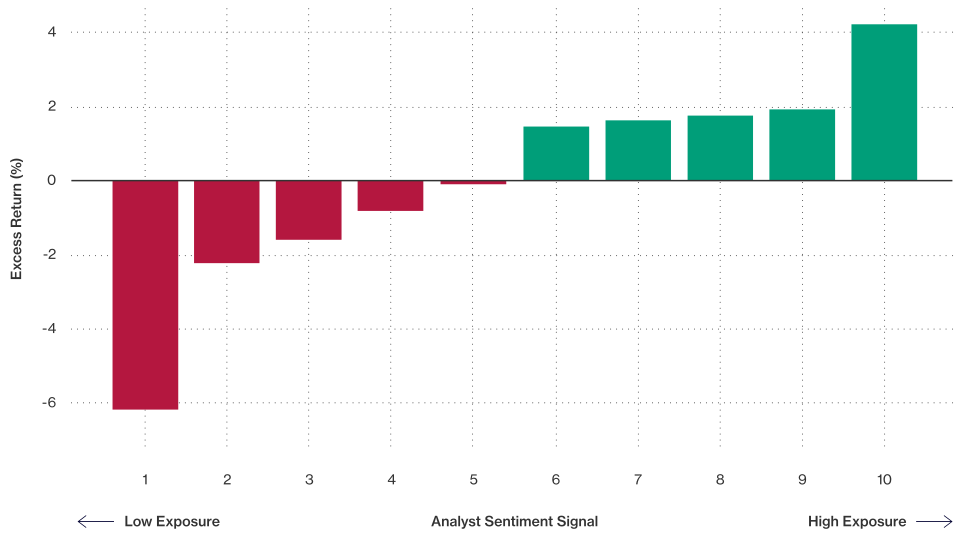

Source: MSCI. Returns based on MSCI ACWI IMI Index from June 29, 2007, to March 31, 2026. Past performance is not a guarantee of future results.
Why Does Analyst Sentiment Outperform Other Factors?
Not all factors are created equal. Analyst sentiment has a set of characteristics that distinguish it from more widely implemented smart beta approaches and that help explain why the return premium has proven durable. Below are the four properties that make it a systematic way to capture and leverage the evolving opinions of sell-side analysts.
- Forward looking: Identifies companies with improving forward fundamentals by capturing changes in earnings expectations and valuation outlooks. This is in stark contrast to most traditional factors like growth, value and momentum, which use backward-looking data to determine the factor score.
- Distinct: Changes in expectations have historically been associated with persistent excess returns, reflecting improving business outlooks. This persistence distinguishes analyst sentiment from price-based signals, which tend to revert, and from static fundamental screens, which lag actual business inflection points.
- Resilient over multiple time frames: Improving fundamentals have driven returns across market cycles and macro environments. Unlike cyclical factors that outperform only in specific regimes, analyst sentiment has shown consistent efficacy across rising rate periods, growth slowdowns and periods of elevated volatility.
- Systematic: Rules-based index designed to systematically capture companies with improving prospects, while remaining investable and scalable. The process removes discretionary judgment from stock selection, ensuring consistent application of the sentiment signal across every quarterly rebalance.
What is Analyst Sentiment?
Analyst sentiment captures how the views of professional sell-side analysts are changing over time. When analysts raise their earnings estimates, lift their price targets, or upgrade their ratings on a stock, that reflects a shift in their view of the company’s forward outlook. The opposite is also true: falling estimates and downgrades signal deteriorating expectations.
VEFA and VEEM’s underlying indexes track these shifts systematically. Rather than relying on a single data point, the signal equally weights five distinct analyst revision types.
Are Sell-Side Analyst Ratings Biased?
The question of whether sell-side analysts are structurally biased is a fair one, but it targets the wrong metric. VEFA and VEEM do not rely on analyst ratings or absolute opinion. It tracks the direction of revisions, which means the question of whether analysts skew optimistic is not the relevant one. The relevant question is whether their views are improving or deteriorating, and on that dimension the signal has been consistent.
A stock being upgraded by its analyst coverage tells you something different than one sitting at a longstanding consensus buy with no recent activity. VEFA and VEEM capture that directional shift across five metrics simultaneously: earnings estimates, price targets, sales forecasts, cash flow projections and ratings changes. Whether any individual analyst is optimistic or pessimistic in absolute terms is not the variable that drives the strategy.
It is also worth noting that analyst estimates are public, timestamped and tracked against outcomes by independent data providers. Analysts who miss consistently tend to lose institutional votes and coverage mandates over time. That creates a degree of accountability that reinforces the integrity of the underlying signal, even if it does not guarantee accuracy in any individual case.
How Do VEFA and VEEM Capture the Analyst Sentiment Signal?
VEFA tracks the MSCI EAFE Analyst Sentiment Select Index, while VEEM tracks the MSCI Emerging Markets Analyst Sentiment Select Index. Both indexes take the analyst sentiment signal and builds a portfolio through an optimization process. The objective is to maximize exposure to high-sentiment stocks within strict risk constraints designed to keep the fund usable as a core international allocation.
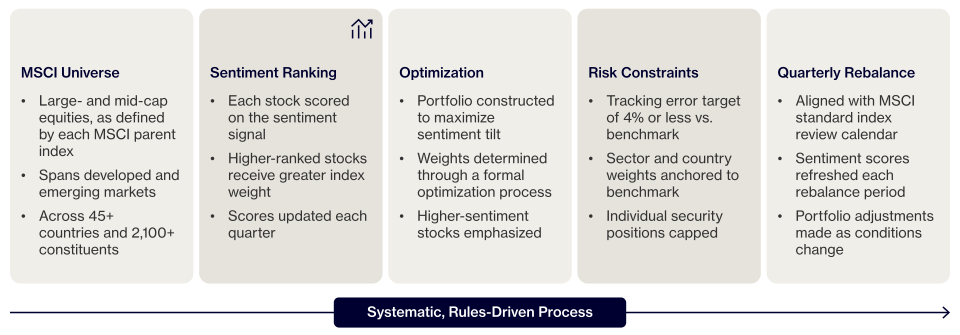
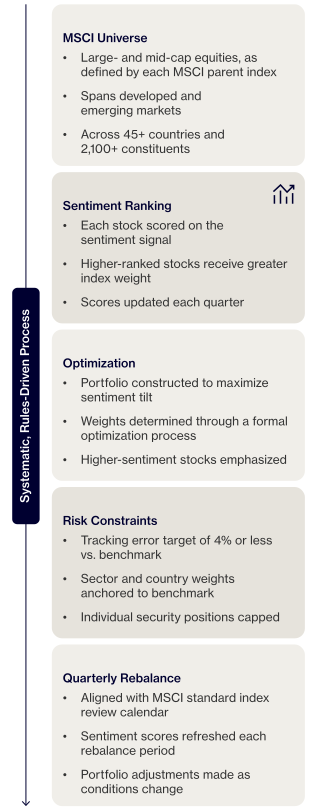
The 4% tracking error ceiling is a core design feature. High-tracking-error factor portfolios can deviate significantly from investor expectations, making them difficult to hold through periods of underperformance and harder to integrate as a primary building block. VEFA and VEEM are constructed to behave like an enhanced core allocation, not a concentrated tactical bet.
Recommended subscription
Why Should Investors Consider International and EM Equities Now?
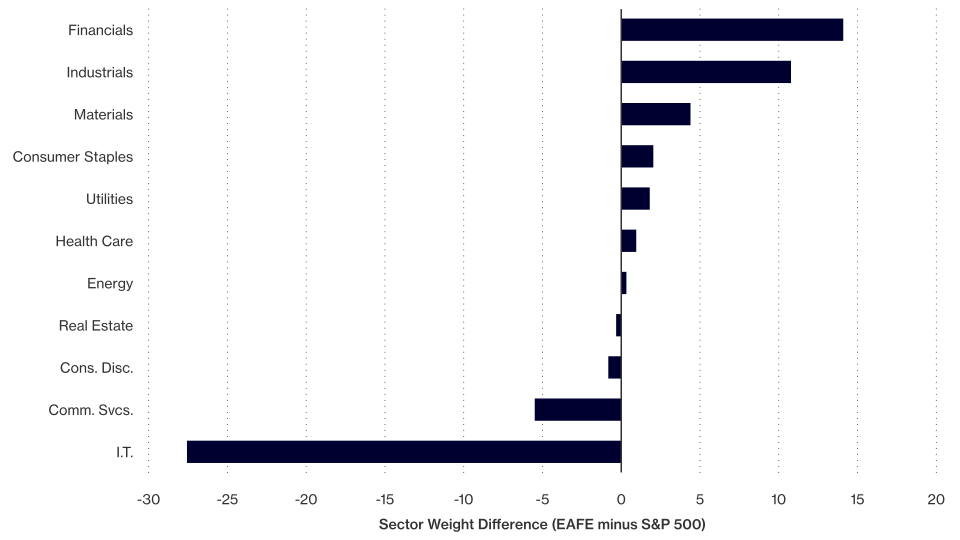
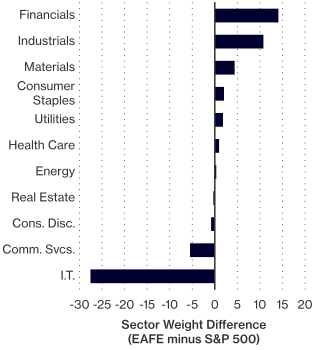
First, diversification. U.S. equities have become increasingly concentrated in a small number of large technology companies. International developed equities, as represented by the MSCI EAFE Index, offer a broader, more balanced sector mix and significantly less single-stock concentration, which can help reduce overall portfolio risk.
International and EM Provide Diversification
Sector Weight Difference Between EAFE and S&P 500
S&P 500 Heavily Concentrated in Top Ten Holdings

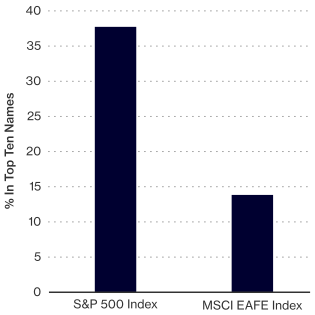
Source: VanEck, as of 8/31/2026. For illustrative purposes only. EAFE represented by the MSCI EAFE Index; S&P 500 by the S&P 500 Index. It is not possible to invest directly in an index.
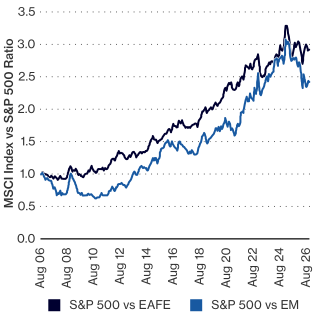
Second, the trend is starting to shift. After more than a decade of U.S. dominance, international and emerging markets stocks are beginning to gain ground. The performance gap between U.S. compared to international and emerging markets peaked in late 2024 and has started to narrow, and there are growing tailwinds for international and emerging markets equities heading into 2026. For investors who have been underweight international stocks, this may be a favorable time to revisit that allocation.
Will U.S. Equities Continue to Outperform?
MSCI EAFE Index and MSCI EM Index versus S&P 500 Index
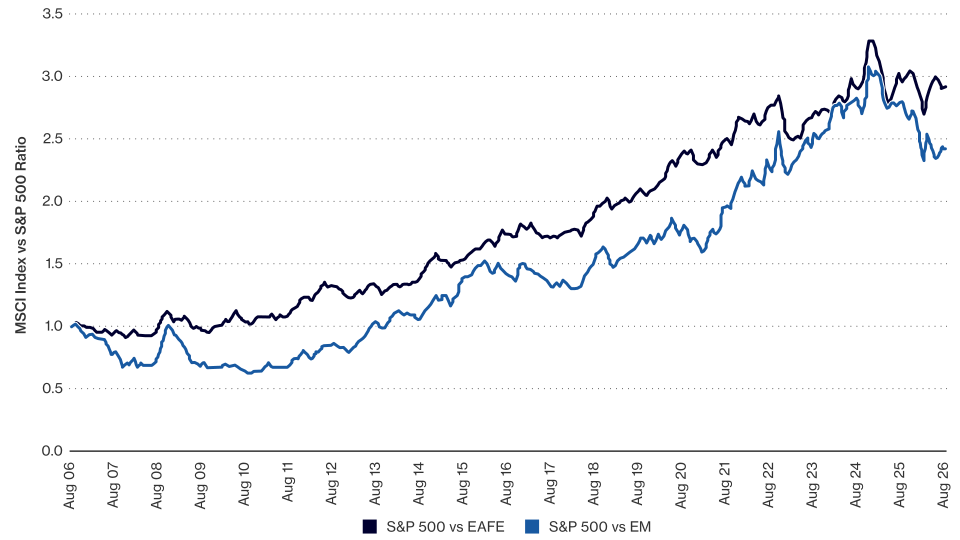
Source: Morningstar as of 8/31/2026. EAFE represented by the MSCI EAFE Index; EM represented by the MSCI Emerging Markets Index. Past performance is no guarantee of future results. Index performance is not representative of fund performance. It is not possible to invest directly in an index.
Third, EM equities offer a compelling growth-to-valuation tradeoff. Emerging markets are currently trading at a significant discount to developed market peers on a forward P/E basis, while offering higher estimated earnings growth in 2026. That combination — cheaper valuations and stronger expected earnings momentum —makes the current environment a favorable entry point for investors looking to diversify into EM.
EM Equities are Trading at a Significant Discount to DM Peers
Emerging markets are offering higher growth at a significant valuation discount to developed market peers
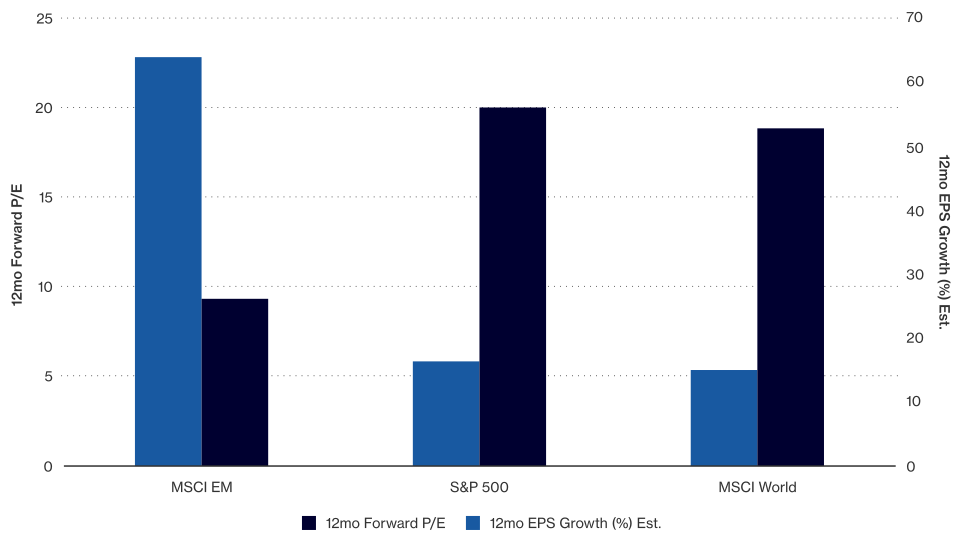

Source: Bloomberg as of 8/31/2026. MSCI EM represented by the MSCI Emerging Markets Index; S&P 500 by the S&P 500 Index; MSCI World by the MSCI World Index. Past performance is no guarantee of future results. Index performance is not representative of fund performance. It is not possible to invest directly in an index.
To receive more Emerging Markets Equity insights, sign up in our subscription center.

Important Disclosures
This is not an offer to buy or sell, or a recommendation to buy or sell any of the securities, financial instruments or digital assets mentioned herein. The information presented does not involve the rendering of personalized investment, financial, legal, tax advice, or any call to action. Certain statements contained herein may constitute projections, forecasts and other forward-looking statements, which do not reflect actual results, are for illustrative purposes only, are valid as of the date of this communication, and are subject to change without notice. Actual future performance of any assets or industries mentioned are unknown. Information provided by third party sources are believed to be reliable and have not been independently verified for accuracy or completeness and cannot be guaranteed. VanEck does not guarantee the accuracy of third party data. The information herein represents the opinion of the author(s), but not necessarily those of VanEck or its other employees.
MSCI EAFE Index: The MSCI EAFE Index is an equity index which captures large and mid cap representation across 21 Developed Markets countries around the world, excluding the US and Canada. With 694 constituents, the index covers approximately 85% of the free float-adjusted market capitalization in each country.
MSCI EAFE Analyst Sentiment Select Index: MSCI EAFE Analyst Sentiment Select Index is based on MSCI EAFE Index, its parent index which includes large and mid-cap stocks across 21 Developed Markets countries around the world, excluding the US and Canada. The index uses an optimization process that aims to maximize the exposure to the Analyst Sentiment factor, while controlling for active risk, active specific risk and net ex-ante beta relative to the parent index.
MSCI ACWI IMI (All Country World Investable Market Index): a comprehensive stock market index capturing large, mid, and small-cap stocks across 23 Developed Markets (DM) and 24 Emerging Markets (EM). It covers roughly 99% of the global equity opportunity set, spanning over 9,000 securities
MSCI Emerging Markets Analyst Sentiment Select Index: The MSCI Emerging Markets Analyst Sentiment Select Index is based on the MSCI Emerging Markets Index, its parent index, which captures large and mid-cap representation across Emerging Markets countries. The index uses an optimization process that aims to maximize the exposure to the Analyst Sentiment factor, while controlling for active risk, active specific risk and net ex-ante beta relative to the parent index.
S&P 500 Index consists of 500 widely held common stocks covering the leading industries of the U.S. economy.
MSCI World Index: The MSCI World Index captures large and mid-cap representation across 23 Developed Markets countries and covers approximately 85% of the free float-adjusted market capitalization in each country.
MSCI Emerging Markets Index: The MSCI Emerging Markets Index captures large and mid cap representation across Emerging Markets countries and covers approximately 85% of the free float-adjusted market capitalization in each country.
Index returns are not Fund returns and do not reflect any management fees or brokerage expenses. Certain indices may take into account withholding taxes. Investors can not invest directly in the Index. Returns for actual Fund investors may differ from what is shown because of differences in timing, the amount invested and fees and expenses. Index returns assume that dividends have been reinvested.
An investment in the VanEck MSCI EM Analyst Sentiment ETF (VEEM) and VanEck MSCI EAFE Analyst Sentiment ETF (VEFA) may be subject to risks which include, but are not limited to, risks related to investments in emerging market issuers, foreign securities, foreign currency, information technology sector, financials sector, basic materials sector, industrials sector, health care sector, special risk considerations of investing in Chinese, European, Indian, Japanese, South Korean, Taiwanese and United Kingdom issuers, cash transactions, depositary receipts, equity securities, issuer-specific changes, medium- and large-capitalization companies, market, operational, index tracking, authorized participant concentration, new fund, no guarantee of active trading market, trading issues, passive management, fund shares trading, premium/discount, liquidity of fund shares, non-diversified, and index-related concentration risks, all of which may adversely affect the Funds. Emerging market issuers and foreign securities may be subject to securities markets, political and economic, investment and repatriation restrictions, different rules and regulations, less publicly available financial information, foreign currency and exchange rates, operational and settlement, and corporate and securities laws risks. Investments in Chinese issuers may entail additional risks that include, among others, lack of liquidity and price volatility, currency devaluations and exchange rate fluctuations, intervention by the Chinese government, nationalization or expropriation, limitations on the use of brokers, and trade limitations. Medium- and large-capitalization companies may be subject to elevated risks.tions. Medium- and large-capitalization companies may be subject to elevated risks.
Investing involves substantial risk and high volatility, including possible loss of principal. An investor should consider the investment objective, risks, charges and expenses of a Fund carefully before investing. To obtain a prospectus and summary prospectus, which contain this and other information, call 800.826.2333 or visit vaneck.com. Please read the prospectus and summary prospectus carefully before investing.
© Van Eck Securities Corporation, Distributor, a wholly owned subsidiary of Van Eck Associates Corporation.
Related Funds
Important Disclosures
This is not an offer to buy or sell, or a recommendation to buy or sell any of the securities, financial instruments or digital assets mentioned herein. The information presented does not involve the rendering of personalized investment, financial, legal, tax advice, or any call to action. Certain statements contained herein may constitute projections, forecasts and other forward-looking statements, which do not reflect actual results, are for illustrative purposes only, are valid as of the date of this communication, and are subject to change without notice. Actual future performance of any assets or industries mentioned are unknown. Information provided by third party sources are believed to be reliable and have not been independently verified for accuracy or completeness and cannot be guaranteed. VanEck does not guarantee the accuracy of third party data. The information herein represents the opinion of the author(s), but not necessarily those of VanEck or its other employees.
MSCI EAFE Index: The MSCI EAFE Index is an equity index which captures large and mid cap representation across 21 Developed Markets countries around the world, excluding the US and Canada. With 694 constituents, the index covers approximately 85% of the free float-adjusted market capitalization in each country.
MSCI EAFE Analyst Sentiment Select Index: MSCI EAFE Analyst Sentiment Select Index is based on MSCI EAFE Index, its parent index which includes large and mid-cap stocks across 21 Developed Markets countries around the world, excluding the US and Canada. The index uses an optimization process that aims to maximize the exposure to the Analyst Sentiment factor, while controlling for active risk, active specific risk and net ex-ante beta relative to the parent index.
MSCI ACWI IMI (All Country World Investable Market Index): a comprehensive stock market index capturing large, mid, and small-cap stocks across 23 Developed Markets (DM) and 24 Emerging Markets (EM). It covers roughly 99% of the global equity opportunity set, spanning over 9,000 securities
MSCI Emerging Markets Analyst Sentiment Select Index: The MSCI Emerging Markets Analyst Sentiment Select Index is based on the MSCI Emerging Markets Index, its parent index, which captures large and mid-cap representation across Emerging Markets countries. The index uses an optimization process that aims to maximize the exposure to the Analyst Sentiment factor, while controlling for active risk, active specific risk and net ex-ante beta relative to the parent index.
S&P 500 Index consists of 500 widely held common stocks covering the leading industries of the U.S. economy.
MSCI World Index: The MSCI World Index captures large and mid-cap representation across 23 Developed Markets countries and covers approximately 85% of the free float-adjusted market capitalization in each country.
MSCI Emerging Markets Index: The MSCI Emerging Markets Index captures large and mid cap representation across Emerging Markets countries and covers approximately 85% of the free float-adjusted market capitalization in each country.
Index returns are not Fund returns and do not reflect any management fees or brokerage expenses. Certain indices may take into account withholding taxes. Investors can not invest directly in the Index. Returns for actual Fund investors may differ from what is shown because of differences in timing, the amount invested and fees and expenses. Index returns assume that dividends have been reinvested.
An investment in the VanEck MSCI EM Analyst Sentiment ETF (VEEM) and VanEck MSCI EAFE Analyst Sentiment ETF (VEFA) may be subject to risks which include, but are not limited to, risks related to investments in emerging market issuers, foreign securities, foreign currency, information technology sector, financials sector, basic materials sector, industrials sector, health care sector, special risk considerations of investing in Chinese, European, Indian, Japanese, South Korean, Taiwanese and United Kingdom issuers, cash transactions, depositary receipts, equity securities, issuer-specific changes, medium- and large-capitalization companies, market, operational, index tracking, authorized participant concentration, new fund, no guarantee of active trading market, trading issues, passive management, fund shares trading, premium/discount, liquidity of fund shares, non-diversified, and index-related concentration risks, all of which may adversely affect the Funds. Emerging market issuers and foreign securities may be subject to securities markets, political and economic, investment and repatriation restrictions, different rules and regulations, less publicly available financial information, foreign currency and exchange rates, operational and settlement, and corporate and securities laws risks. Investments in Chinese issuers may entail additional risks that include, among others, lack of liquidity and price volatility, currency devaluations and exchange rate fluctuations, intervention by the Chinese government, nationalization or expropriation, limitations on the use of brokers, and trade limitations. Medium- and large-capitalization companies may be subject to elevated risks.tions. Medium- and large-capitalization companies may be subject to elevated risks.
Investing involves substantial risk and high volatility, including possible loss of principal. An investor should consider the investment objective, risks, charges and expenses of a Fund carefully before investing. To obtain a prospectus and summary prospectus, which contain this and other information, call 800.826.2333 or visit vaneck.com. Please read the prospectus and summary prospectus carefully before investing.
© Van Eck Securities Corporation, Distributor, a wholly owned subsidiary of Van Eck Associates Corporation.