VEFA & VEEM: Question & Answer
Read Time 7 MIN
- What are the VanEck MSCI EAFE Analyst Sentiment ETF (VEFA) and the VanEck MSCI EM Analyst Sentiment ETF (VEEM)?
- What is Analyst Sentiment?
- Why Does Analyst Sentiment Work as an Investment Signal?
- How do the underlying indexes work
- How is the Index Constructed Step by Step?
- Why is tracking error important in VEFA and VEEM?
- Why Invest in International Developed Markets Now?
- Are Sell-Side Analysts Biased and Does It Matter?
- How do VEFA and VEEM fit in a portfolio?
- How to Buy VanEck ETFs?
What are the VanEck MSCI EAFE Analyst Sentiment ETF (VEFA) and the VanEck MSCI EM Analyst Sentiment ETF (VEEM)?
VEFA and VEEM are passively managed ETFs that track the MSCI EAFE Analyst Sentiment Select Index and the MSCI Emerging Markets Analyst Sentiment Select Index, respectively. VEFA provides exposure to large- and mid-cap companies across developed markets outside the U.S. and Canada, while VEEM provides exposure to large- and mid-cap companies across emerging markets. Both funds apply a systematic tilt toward stocks where sell-side analysts are becoming more optimistic and are designed to serve as enhanced core equity allocations, not concentrated tactical bets.
What is Analyst Sentiment?
Analyst sentiment captures how the views of professional sell-side analysts are changing over time. When analysts raise their earnings estimates, lift their price targets, or upgrade their ratings on a stock, that reflects a shift in their view of the company's forward outlook. The opposite is also true: falling estimates and downgrades signal deteriorating expectations.
VEFA and VEEM’s underlying indexes track these shifts systematically. Rather than relying on a single data point, the signal equally weights five distinct analyst revision types:
- Earnings per share revisions: Changes in analyst EPS forecasts, the most widely followed measure of a company's profitability outlook.
- Sales forecast: Shifts in revenue expectations, which capture top-line momentum before it flows through to earnings.
- Cash flow per share: Changes in cash flow estimates, reflecting how analysts view a company's ability to generate real cash.
- Price target adjustments: Moves in the price analysts believe the stock should trade at, representing their overall valuation view.
- Buy/sell recommendation changes: Upgrades or downgrades in analyst ratings, the most direct expression of whether an analyst thinks the stock is worth owning.
By aggregating across all five equally weighted inputs, the signal captures a more complete picture of how professional opinion is shifting. Stocks showing broad improvement across multiple inputs receive the strongest positive signal, identifying companies where the analyst community is broadly becoming more optimistic, not just selectively.
Why Does Analyst Sentiment Work as an Investment Signal?
There is a clear, well-documented relationship between analyst sentiment and future stock returns. Stocks in the highest decile of analyst sentiment have generally outperformed those in the lowest decile, with a near-monotonic return gradient from bottom to top across the MSCI ACWI universe.
Analyst Sentiment Exposure-Return Relationship
A clear relationship between analyst sentiment exposure and future returns
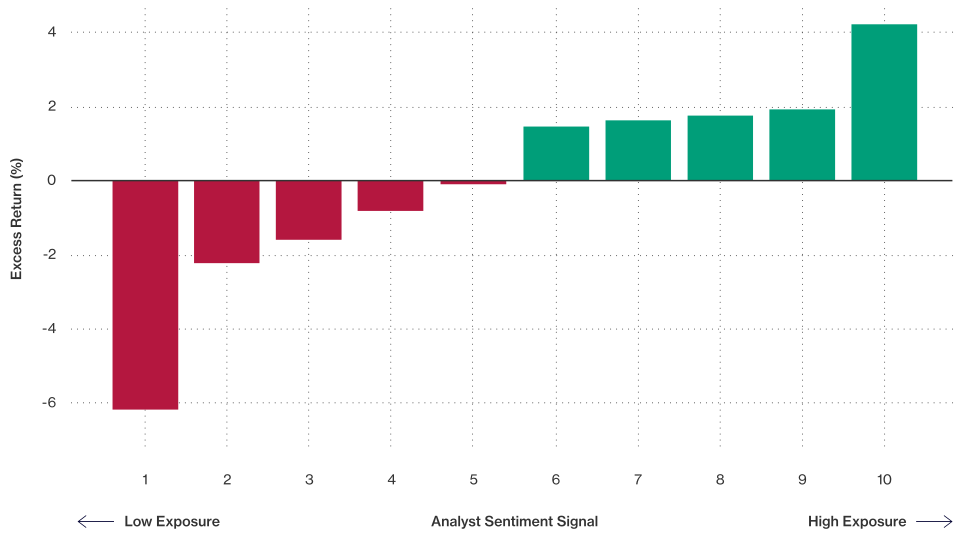
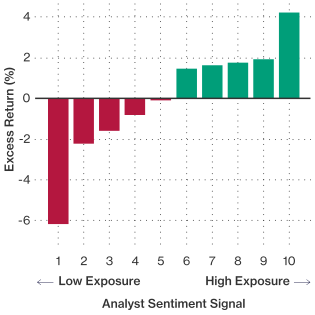
Source: MSCI. Returns based on MSCI ACWI IMI Index from June 29, 2007, to March 31, 2026. Past performance is no guarantee of future results. Index performance is not representative of fund performance. It is not possible to invest directly in an index.
What makes analyst sentiment distinct from other factors comes down to four properties:
- Forward-looking. It captures changes in earnings expectations rather than relying on backward-looking data like most traditional factors.
- Fundamentally driven. It reflects actual shifts in business outlooks, unlike price-based signals that tend to revert.
- Resilient across cycles. Historically, improving fundamentals have driven returns through rising rate periods, growth slowdowns, and periods of elevated volatility.
- Systematic. It is applied through a rules-based process that removes discretionary judgment from stock selection.
How do the underlying indexes work?
Both the MSCI EAFE Analyst Sentiment Select Index and the MSCI Emerging Markets Analyst Sentiment Select Index start with their respective MSCI parent universe. Each stock is scored on the sentiment signal every quarter, and an optimization process builds a portfolio that maximizes exposure to high-sentiment stocks while staying within strict risk constraints.
Those constraints are a core design feature for both indexes. Sector and country weights are anchored to the benchmark, individual security positions are capped, and each index targets an ex-ante tracking error of 4% or less versus its parent index. The portfolios are rebalanced quarterly in line with MSCI's standard review calendar, with sentiment scores refreshed at each rebalance.
How are the indexes constructed step by step?
Both the MSCI EAFE Analyst Sentiment Select Index and the MSCI Emerging Markets Analyst Sentiment Select Index follow a disciplined, repeatable process to translate analyst revisions into a systematic portfolio. Each moves through five stages:
- Starting Universe: The MSCI EAFE Analyst Sentiment Select Index starts with the full MSCI EAFE Index, covering large- and mid-cap developed market stocks across 21 countries (excluding the U.S. and Canada). The MSCI Emerging Markets Analyst Sentiment Select Index starts with the full MSCI Emerging Markets Index, covering large- and mid-cap emerging market stocks.
- Sentiment Signal: Each stock is scored on the analyst sentiment signal. Higher-ranked stocks -- those where analysts are most actively raising expectations -- receive greater emphasis. Scores are updated every quarter.
- Optimization: Portfolio weights are determined through a formal optimization process designed to maximize the overall tilt toward high-sentiment stocks while keeping the portfolio investable and diversified.
- Risk Constraints: Tracking error is targeted ex-ante at 4% or less versus each fund's respective parent index. Sector and country weights are anchored to the benchmark, and individual security positions are capped to limit concentration.
- Quarterly Rebalance: The portfolio is rebalanced in line with MSCI's standard index review calendar. Sentiment scores are refreshed and portfolio adjustments are made as conditions change.
The result for each index is a portfolio that systematically overweights stocks with improving analyst sentiment while staying close to the benchmark in terms of overall risk profile.
Why is tracking error important in VEFA and VEEM?
High-tracking-error factor portfolios can look very different from their benchmark, which creates uncertainty about what is driving returns and increases the risk of disappointing results versus expectations. That makes them harder to hold through periods of underperformance and harder to use as a core allocation.
Both VEFA and VEEM's underlying indexes are designed to keep tracking error constrained, so each fund behaves like an enhanced version of a core holding (VEFA relative to EAFE, VEEM relative to EM) rather than a standalone factor bet. Portfolio weights stay aligned with benchmark sectors and factors, with relative limits on individual positions, country weights and sector weights to control active risk. The goal is to add value from the sentiment signal without introducing the kind of drift that can undermine investor confidence.
Why Invest in International and Emerging Markets Now?
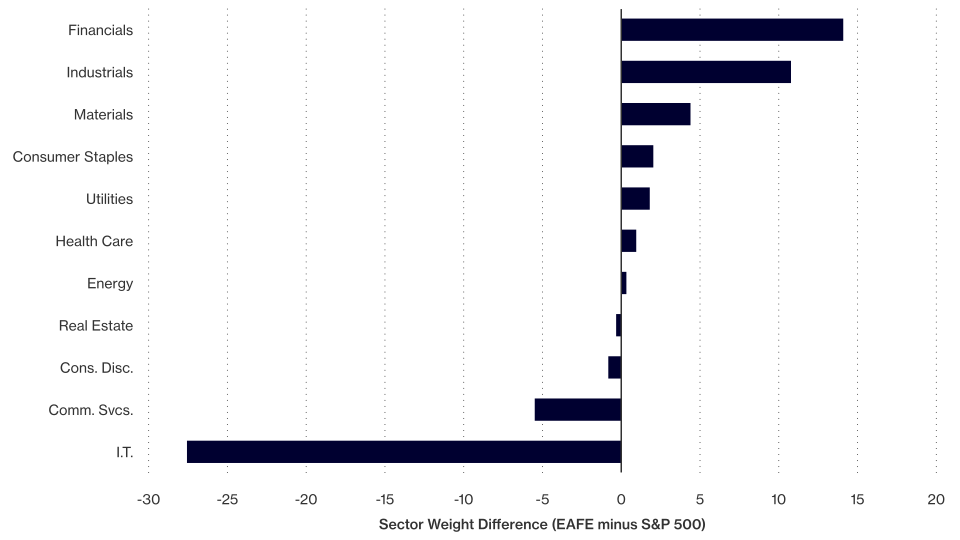
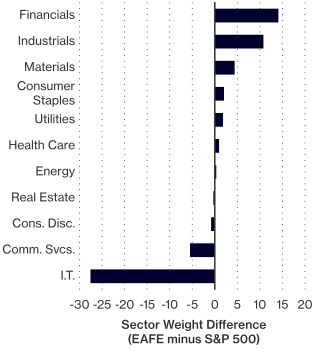
First, diversification. U.S. equities have become increasingly concentrated in a small number of large technology companies. International developed as represented by the MSCI EAFE Index offer a broader, more balanced sector mix and significantly less single-stock concentration, which can help reduce overall portfolio risk.
Sector Weight Difference Between EAFE and S&P 500
S&P 500 Heavily Concentrated in Top Ten Holdings
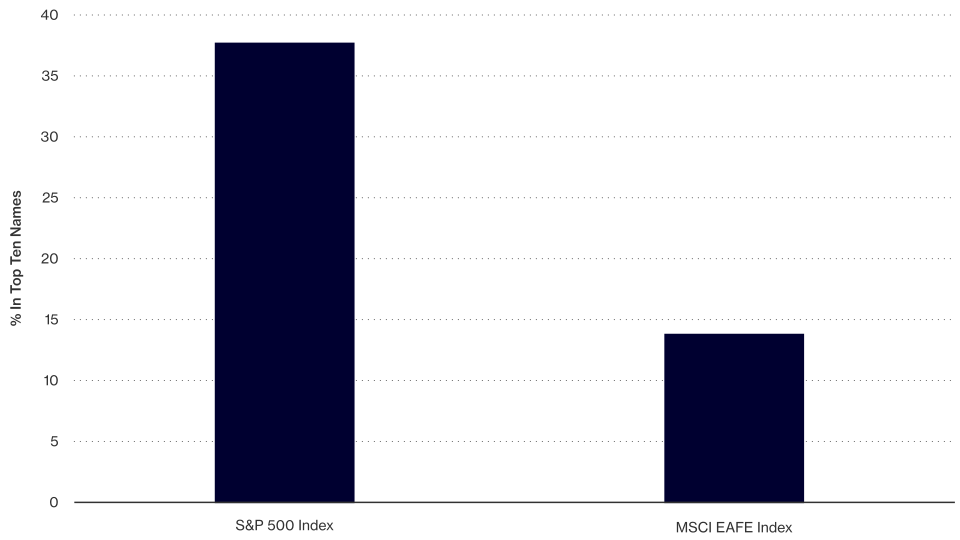
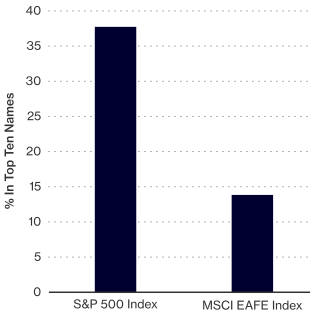
Source: VanEck, as of 8/31/2026. For illustrative purposes only. EAFE represented by the MSCI EAFE Index; S&P 500 by the S&P 500 Index. It is not possible to invest directly in an index.
Second, the trend is starting to shift. After more than a decade of U.S. dominance, international and emerging markets stocks are beginning to gain ground. The performance gap between U.S. compared to international and emerging markets peaked in late 2024 and has started to narrow, and there are growing tailwinds for international and emerging markets equities heading into 2026. For investors who have been underweight international stocks, this may be a favorable time to revisit that allocation.
MSCI EAFE Index and MSCI EM Index versus S&P 500 Index
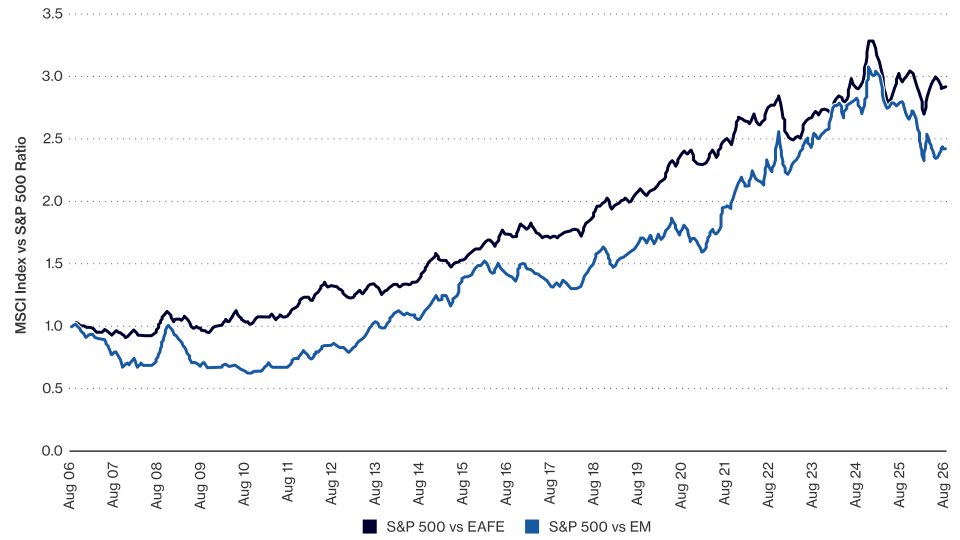
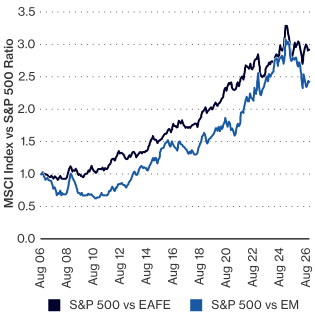
Source: Morningstar as of 8/31/2026 . EAFE represented by the MSCI EAFE Index; EM represented by the MSCI Emerging Markets Index. Past performance is no guarantee of future results. Index performance is not representative of fund performance. It is not possible to invest directly in an index.
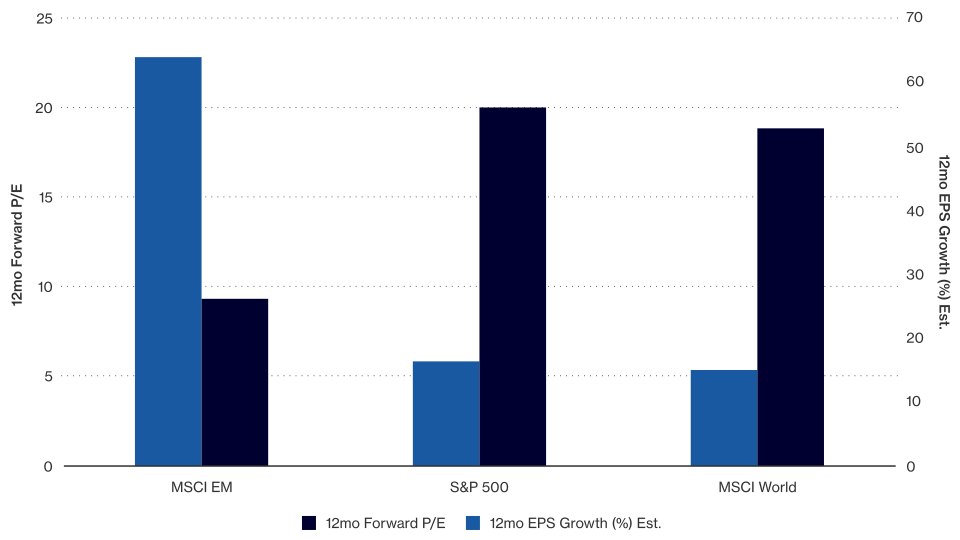
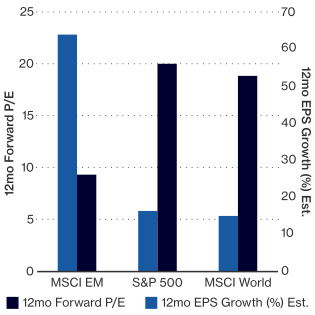
Third, EM equities offer a compelling growth-to-valuation tradeoff. Emerging markets are currently trading at a significant discount to developed market peers on a forward P/E basis, while offering higher estimated earnings growth in 2026. That combination -- cheaper valuations and stronger expected earnings momentum -- makes the current environment a favorable entry point for investors looking to diversify into EM.
Emerging markets are offering higher growth at a significant valuation discount to developed market peers
Source: Bloomberg as of 8/31/2026. MSCI EM represented by the MSCI Emerging Markets Index; S&P 500 by the S&P 500 Index; MSCI World by the MSCI World Index. Past performance is no guarantee of future results. Index performance is not representative of fund performance. It is not possible to invest directly in an index.
Recommended subscription
Are sell-side analysts biased and does it matter?
The question of whether sell-side analysts are structurally biased is a fair one, but it targets the wrong metric. Neither VEFA nor VEEM relies on analyst ratings or absolute opinion. Both track the direction of revisions, which means the question of whether analysts skew optimistic is not the relevant one. The relevant question is whether their views are improving or deteriorating, and on that dimension the signal has been historically consistent.
A stock being upgraded by its analyst coverage tells you something different than one sitting at a longstanding consensus buy with no recent activity. Both funds capture that directional shift across five metrics simultaneously: earnings estimates, price targets, sales forecasts, cash flow projections and ratings changes. Whether any individual analyst is optimistic or pessimistic in absolute terms is not the variable that drives the strategy.
It is also worth noting that analyst estimates are public, timestamped and tracked against outcomes by independent data providers. Analysts who miss consistently tend to lose institutional votes and coverage mandates over time. That creates a degree of accountability that reinforces the integrity of the underlying signal, even if it does not guarantee accuracy in any individual case.
How do VEFA and VEEM fit in a portfolio?
VEFA is designed to serve as a core international developed market equity allocation, and VEEM as a core emerging market equity allocation. Because both indexes are built with risk constraints that keep sector, country and factor exposures close to their respective benchmarks, each fund can replace or complement a standard passive allocation with the added benefit of a systematic sentiment tilt.
For investors who currently hold passive EAFE or EM exposure and are looking for a way to potentially enhance returns without significantly changing their risk profile, VEFA and VEEM offer a straightforward path. Each can also serve as a complement alongside active managers, providing a transparent, rules-based layer of factor exposure.
How to buy VanEck ETFs?
Explore Investment Ideas
To receive more Emerging Markets Equity insights, sign up in our subscription center.

Important Disclosures
This is not an offer to buy or sell, or a recommendation to buy or sell any of the securities, financial instruments or digital assets mentioned herein. The information presented does not involve the rendering of personalized investment, financial, legal, tax advice, or any call to action. Certain statements contained herein may constitute projections, forecasts and other forward-looking statements, which do not reflect actual results, are for illustrative purposes only, are valid as of the date of this communication, and are subject to change without notice. Actual future performance of any assets or industries mentioned are unknown. Information provided by third party sources are believed to be reliable and have not been independently verified for accuracy or completeness and cannot be guaranteed. VanEck does not guarantee the accuracy of third party data. The information herein represents the opinion of the author(s), but not necessarily those of VanEck or its other employees.
MSCI EAFE Index: The MSCI EAFE Index is an equity index which captures large and mid cap representation across 21 Developed Markets countries around the world, excluding the US and Canada. With 694 constituents, the index covers approximately 85% of the free float-adjusted market capitalization in each country.
MSCI EAFE Analyst Sentiment Select Index: MSCI EAFE Analyst Sentiment Select Index is based on MSCI EAFE Index, its parent index which includes large and mid-cap stocks across 21 Developed Markets countries around the world, excluding the US and Canada. The index uses an optimization process that aims to maximize the exposure to the Analyst Sentiment factor, while controlling for active risk, active specific risk and net ex-ante beta relative to the parent index.
MSCI Emerging Markets Index: The MSCI Emerging Markets Index captures large- and mid-cap representation across 24 Emerging Markets countries. With over 1,200 constituents, the index covers approximately 85% of the free float-adjusted market capitalization in each country.
MSCI Emerging Markets Analyst Sentiment Select Index: The MSCI Emerging Markets Analyst Sentiment Select Index is based on the MSCI Emerging Markets Index, its parent index which includes large- and mid-cap stocks across Emerging Markets countries. The index uses an optimization process that aims to maximize exposure to the Analyst Sentiment factor, while controlling for active risk, active specific risk and net ex-ante beta relative to the parent index.
MSCI ACWI IMI (All Country World Investable Market Index): a comprehensive stock market index capturing large, mid, and small-cap stocks across 23 Developed Markets (DM) and 24 Emerging Markets (EM). It covers roughly 99% of the global equity opportunity set, spanning over 9,000 securities
S&P 500 Index consists of 500 widely held common stocks covering the leading industries of the U.S. economy.
MSCI World Index: The MSCI World Index captures large- and mid-cap representation across 23 Developed Markets countries. It covers approximately 85% of the free float-adjusted market capitalization in each country.
Index returns are not Fund returns and do not reflect any management fees or brokerage expenses. Certain indices may take into account withholding taxes. Investors can not invest directly in the Index. Returns for actual Fund investors may differ from what is shown because of differences in timing, the amount invested and fees and expenses. Index returns assume that dividends have been reinvested.
AAn investment in the VanEck MSCI EM Analyst Sentiment ETF (VEEM) and VanEck MSCI EAFE Analyst Sentiment ETF (VEFA) may be subject to risks which include, but are not limited to, risks related to investments in emerging market issuers, foreign securities, foreign currency, information technology sector, financials sector, basic materials sector, industrials sector, health care sector, special risk considerations of investing in Chinese, European, Indian, Japanese, South Korean, Taiwanese and United Kingdom issuers, cash transactions, depositary receipts, equity securities, issuer-specific changes, medium- and large-capitalization companies, market, operational, index tracking, authorized participant concentration, new fund, no guarantee of active trading market, trading issues, passive management, fund shares trading, premium/discount, liquidity of fund shares, non-diversified, and index-related concentration risks, all of which may adversely affect the Funds. Emerging market issuers and foreign securities may be subject to securities markets, political and economic, investment and repatriation restrictions, different rules and regulations, less publicly available financial information, foreign currency and exchange rates, operational and settlement, and corporate and securities laws risks. Investments in Chinese issuers may entail additional risks that include, among others, lack of liquidity and price volatility, currency devaluations and exchange rate fluctuations, intervention by the Chinese government, nationalization or expropriation, limitations on the use of brokers, and trade limitations. Medium- and large-capitalization companies may be subject to elevated risks.
Investing involves substantial risk and high volatility, including possible loss of principal. An investor should consider the investment objective, risks, charges and expenses of a Fund carefully before investing. To obtain a prospectus and summary prospectus, which contain this and other information, call 800.826.2333 or visit vaneck.com. Please read the prospectus and summary prospectus carefully before investing.
© Van Eck Securities Corporation, Distributor, a wholly owned subsidiary of Van Eck Associates Corporation.
Related Funds
Important Disclosures
This is not an offer to buy or sell, or a recommendation to buy or sell any of the securities, financial instruments or digital assets mentioned herein. The information presented does not involve the rendering of personalized investment, financial, legal, tax advice, or any call to action. Certain statements contained herein may constitute projections, forecasts and other forward-looking statements, which do not reflect actual results, are for illustrative purposes only, are valid as of the date of this communication, and are subject to change without notice. Actual future performance of any assets or industries mentioned are unknown. Information provided by third party sources are believed to be reliable and have not been independently verified for accuracy or completeness and cannot be guaranteed. VanEck does not guarantee the accuracy of third party data. The information herein represents the opinion of the author(s), but not necessarily those of VanEck or its other employees.
MSCI EAFE Index: The MSCI EAFE Index is an equity index which captures large and mid cap representation across 21 Developed Markets countries around the world, excluding the US and Canada. With 694 constituents, the index covers approximately 85% of the free float-adjusted market capitalization in each country.
MSCI EAFE Analyst Sentiment Select Index: MSCI EAFE Analyst Sentiment Select Index is based on MSCI EAFE Index, its parent index which includes large and mid-cap stocks across 21 Developed Markets countries around the world, excluding the US and Canada. The index uses an optimization process that aims to maximize the exposure to the Analyst Sentiment factor, while controlling for active risk, active specific risk and net ex-ante beta relative to the parent index.
MSCI Emerging Markets Index: The MSCI Emerging Markets Index captures large- and mid-cap representation across 24 Emerging Markets countries. With over 1,200 constituents, the index covers approximately 85% of the free float-adjusted market capitalization in each country.
MSCI Emerging Markets Analyst Sentiment Select Index: The MSCI Emerging Markets Analyst Sentiment Select Index is based on the MSCI Emerging Markets Index, its parent index which includes large- and mid-cap stocks across Emerging Markets countries. The index uses an optimization process that aims to maximize exposure to the Analyst Sentiment factor, while controlling for active risk, active specific risk and net ex-ante beta relative to the parent index.
MSCI ACWI IMI (All Country World Investable Market Index): a comprehensive stock market index capturing large, mid, and small-cap stocks across 23 Developed Markets (DM) and 24 Emerging Markets (EM). It covers roughly 99% of the global equity opportunity set, spanning over 9,000 securities
S&P 500 Index consists of 500 widely held common stocks covering the leading industries of the U.S. economy.
MSCI World Index: The MSCI World Index captures large- and mid-cap representation across 23 Developed Markets countries. It covers approximately 85% of the free float-adjusted market capitalization in each country.
Index returns are not Fund returns and do not reflect any management fees or brokerage expenses. Certain indices may take into account withholding taxes. Investors can not invest directly in the Index. Returns for actual Fund investors may differ from what is shown because of differences in timing, the amount invested and fees and expenses. Index returns assume that dividends have been reinvested.
AAn investment in the VanEck MSCI EM Analyst Sentiment ETF (VEEM) and VanEck MSCI EAFE Analyst Sentiment ETF (VEFA) may be subject to risks which include, but are not limited to, risks related to investments in emerging market issuers, foreign securities, foreign currency, information technology sector, financials sector, basic materials sector, industrials sector, health care sector, special risk considerations of investing in Chinese, European, Indian, Japanese, South Korean, Taiwanese and United Kingdom issuers, cash transactions, depositary receipts, equity securities, issuer-specific changes, medium- and large-capitalization companies, market, operational, index tracking, authorized participant concentration, new fund, no guarantee of active trading market, trading issues, passive management, fund shares trading, premium/discount, liquidity of fund shares, non-diversified, and index-related concentration risks, all of which may adversely affect the Funds. Emerging market issuers and foreign securities may be subject to securities markets, political and economic, investment and repatriation restrictions, different rules and regulations, less publicly available financial information, foreign currency and exchange rates, operational and settlement, and corporate and securities laws risks. Investments in Chinese issuers may entail additional risks that include, among others, lack of liquidity and price volatility, currency devaluations and exchange rate fluctuations, intervention by the Chinese government, nationalization or expropriation, limitations on the use of brokers, and trade limitations. Medium- and large-capitalization companies may be subject to elevated risks.
Investing involves substantial risk and high volatility, including possible loss of principal. An investor should consider the investment objective, risks, charges and expenses of a Fund carefully before investing. To obtain a prospectus and summary prospectus, which contain this and other information, call 800.826.2333 or visit vaneck.com. Please read the prospectus and summary prospectus carefully before investing.
© Van Eck Securities Corporation, Distributor, a wholly owned subsidiary of Van Eck Associates Corporation.