CLO Opportunities Fund: Question & Answer
Read Time 11 MIN
- What does the VanEck CLO Opportunities Fund invest in?
- How does the Fund complement CLOI and CLOB?
- How can the Fund be used within a portfolio?
- What is CLO equity?
- How has CLO equity performed historically?
- How has CLO mezzanine debt performed historically?*
- Why invest in the CLO Opportunities Fund?
- How do I invest?
- How can I redeem my shares?
- If I put in a redemption request, can I change or cancel it before the deadline?
- What is a CLO?
- What is the process used to select securities and construct the portfolio?
What does the VanEck CLO Opportunities Fund invest in?
The VanEck CLO Opportunities Fund is an interval fund that invests primarily in the equity and junior mezzanine debt tranches of collateralized loan obligations (CLOs) backed by broadly syndicated loans. CLO equity is the junior–most tranche in a CLO, receiving residual cash flows from a diversified portfolio of 200–300+ leveraged loans after debt investors and operating expenses are paid. This positioning provides leveraged exposure to the underlying loan portfolio, generating high income through residual distributions. The Fund also invests in lower–rated CLO debt tranches, including BB, B, and BBB–rated CLOs, which offer significantly higher spreads and yield potential versus investment grade CLO tranches and similarly rated corporate bonds and loans.
The Fund is actively managed by PineBridge Investments, which serves as the sub–advisor. PineBridge has been active in the CLO market since the 1990s and is both a CLO manager and tranche investor, bringing decades of experience and extensive credit capabilities to the Fund’s investment process.
How does the Fund complement CLOI and CLOB?
The VanEck CLO ETF (CLOI) focuses on investment grade CLOs and offers investors a way to add CLO exposure to their core bond portfolio. The VanEck AA–BB CLO ETF (CLOB) provides access to mezzanine CLO tranches rated AA to BB, aiming to deliver significantly greater return potential versus an investment grade strategy with a strong focus on managing downside risk. The CLO Opportunities Fund extends this product suite by investing in CLO equity and the most junior mezzanine debt tranches, targeting a higher level of income and total return potential for investors who can tolerate greater risk and lower liquidity.
The CLO Opportunities Fund provides a high income option for investors who are able to tolerate a higher degree of risk in a less liquid vehicle, and can serve as an attractive complement to the stable income and daily liquidity provided by CLOI and CLOB. All three funds are sub–advised by PineBridge Investments and benefit from the same investment team and process.
How can the Fund be used within a portfolio?
The Fund may be an attractive addition within an income–oriented portfolio for investors seeking high yield potential with diversification benefits. CLO equity has exhibited low to moderate correlations versus other asset classes such as high yield bonds, senior CLO debt, U.S. equities, and investment grade corporate debt. Its differentiated return drivers can provide stability and diversification within a broader portfolio.
The Fund may be appropriate for investors who seek exposure to alternative investments without private fund complexity, have longer investment horizons and can accept limited liquidity, seek yield enhancement or diversification benefits, and prefer NAV–based pricing. CLO equity also offers a relatively shorter average life than asset classes with similar return profiles, such as private equity, without the negative returns typically associated with such investments in early years (the “j–curve”).
What is CLO equity?
CLO equity is the junior–most tranche in a collateralized loan obligation (CLO), receiving the residual cash flows from a diversified portfolio of 200–300+ leveraged loans after all debt investors and operating expenses have been paid. This positioning provides leveraged exposure to the underlying loan portfolio, as the equity tranche typically comprises approximately 10% of a CLO’s capital structure, resulting in structural leverage of approximately 10x. CLO equity investors benefit not only from high income through residual distributions, but also from potential upside through active management—for example, when a CLO manager buys undervalued loans and sells appreciated ones, the resulting gains are amplified by structural leverage, translating small portfolio gains into outsized equity returns.
CLO equity investors also benefit from embedded optionality not available to debt investors. They can direct the manager to call the CLO (liquidating the portfolio and capturing any value above par), refinance when debt spreads tighten (replacing existing debt with cheaper financing to increase residual payments), or reset the deal at current market terms (locking in favorable spreads and extending the life of the transaction). The trade–off for this return potential is risk: as the first–loss tranche, equity absorbs all default losses before any debt tranche is impacted, and leveraged exposure amplifies price volatility. However, several structural features provide protection, including highly diversified portfolios, active management by CLO managers, and term financing without mark–to–market triggers that prevent forced liquidation during market stress.
How has CLO equity performed historically?
CLO equity has historically delivered substantial, front–loaded returns driven largely by regular quarterly cash distributions. Equity investors typically, target 12–15% IRRs,1 though this can vary significantly by vintage year and manager, and returns exhibit significant dispersion. For example, in 2024, the bottom quartile of CLO equity returned 6% while the top quartile provided returns of 29%,2 highlighting the importance of manager selection. Because CLO equity does not carry a stated coupon, expected returns are based on several assumptions including default rates, prepayment speed, and recovery rates.
CLO equity has also exhibited low to moderate correlations versus other asset classes including high yield bonds, senior CLO debt and U.S. equities, making it an attractive addition to a broader portfolio while also providing high income potential.
How has CLO mezzanine debt performed historically?*
Mezzanine CLO debt has demonstrated attractive risk–adjusted returns relative to other fixed income asset classes. Over the past decade through 12/31/2025, BBB and BB–rated CLOs have returned 7.0 and 11.4% annually, respectively, compared to 4.2% for broad investment grade CLOs and 6.5% for U.S. high yield corporate bonds. BB CLO returns have been particularly strong in recent years, outperforming the S&P 5001 3 since the beginning of 2022 on both an absolute and risk–adjusted basis. At each rating category below AAA, CLOs provide a higher yield than similarly rated bonds and loans, driven by significantly higher credit spreads.
CLO debt also benefits from meaningfully lower historical default rates compared to similarly rated corporate bonds. Since 1997, the average annual default rate for BBB CLOs has been 0.00% (versus 0.15% for BBB corporates), and for BB CLOs it has been 0.01% (versus 0.60% for BB corporates).4 These favorable default characteristics reflect the multiple structural protections inherent in CLOs, including subordination, active management, covenants and collateral quality requirements, and excess spread. CLO debt is floating rate, providing insulation from interest rate volatility, and high yields provide a stable stream of regular income.
The returns discussed in this section are index returns, which are not illustrative of fund returns. It is not possible to invest directly in an index. CLO debt and equities differ significantly in structure, volatility, liquidity, and risk characteristics, and investors cannot invest directly in an index. Past performance is no guarantee of future results.
Why invest in the CLO Opportunities Fund?
The investment case for the Fund centers on the ability to dynamically allocate between CLO equity and mezzanine debt to capture the most attractive opportunities in a given market environment. Debt and equity can have different return drivers—for example, a strong credit environment typically favors equity over debt, while higher volatility may have a more negative impact on equity prices in the near term but ultimately drive higher equity forward returns due to the ability to actively trade the loan portfolio. Returns can vary significantly between debt and equity in a given year, and equity is not always the highest returning tranche.
The Fund also benefits from significant dispersion within CLO equity and debt, which creates opportunities for active management to add value through bottom–up deal selection and top–down portfolio positioning. PineBridge’s extensive credit capabilities, including a 15–member credit research team and proprietary credit analysis platform, allow the team to identify high quality portfolios and skilled CLO managers, perform rigorous due diligence and stress testing, and determine which tranche of a CLO provides the most attractive value. The flexibility to invest across mezzanine debt and equity, combined with the expertise to evaluate CLO portfolios and identify attractive opportunities, is central to the Fund’s approach.
How do I invest?
Investing in the VanEck CLO Opportunities Fund is similar to purchasing shares of a mutual fund. Shares may be purchased through a financial advisor or directly through the Fund’s transfer agent.
How can I redeem my shares?
As an interval fund, the VanEck CLO Opportunities Fund offers liquidity through quarterly repurchase offers rather than daily redemptions, typically for 5% of shares outstanding each quarter (which may be increased). Shareholders submit a repurchase request through their broker, advisor, or directly to the Fund’s transfer agent before the stated deadline for each quarterly repurchase offer.
If total repurchase requests exceed the offer amount, requests are fulfilled on a pro–rata basis. For example, if the Fund offers to repurchase 5% of shares but receives requests for 10%, each investor would receive 50% of their requested amount. Proceeds are typically paid within 7 days after the repurchase pricing date.
If I put in a redemption request, can I change or cancel it before the deadline?
Yes, shareholders may withdraw or change a repurchase request by submitting a proper instruction in good form at any point before the repurchase request deadline. Shareholders should coordinate with their financial advisor or the Fund’s transfer agent to ensure any changes or cancellations are submitted well in advance of the deadline.
What is a CLO?
A CLO is a portfolio of predominantly senior secured bank loans that is securitized and actively managed. Each CLO issues a series of floating rate bonds, along with a first–loss equity tranche. The tranches differ in terms of subordination and priority–and, thus, lowest to highest in order of riskiness.
Subordination and Priority of CLO Tranches
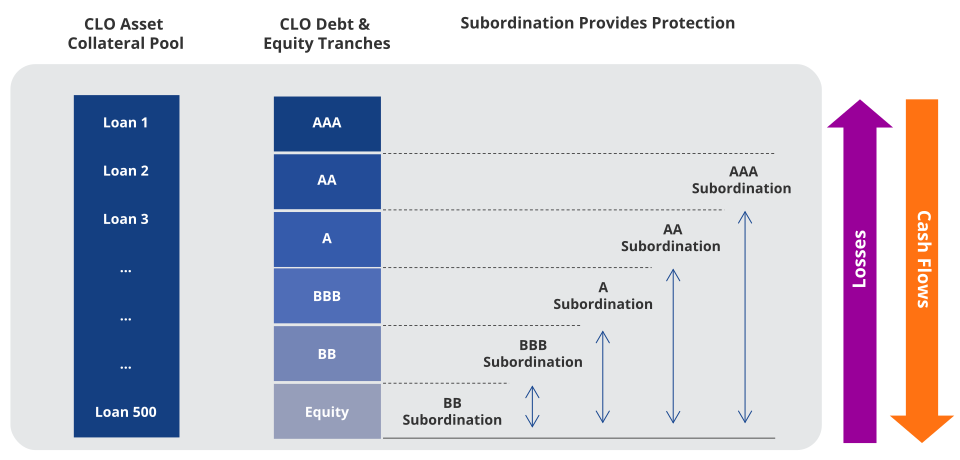
Source: PineBridge Investments. This is not an offer to buy or sell, or recommendation to buy or sell any of the securities mentioned herein. Past performance is no guarantee of future results. For illustrative purposes only.
CLOs are actively managed vehicles–i.e., they have a reinvestment period during which the manager can buy and sell loans within the portfolio and reinvest within the parameters set forth by the governing documents. Managers can add value by reinvesting and positioning portfolios to increase returns in benign economic environments and protect against downside risk during weaker economic times.
Each CLO has a defined lifecycle in which collateral is purchased, managed, redeemed, and returned to investors. The standard lifecycle includes five stages:
- Warehousing (3–6 months): The manager purchases the initial collateral before the closing date.
- Ramp–up (1–6 months): Following the closing date, the manager purchases the remaining collateral to complete the original portfolio. After the ramp–up is complete, the manager also performs monthly tests to ensure the portfolio’s ability to cover its interest and principal payments.
- Reinvestment (1–5 years): Following the ramp–up period, the manager can reinvest all loan proceeds, either purchasing or selling bank loans to improve the portfolio’s credit quality.
- Non–call (first 0.5 to 2 years of reinvestment): Loan–tranche holders earn a per–tranche yield spread specified at closing, after which the majority equity–tranche holder can call or refinance the loan tranches.
- Repayment and deleveraging (1–4 years): As underlying loans are paid off, the manager pays down the loan tranches in order of seniority and distributes the remaining proceeds to the equity–tranche holders.
CLO Lifecycle
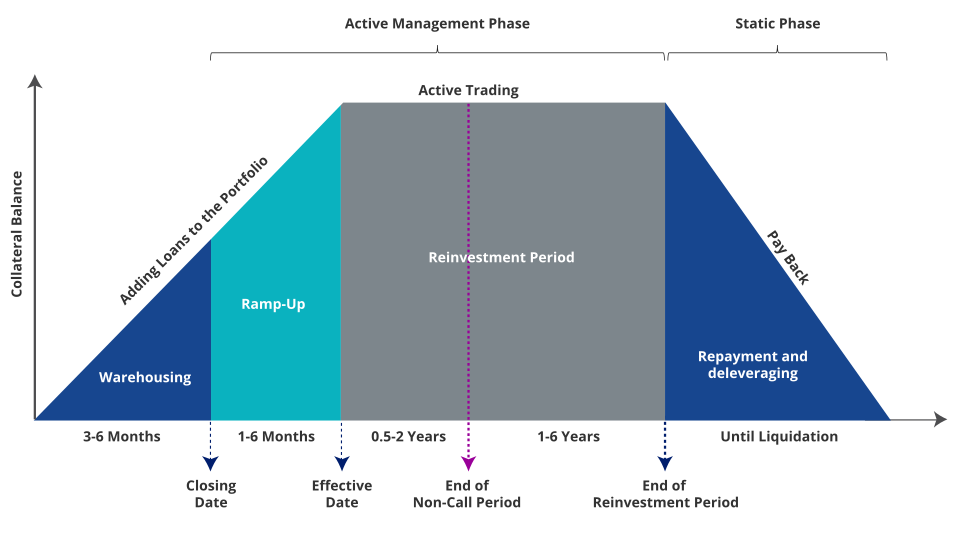
Source: VanEck. This is not an offer to buy or sell, or recommendation to buy or sell any of the securities mentioned herein. Past performance is no guarantee of future results. For illustrative purposes only.
What is the process used to select securities and construct the portfolio?
PineBridge draws on its decades of CLO market experience and the credit expertise of its leveraged finance team to identify credit and CLO manager risk within a CLO. The process is summarized below:
- CLO Manager Due Diligence: Based on a systematic due diligence process, PineBridge classifies CLO managers and focuses investments on those with an established process and team.
- Re–Underwrite CLO: PineBridge collects and analyzes fundamental loan–level data using its proprietary credit platform, which drives portfolio credit analysis, risk measurement and optimization. The team reviews each CLO’s structure and documentation, which—combined with the collateral analysis and stress–test analysis—is the basis of the investment analysis.
- Construct Portfolio: Portfolios are constructed by PineBridge using both bottom–up deal selection from the re–underwriting process and a top–down overlay that incorporates the group’s credit views.
- Risk Monitoring: There is ongoing compliance and risk monitoring, as well as regular reviews of the portfolio and CLO–specific metrics that can result in rebalancing. Various portfolio and performance metrics act as “credit review triggers” and form the basis of the sell discipline.



Important Disclosures
1 Source: BofA Research
2 Source: BofA Research
3 Source: Morningstar and J.P. Morgan. From January 1, 2022, through December 31, 2025, BB-rated CLOs generated an annualized total return of 11.7% (Sharpe ratio of 0.99), compared to 11.1% (Sharpe ratio of 0.48) for the S&P 500 Index over the same period. Risk-adjusted returns are measured using the Sharpe ratio, which calculates excess return (over the risk-free rate) per unit of total return volatility, as measured by standard deviation. A higher Sharpe ratio indicates greater return per unit of risk over the stated period.
4 Source: S&P Global: Default, Transition, and Recovery: 2024 Annual Global Leveraged Loan CLO Default And Rating Transition Study and S&P Global: Default, Transition, and Recovery: 2024 Annual Global Corporate Default And Rating Transition Study.
BBB Rated CLOs represented by J.P. Morgan CLO BBB Index.
BB Rated CLOs represented by J.P. Morgan CLO BB Index.
Broad IG CLOs represented by J.P. Morgan CLO IG Index.
US HY Corporate Bonds represented by ICE BofA US High Yield Index.
This is not an offer to buy or sell, or a recommendation to buy or sell any of the securities, financial instruments or digital assets mentioned herein. The information presented does not involve the rendering of personalized investment, financial, legal, tax advice, or any call to action. Certain statements contained herein may constitute projections, forecasts and other forward–looking statements, which do not reflect actual results, are for illustrative purposes only, are valid as of the date of this communication, and are subject to change without notice. Actual future performance of any assets or industries mentioned are unknown. Information provided by third party sources are believed to be reliable and have not been independently verified for accuracy or completeness and cannot be guaranteed. VanEck does not guarantee the accuracy of third party data. The information herein represents the opinion of the author(s), but not necessarily those of VanEck or its other employees.
VanEck CLO Opportunities Fund (“CLOO”) Risks
The fund is subject to a high degree of risk and volatility and could result in significant losses, including the loss of a substantial portion or all of your investment.
An investment in the Fund may be subject to risks which includes, among others, CLO, CLO equity tranche, debt securities, high yield securities, income, valuation, privately issued securities, covenant lite loans, SOFR, investment sourcing, defaulted securities, syndicated loan, correlation, liquidity (quarterly repurchases and underlying investments), leveraging, CLO manager, investment focus, newly issued securities, extended settlement, private credit, underlying fund, business development company, foreign currency, derivatives, repurchase policy, distribution and RIC status, new fund, market, active management, non–diversified, potential conflicts of interest, and minimal capitalization risks, all of which may adversely affect the Fund. Debt securities may be subject to additional risks, such as liquidity, interest rate, floating rate obligations, credit, call, and extension risks.
The Fund is a closed–end management investment company structured as an “interval fund,” and its shares are not listed on any securities exchange and are not expected to have a secondary market, so an investment should be considered illiquid. Liquidity is provided only through quarterly repurchase offers conducted pursuant to Rule 23c–3 under the Investment Company Act of 1940, which generally permit the Fund to offer to repurchase between 5% and 25% of outstanding shares per quarter, as determined by the Fund’s Board. Repurchase requests may be oversubscribed and prorated, meaning you may be unable to sell all (or any) of your shares when desired and may have to hold shares for an indefinite period, and repurchase offers may be suspended or postponed in limited circumstances.
The Fund invests primarily in CLO debt and CLO equity (including BBB–rated and lower tranches and unrated equity). CLOs are complex and may be difficult to value and trade and are exposed to leveraged–loan credit risk, including borrower defaults and reduced recoveries. Investments in CLO equity and other junior tranches are subject to structural subordination and “first–loss” risk, including the diversion of cash flows to senior tranches after certain collateral quality test failures, and may result in a partial or total loss of investment.
The Fund may employ leverage, which may magnify gains and losses and increase volatility of the Fund’s net asset value. The Fund’s distributions, if any, are not guaranteed and may be paid from sources other than net investment income, including return of capital or borrowings, which may reduce the Fund’s net asset value and capital available for future investment.
VanEck AA–BB CLO ETF (CLOB) and VanEck CLO ETF (CLOI) Risks
The fund is subject to a high degree of risk and volatility and could result in significant losses, including the loss of a substantial portion or all of your investment.
An investment in the Funds may be subject to risks which include, but are not limited to, risks related to Collateralized Loan Obligations (CLO), debt securities, foreign currency, foreign securities, investment focus, newly–issued securities, extended settlement, affiliated fund investment, management and capital preservation, derivatives, currency management strategies, cash transactions, market, Sub–Adviser, operational, authorized participant concentration, no guarantee of active trading market, trading issues, fund shares trading, premium/discount, liquidity of fund shares, non–diversified, seed investor, and new fund risks, all of which may adversely affect the Funds. Investments in debt securities may expose the Fund to other risks, such as risks related to liquidity, interest rate, floating rate obligations, credit, call, extension, high yield securities, income, valuation, privately–issued securities, covenant lite loans, default of the underlying asset and CLO manager risks, all of which may impact the Fund’s performance. Derivatives may involve certain costs and risks such as liquidity, interest rate, and the risk that a position could not be closed when most advantageous.
Investing involves substantial risk and high volatility, including possible loss of principal. An investor should consider the investment objective, risks, charges and expenses of the Funds carefully before investing. To obtain a prospectus and summary prospectus, which contain this and other information, call 800.826.2333 or visit vaneck.com. Please read the prospectus and summary prospectus carefully before investing.
© Van Eck Securities Corporation, Distributor, a wholly–owned subsidiary of Van Eck Associates Corporation.
Related Funds
Important Disclosures
1 Source: BofA Research
2 Source: BofA Research
3 Source: Morningstar and J.P. Morgan. From January 1, 2022, through December 31, 2025, BB-rated CLOs generated an annualized total return of 11.7% (Sharpe ratio of 0.99), compared to 11.1% (Sharpe ratio of 0.48) for the S&P 500 Index over the same period. Risk-adjusted returns are measured using the Sharpe ratio, which calculates excess return (over the risk-free rate) per unit of total return volatility, as measured by standard deviation. A higher Sharpe ratio indicates greater return per unit of risk over the stated period.
4 Source: S&P Global: Default, Transition, and Recovery: 2024 Annual Global Leveraged Loan CLO Default And Rating Transition Study and S&P Global: Default, Transition, and Recovery: 2024 Annual Global Corporate Default And Rating Transition Study.
BBB Rated CLOs represented by J.P. Morgan CLO BBB Index.
BB Rated CLOs represented by J.P. Morgan CLO BB Index.
Broad IG CLOs represented by J.P. Morgan CLO IG Index.
US HY Corporate Bonds represented by ICE BofA US High Yield Index.
This is not an offer to buy or sell, or a recommendation to buy or sell any of the securities, financial instruments or digital assets mentioned herein. The information presented does not involve the rendering of personalized investment, financial, legal, tax advice, or any call to action. Certain statements contained herein may constitute projections, forecasts and other forward–looking statements, which do not reflect actual results, are for illustrative purposes only, are valid as of the date of this communication, and are subject to change without notice. Actual future performance of any assets or industries mentioned are unknown. Information provided by third party sources are believed to be reliable and have not been independently verified for accuracy or completeness and cannot be guaranteed. VanEck does not guarantee the accuracy of third party data. The information herein represents the opinion of the author(s), but not necessarily those of VanEck or its other employees.
VanEck CLO Opportunities Fund (“CLOO”) Risks
The fund is subject to a high degree of risk and volatility and could result in significant losses, including the loss of a substantial portion or all of your investment.
An investment in the Fund may be subject to risks which includes, among others, CLO, CLO equity tranche, debt securities, high yield securities, income, valuation, privately issued securities, covenant lite loans, SOFR, investment sourcing, defaulted securities, syndicated loan, correlation, liquidity (quarterly repurchases and underlying investments), leveraging, CLO manager, investment focus, newly issued securities, extended settlement, private credit, underlying fund, business development company, foreign currency, derivatives, repurchase policy, distribution and RIC status, new fund, market, active management, non–diversified, potential conflicts of interest, and minimal capitalization risks, all of which may adversely affect the Fund. Debt securities may be subject to additional risks, such as liquidity, interest rate, floating rate obligations, credit, call, and extension risks.
The Fund is a closed–end management investment company structured as an “interval fund,” and its shares are not listed on any securities exchange and are not expected to have a secondary market, so an investment should be considered illiquid. Liquidity is provided only through quarterly repurchase offers conducted pursuant to Rule 23c–3 under the Investment Company Act of 1940, which generally permit the Fund to offer to repurchase between 5% and 25% of outstanding shares per quarter, as determined by the Fund’s Board. Repurchase requests may be oversubscribed and prorated, meaning you may be unable to sell all (or any) of your shares when desired and may have to hold shares for an indefinite period, and repurchase offers may be suspended or postponed in limited circumstances.
The Fund invests primarily in CLO debt and CLO equity (including BBB–rated and lower tranches and unrated equity). CLOs are complex and may be difficult to value and trade and are exposed to leveraged–loan credit risk, including borrower defaults and reduced recoveries. Investments in CLO equity and other junior tranches are subject to structural subordination and “first–loss” risk, including the diversion of cash flows to senior tranches after certain collateral quality test failures, and may result in a partial or total loss of investment.
The Fund may employ leverage, which may magnify gains and losses and increase volatility of the Fund’s net asset value. The Fund’s distributions, if any, are not guaranteed and may be paid from sources other than net investment income, including return of capital or borrowings, which may reduce the Fund’s net asset value and capital available for future investment.
VanEck AA–BB CLO ETF (CLOB) and VanEck CLO ETF (CLOI) Risks
The fund is subject to a high degree of risk and volatility and could result in significant losses, including the loss of a substantial portion or all of your investment.
An investment in the Funds may be subject to risks which include, but are not limited to, risks related to Collateralized Loan Obligations (CLO), debt securities, foreign currency, foreign securities, investment focus, newly–issued securities, extended settlement, affiliated fund investment, management and capital preservation, derivatives, currency management strategies, cash transactions, market, Sub–Adviser, operational, authorized participant concentration, no guarantee of active trading market, trading issues, fund shares trading, premium/discount, liquidity of fund shares, non–diversified, seed investor, and new fund risks, all of which may adversely affect the Funds. Investments in debt securities may expose the Fund to other risks, such as risks related to liquidity, interest rate, floating rate obligations, credit, call, extension, high yield securities, income, valuation, privately–issued securities, covenant lite loans, default of the underlying asset and CLO manager risks, all of which may impact the Fund’s performance. Derivatives may involve certain costs and risks such as liquidity, interest rate, and the risk that a position could not be closed when most advantageous.
Investing involves substantial risk and high volatility, including possible loss of principal. An investor should consider the investment objective, risks, charges and expenses of the Funds carefully before investing. To obtain a prospectus and summary prospectus, which contain this and other information, call 800.826.2333 or visit vaneck.com. Please read the prospectus and summary prospectus carefully before investing.
© Van Eck Securities Corporation, Distributor, a wholly–owned subsidiary of Van Eck Associates Corporation.