Preferred Stocks Emerge as a High Monthly Income Source
November 24, 2025
Read Time 4 MIN
Key Points
- Preferred securities can help investors maximize yields during times of falling rates due to their unique structure that sits between bonds and common equity.
- Preferred securities can be imbalanced towards financial companies. By excluding financials investors have a more balanced and differentiated portfolio.
- The VanEck Preferred Securities ex Financials ETF (PFXF) provides diversified exposure to U.S.-listed preferred securities without the financial sector risk.
Maximizing Yields for Falling Rates
In an environment where income is harder to come by, preferred securities remain appealing. These hybrid instruments sit between bonds and common equity in a company’s capital structure, offering higher coupons than bonds while retaining seniority over common stock. The appeal is amplified now, as many income-oriented investors brace for muted bond returns and look for additional yield.
By avoiding preferred securities issued by financial institutions (banks, insurers, etc.), PFXF focuses on high-yielding preferreds from utilities, REITs, industrial hybrids, and other non-financial issuers. That distinction matters in late 2025, as the financial sector faces renewed uncertainty.
Ex-financial preferreds sit toward the top of the income spectrum. At roughly 6.9% current yield, they outpace not only the S&P 500’s 1.1% dividend yield but also Treasuries (4.2%), high-grade corporates (4.7%), and even broad preferred-stock benchmarks (6.1%). In a market where traditional income sources remain compressed, that incremental yield can make a meaningful difference in total return potential and portfolio diversification.
Ex-Financial Preferreds Yield Comparison
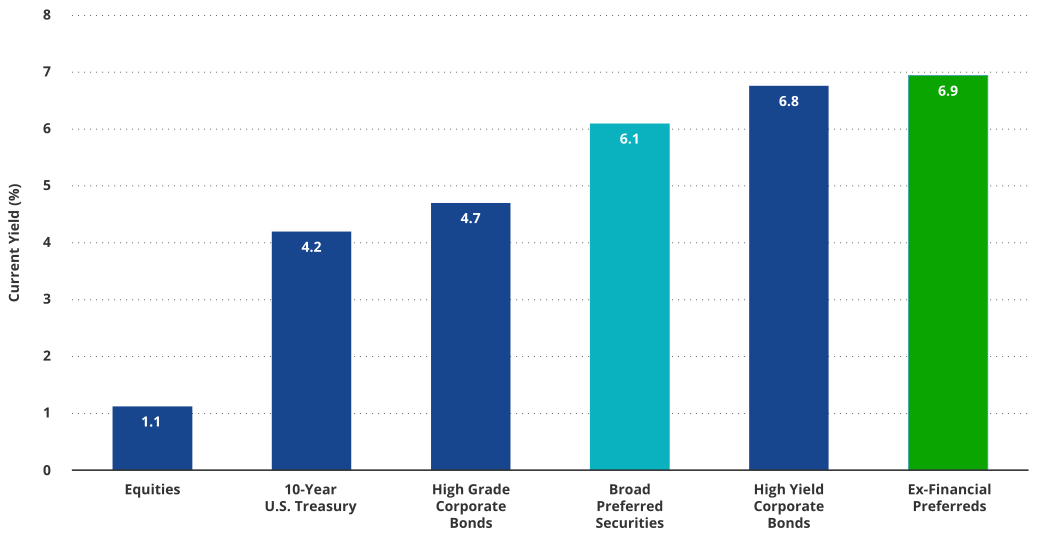
Source: ICE Data Indices, FactSet as of October 2025. Yields presented are current yields (ratio of annual interest payment and the security’s current price), except for Equities’ dividend yield (dividend per share, divided by the price per share. Broad Preferred Securities universe is represented by the ICE Exchange-Listed Fixed & Adjustable Rate Preferred Securities Index (PFAR), Ex-Financial Preferreds represented by the ICE Exchange-Listed Fixed & Adjustable Rate Non-Financial Preferred Securities Index (PFAN), 10-Year U.S. Treasury represents ICE BofA Current 10-Year US Treasury Index (GA10), Equities represents S&P 500® Index (SPX), High Grade Corporate Bonds represents ICE BofA US Corporate Index (C0A0), and High Yield Corporate Bonds represents ICE BofA US High Yield Index (H0A0). See disclaimers and index descriptions at the end of this presentation. An index's performance is not illustrative of a fund's performance. Indices are not securities in which investments can be made. Past performance is not a guarantee of future results.
Recommended subscription
Why Concentration Risk Adds Weight to the “Ex-Financials” Case
While investors often discuss “Mag 7” concentration in equities, few recognize that preferreds face an even greater imbalance toward Financials. Banks and insurers issue most preferred securities, leaving most broad preferred strategies heavily concentrated in one sector. This concentration means that shifts in regulation, credit conditions, or capital requirements can move a large portion of the preferreds market at once, reducing diversification and increasing volatility.
At the same time, the financial landscape itself is evolving. Growth in digital assets and stablecoin adoption is reshaping conversations around payments, deposits, and balance-sheet design. These changes are still developing, but they highlight how quickly business models at traditional financial institutions can shift. For preferred investors, that backdrop reinforces the value of reducing heavy exposure to any one sector.
By excluding Financials, PFXF avoids that concentration and provides access to preferred income sourced from utilities, REITs, industrial hybrids, and other non-financial issuers. The result is a more balanced and differentiated preferreds profile that complements, rather than mirrors, the financial sector’s cycle.
How to Manage Call Risk and Reinvestment Stability
A key differentiator for PFXF is its lower exposure to callable and perpetual preferred securities compared to the broader preferreds market. Many traditional preferreds can be called by issuers when rates decline, forcing investors to reinvest proceeds at lower yields, a dynamic known as call risk.
Because PFXF’s underlying holdings feature fewer perpetual and long-dated issues, the fund is naturally positioned with less call exposure. This structure helps preserve yield stability and reduces reinvestment risk during periods of falling rates or renewed issuance activity.
| Characteristics | Ex-Financial Preferreds Index | Broad Preferreds Index |
| Perpetual (%) | 44.64 | 63.01 |
| Modified Duration (Yrs) | 8.62 | 12.66 |
| Effective Duration (Yrs) | 4.62 | 7.56 |
| Callable (%) | 68.52 | 99.66 |
Source: ICE Data Indices, FactSet. Data as of 9/30/2025. Ex-Financial Preferreds represented by the ICE Exchange-Listed Fixed & Adjustable Rate Non-Financial Preferred Securities Index (PFAN) and Broad Preferred universe is represented by the ICE Exchange-Listed Fixed & Adjustable Rate Preferred Securities Index (PFAR). See disclaimers and index descriptions at the end of this presentation. An index's performance is not illustrative of a fund's performance. Indices are not securities in which investments can be made.
PFXF | VanEck Preferred Securities ex Financials ETF
Access to Income and Diversification
The VanEck Preferred Securities ex Financials ETF (PFXF) provides diversified exposure to U.S.-listed preferred securities without the financial sector risk. By focusing on issuers such as utilities, REITs, and industrials, PFXF offers access to attractive income potential with broader sector diversification. The ETF combines high-yield opportunity, reduced bank exposure, and the convenience of a single, transparent vehicle for investors seeking preferreds without managing individual holdings.
The VanEck Preferred Securities ex Financials ETF (PFXF) seeks to replicate as closely as possible, before fees and expenses, the price and yield performance of the ICE Exchange-Listed Fixed & Adjustable Rate Non-Financial Preferred Securities Index (PFAN4PM), which is intended to track the overall performance of U.S. exchange-listed hybrid debt, preferred stock and convertible preferred stock issued by non-financial corporations.
To receive more Income Investing insights, sign up in our subscription center.

IMPORTANT DISCLOSURE
This is not an offer to buy or sell, or a solicitation of any offer to buy or sell any of the securities mentioned herein. The information presented does not involve the rendering of personalized investment, financial, legal, or tax advice. Certain statements contained herein may constitute projections, forecasts and other forward looking statements, which do not reflect actual results, are valid as of the date of this communication and subject to change without notice. Information provided by third party sources are believed to be reliable and have not been independently verified for accuracy or completeness and cannot be guaranteed. The information herein represents the opinion of the author(s), but not necessarily those of VanEck.
ICE BofA Fixed Rate Preferred Securities Index tracks the performance of fixed rate US dollar denominated preferred securities issued in the US domestic market. ICE Exchange-Listed Fixed & Adjustable Rate Non-Financial Preferred Securities Index is a rules-based index designed to track the overall performance of exchange-listed U.S. dollar denominated hybrid debt, preferred stock and convertible preferred stock publicly issued by non-financial corporations in the U.S. domestic market. ICE BofA Current 10 Year U.S. Treasury Index represents the performance of the most recently issued 10 Year U.S. Treasury bond. ICE BofA U.S. Corporate Index represents the performance of U.S. dollar denominated investment grade corporate debt. ICE BofA U.S. High Yield Index tacks the performance of U.S. dollar denominated below investment grade corporate bonds. S&P 500 Index is a market capitalization weighted index of 500 leading publicly traded U.S. companies.
Duration Definitions
Modified Duration
Measures how sensitive a bond or portfolio is to changes in interest rates. It estimates the percentage change in price for a one percentage point change in rates, assuming cash flows remain the same.
Effective Duration
Measures interest rate sensitivity while also accounting for securities that contain embedded options, such as calls, which can change expected cash flows when rates move.
Perpetual Preferreds
Preferred securities with no stated maturity date. Without a redemption date, they generally exhibit higher interest rate sensitivity than preferreds with set maturities.
ICE Data Indices, LLC and its affiliates (“ICE Data”) indices and related information, the name "ICE Data", and related trademarks, are intellectual property licensed from ICE Data, and may not be copied, used, or distributed without ICE Data's prior written approval. The licensee's products have not been passed on as to their legality or suitability, and are not regulated, issued, endorsed, sold, guaranteed, or promoted by ICE Data. ICE Data MAKES NO WARRANTIES AND BEARS NO LIABILITY WITH RESPECT TO THE INDICES, ANY RELATED INFORMATION, ITS TRADEMARKS, OR THE PRODUCT(S) (INCLUDING WITHOUT LIMITATION, THEIR QUALITY, ACCURACY, SUITABILITY AND/OR COMPLETENESS).
Index returns are not Fund returns and do not reflect any management fees or brokerage expenses. Certain indices may take into account withholding taxes. Investors can not invest directly in the Index. Returns for actual Fund investors may differ from what is shown because of differences in timing, the amount invested and fees and expenses. Index returns assume that dividends have been reinvested.
An investment in the Fund may be subject to risks which includes, among others, preferred securities, convertible securities, hybrid Securities, foreign securities, credit, interest rate, floating rate, floating rate LIBOR, subordinated obligations, REITs, small- and medium-capitalization companies, utilities sector, real estate sector, information technology sector, market, operational, call, index tracking, authorized participant concentration, no guarantee of active trading market, trading issues, passive management, fund shares trading, premium/discount and liquidity of fund shares, non-diversified, and index-related concentration risks, all of which may adversely affect the Fund. Small- and medium-capitalization companies may be subject to elevated risks.
Investing involves substantial risk and high volatility, including possible loss of principal. Bonds and bond funds will decrease in value as interest rates rise. An investor should consider the investment objective, risks, charges and expenses of the Fund carefully before investing. To obtain a prospectus and summary prospectus, which contains this and other information, call 800.826.2333 or visit vaneck.com/etfs. Please read the prospectus and summary prospectus carefully before investing.
© Van Eck Securities Corporation, Distributor, a wholly owned subsidiary of Van Eck Associates Corporation.
Related Funds
IMPORTANT DISCLOSURE
This is not an offer to buy or sell, or a solicitation of any offer to buy or sell any of the securities mentioned herein. The information presented does not involve the rendering of personalized investment, financial, legal, or tax advice. Certain statements contained herein may constitute projections, forecasts and other forward looking statements, which do not reflect actual results, are valid as of the date of this communication and subject to change without notice. Information provided by third party sources are believed to be reliable and have not been independently verified for accuracy or completeness and cannot be guaranteed. The information herein represents the opinion of the author(s), but not necessarily those of VanEck.
ICE BofA Fixed Rate Preferred Securities Index tracks the performance of fixed rate US dollar denominated preferred securities issued in the US domestic market. ICE Exchange-Listed Fixed & Adjustable Rate Non-Financial Preferred Securities Index is a rules-based index designed to track the overall performance of exchange-listed U.S. dollar denominated hybrid debt, preferred stock and convertible preferred stock publicly issued by non-financial corporations in the U.S. domestic market. ICE BofA Current 10 Year U.S. Treasury Index represents the performance of the most recently issued 10 Year U.S. Treasury bond. ICE BofA U.S. Corporate Index represents the performance of U.S. dollar denominated investment grade corporate debt. ICE BofA U.S. High Yield Index tacks the performance of U.S. dollar denominated below investment grade corporate bonds. S&P 500 Index is a market capitalization weighted index of 500 leading publicly traded U.S. companies.
Duration Definitions
Modified Duration
Measures how sensitive a bond or portfolio is to changes in interest rates. It estimates the percentage change in price for a one percentage point change in rates, assuming cash flows remain the same.
Effective Duration
Measures interest rate sensitivity while also accounting for securities that contain embedded options, such as calls, which can change expected cash flows when rates move.
Perpetual Preferreds
Preferred securities with no stated maturity date. Without a redemption date, they generally exhibit higher interest rate sensitivity than preferreds with set maturities.
ICE Data Indices, LLC and its affiliates (“ICE Data”) indices and related information, the name "ICE Data", and related trademarks, are intellectual property licensed from ICE Data, and may not be copied, used, or distributed without ICE Data's prior written approval. The licensee's products have not been passed on as to their legality or suitability, and are not regulated, issued, endorsed, sold, guaranteed, or promoted by ICE Data. ICE Data MAKES NO WARRANTIES AND BEARS NO LIABILITY WITH RESPECT TO THE INDICES, ANY RELATED INFORMATION, ITS TRADEMARKS, OR THE PRODUCT(S) (INCLUDING WITHOUT LIMITATION, THEIR QUALITY, ACCURACY, SUITABILITY AND/OR COMPLETENESS).
Index returns are not Fund returns and do not reflect any management fees or brokerage expenses. Certain indices may take into account withholding taxes. Investors can not invest directly in the Index. Returns for actual Fund investors may differ from what is shown because of differences in timing, the amount invested and fees and expenses. Index returns assume that dividends have been reinvested.
An investment in the Fund may be subject to risks which includes, among others, preferred securities, convertible securities, hybrid Securities, foreign securities, credit, interest rate, floating rate, floating rate LIBOR, subordinated obligations, REITs, small- and medium-capitalization companies, utilities sector, real estate sector, information technology sector, market, operational, call, index tracking, authorized participant concentration, no guarantee of active trading market, trading issues, passive management, fund shares trading, premium/discount and liquidity of fund shares, non-diversified, and index-related concentration risks, all of which may adversely affect the Fund. Small- and medium-capitalization companies may be subject to elevated risks.
Investing involves substantial risk and high volatility, including possible loss of principal. Bonds and bond funds will decrease in value as interest rates rise. An investor should consider the investment objective, risks, charges and expenses of the Fund carefully before investing. To obtain a prospectus and summary prospectus, which contains this and other information, call 800.826.2333 or visit vaneck.com/etfs. Please read the prospectus and summary prospectus carefully before investing.
© Van Eck Securities Corporation, Distributor, a wholly owned subsidiary of Van Eck Associates Corporation.