The Rise of Corporate Blockchains
May 05, 2026
Read Time 13 MIN
Please note that VanEck may have a position(s) in the digital asset(s) described below.
Key takeaways
- Blockchain rails are displacing the deposit layer: tokenization compresses settlement time and expands trading hours, while GENIUS Act stablecoins create a compliant crypto rail that bypasses traditional deposits.
- Corporations are building their own chains to defend core economics rather than pay “protocol taxes” to public networks.
- Many public crypto projects will lose substantial value if they cannot assert their revenue-generating use cases in a world awash in corpchains.
The Rise of Corporate Blockchains: Settlement Goes Onchain, Value Capture Goes In-House
Since the beginning of 2025, altcoins like ETH and SOL have fallen by -40% and -57% while an index of crypto equities (MVDAPPP) is down -4%. The divergence reflects a deeper shift: corporations are capturing the settlement economics that previously flowed to public-chain tokens. Even with a more permissive regulatory environment under a “Bitcoin President,” value is migrating from protocol tokens to the equities and infrastructure providers building corporate blockchains (“corpchains”).
L1 Blockchain Tokens Are Down -51% Since the Start of 2025
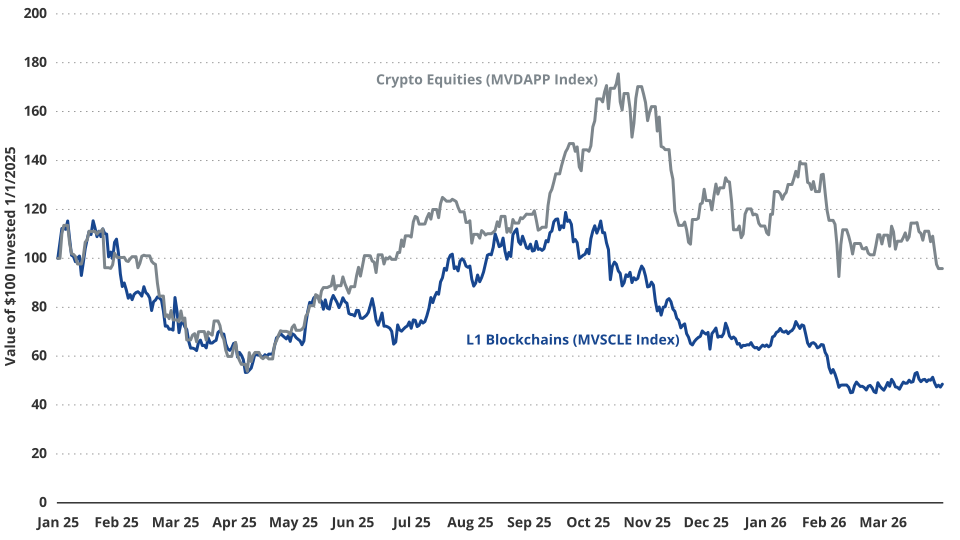
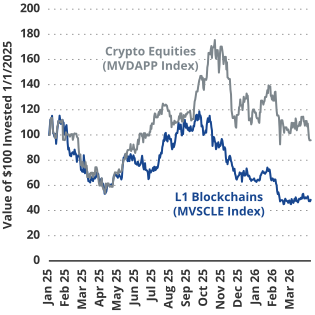
Source: Bloomberg as of 3/30/2026. Past performance is not a guarantee of future results. Not intended as a recommendation to buy or sell any securities named herein.
Three forces are converging to drive this shift: economic incentives from faster onchain settlement, the GENIUS Act formalizing compliant stablecoin issuance, and direct integration with Federal Reserve rails through new banking charters. Together, they enable corporations to run regulated blockchain settlement systems while bypassing the traditional deposit layer. We unpack each below.
One major reason is that stablecoins and real-world asset (RWA) tokenization have achieved some measure of regulatory clarity. Meanwhile, many public blockchain tokens are stuck in an uncomfortable legal limbo in which they can neither provide strong value accrual nor offer important investor protections via a functioning disclosure regime. The competitive landscape has also materially widened to include banks, fintechs, financial entities, and newly public infrastructure providers. Some of these companies even have substantial advantages including special-purpose bank charters.
The blockchain revolution is here, but enterprises are capturing the value while many tokens get left behind.
Corporate Blockchains
| Use Case | Legacy Incumbent | Public Chain Challengers | Corp / Permissioned Chain | 2030 Opportunity Size |
| Cross-Border Payments | SWIFT / banks | ETH / Tron / Base | Kinexys / Fnality / Tempo / XRPL | $20B of annual revenue $7.5T/day in FX volumes 5-10% on chain 5-10bps take rate |
| Collateral & Settlement | DTCC / LCH / Euroclear | ETH / Base / BUIDL | Canton / Kinexys / XRPL | $10B of annual revenue $2.3 Quadrillion settled $5T onchain 10-30bps take rate |
| Securitization | Goldman / JPM / Citi | Ethereum / Ondo / Securitize / Base | Provenance (FIGR) / Canton / XRPL | $15B of annual revenue $3T-$4T securitized 10-20% onchain 50-300bps take rate |
| Derivatives Trading | CME / ICE / LCH | Hyperliquid / dYdX | Canton / Kinexys | $12B of annual revenue $800T trading volume 5-10% onchain 1-3bps take rate |
| Cash Securities Trading | NYSE / Nasdaq / LSE | Ondo / Robinhood Chain / Base | Canton / DTCC / Nasdaq / NYSE / Tradeweb | $5B of annual revenue $130T trading volume 5-10% onchain 3-7bps take rate |
Source: VanEck Research, BIS, DTCC as of 3/30/2026. Past performance is not a guarantee of future results. Not intended as a recommendation to buy or sell any securities named herein.
While public blockchains excel at innovation, they struggle with governance, compliance, and service guarantees required by regulated financial players. Most importantly, value accrues to onchain traders and tokenholders. These incumbent-built “corpchains” will move regulated value (cash, collateral, securities) with controlled validator sets, privacy, and fee capture.
Why Corpchains Now: Three Forces Converging
1) Economic Incentives: Faster Settlement Unlocks Idle Capital
When ownership transfer completes in seconds rather than days, capital can move faster. This enables more trading turnover in existing securities and allows new trading venues and financial markets to spawn. Market makers, for example, gain capacity to build deeper liquidity in prediction markets. An estimated >$1T of initial margin was held at clearing houses at the end of 2025. Moving from T+2 days to T+12 seconds (or less) will enable working capital to more efficiently stream across trading venues. Tens of trillions more in assets and commodities also rest in systems in which they cannot be used as collateral.
2) The GENIUS Act Formalized “Narrow-Bank-Like” Stablecoin Issuance
GENIUS creates a legal framework for stablecoins to act as “narrow banking” or “skinny” entities that only hold safe, liquid reserves and do not make loans (except to the US Treasury). This codifies stablecoins as a regulated, nimbler form of transferable demand deposits. The result is a federal framework for payment stablecoins with 100% reserve backing, required disclosures and attestations, and full Bank Secrecy Act (BSA) and anti-money laundering (AML) compliance.
Predictably, banks are trying to constrain stablecoins by seeking regulation that prohibits yield incentives and also labels stablecoins as a “systemic risk.” However, banks are quickly adopting stablecoins themselves and linking them to their existing business franchises. Going forward, stablecoins give both consumers and institutions more freedom by acting as important payment mechanisms and more dynamic collateral. Visa is processing $3.5B annualized, Fiserv has made the FIUSD stablecoin available to more than 10,000 financial institutions, and stablecoin supply currently sits at $310B.
3) Direct Fed-Rail Integration Is Happening
A major milestone for crypto entities has been to link the blockchain financial system to the banking rails that run directly to the Federal Reserve. A banking charter enables a crypto-linked firm to connect crypto with global settlement and payment systems, and could allow blockchain finance to tap into Federal Reserve liquidity. More than 21 crypto entities have applied for state and national banking charters since 20201, and approvals could lead to direct Fed connections. To date, 9 bank national charters have been approved and 4 of them are effective. Another 4 crypto entities have been granted state bank charters in Wyoming. Payward, the owner of Kraken, was granted a limited-purpose Fed master account through the Kansas City Fed.
These banking licenses are key enablers for corpchains. If the cash leg can clear through regulated stablecoin issuers or limited-purpose chartered entities with privileged Fed connectivity, corporations can run blockchain settlement systems without relying on the traditional deposit layer or the correspondent banking system. Private networks can manage identity, permissions, privacy, and governance while still settling in compliant dollars that move faster and sit closer to the Fed’s core infrastructure.
The result: corporate adoption of blockchains for settlement + regulated reserve institutions (GENIUS) + direct integration with Fed rails. Collectively, we believe corporate blockchains could create $60B+ in revenue by 2030.
Corpchain Valuation Snapshot
Quantitative snapshot: economic value hosted on each chain today, current annual fee capture, and estimated market value of the operator.
| Chain | Economic Value Hosted Today | Annual Current Value Capture | Market Value |
| XRP Ledger (XRPL) | $85B mkt cap; $47M DeFi TVL | $365k (Chain Fees) | $82B (Market Value XRP) |
| BASE | $18B (stablecoins + bridge TVL) | $256M (Chain Fees + Stablecoin Float) | $11B (Est.) |
| Provenance/FIGR | $23B HELOCs | $514M (Corp + Chain Rev) | $7.2B (Market Value FIGR + Provenance) |
| Canton | $300B in Repo | $700M (Chain Fees) | $5.3B (Market Value Canton) |
| Tempo/Bridge/Stripe | Pre-launch | Pre-Launch | $5B (Est.) |
| Kinexys/JPM | $5B/day Repo | Internalized into JPM revenues | $2.6B (Est.) |
| Finality | GBP live; USD/EUR pending | Small Scale Usage | $1.25B (Est.) |
| ARC | Pre-Launch | Pre-Launch | $400M (Est.) |
| Robinhood Chain | Pre-launch | Pre-Launch | $250M (Est.) |
Source: VanEck Research as of 4/14/2026. Past performance is not a guarantee of future results. Not intended as a recommendation to buy or sell any securities named herein.
Note: Valuations were based on comps and assumptions about blockchain’s impact on revenues within the next 2-3 years.
Why Corporations Aren’t Embracing Public Chains
If enforcement eases but market structure clarity lags, the perceived “wild west” problem for crypto won’t disappear. Public blockchains carry real risks for regulated users: service disruptions, potential interaction with prohibited parties, and volatile blockspace pricing. As such, it gets harder for public companies to justify relying on open networks for regulated value. The lack of a clear market structure bill makes this worse as companies are uncertain about the legal definitions of activity types or how to treat various crypto tokens.
So instead of adopting open-source chains (and “giving up the tolls”), many firms are building corpchains that let them:
- Control validators and counterparty participation
- Prevent asset leakage
- Offer privacy, compliance, and auditability
- Capture value
- Guarantee deterministic performance and costs
The result: corpchains offer strong value propositions to regulated, corporate clients that also deliver significant bottom-line impact for corpchain builders. This does not mean public chains do not have a place, but it suggests that they need to assert their contributions to the emerging, regulated digital assets regime or they will be left behind. The substantial valuations of public chains such as Ethereum and Solana are premised on a future in which serious financial activity takes place on these blockchains. If corpchains absorb the majority of this projected financial activity, public-chain valuations may need to de-rate considerably.
Corpchain Qualitative Scorecard
Qualitative scorecard: each chain’s institutional adoption, use case focus, regulatory clarity, revenue model, and overall standing.
| Chain | Institutional Adoption | Use Case Specificity | Regulatory Clarity | Revenue Model | Verdict and Adoption Score |
|---|---|---|---|---|---|
| Canton | GS, Nasdaq, Tradeweb, Broadridge; $280B repo/day | Collateral + settlement; single focus | HIGH | Transaction fees | TOP TIER (9/10): deepest TradFi buy-in |
| Provenance (FIGR) | Figure anchor; 15 of top 20 mortgage lenders; $21B+ HELOCs | Mortgage/HELOC origination; proven | HIGH | Originations and trading fees | BEST REVENUE MODEL (9/10): best adoption, $1B revenue pathway |
| Kinexys (JPM) | JPM balance sheet + Axis Bank live; $3T+ processed since 2020 | Interbank payments + collateral mobility | VERY HIGH | Embedded in JPM fee structure | TOP TIER (8/10): captive bank distribution |
| Tempo | Paradigm, Stripe backing, live in March 2026; Nubank, Visa, Shopify | Cross-border B2B payments; EM-focused | MED-HIGH | Transaction fees | EMERGING (8/10): strong distribution, neutrality |
| Circle Arc (CRCL) | Visa, Mastercard, JPMorgan, Intuit, Interactive Brokers, XYZ | Settlement + payments + tokenization | VERY HIGH | Reserve yield/Transaction fees/Bridge Fees | STABLECOIN LEADER (8/10): deepest regulatory moat |
| Base (Coinbase) | Coinbase backing; 100M+ Coinbase verified users | Payments, DeFi, tokenized assets, stablecoins | MED-HIGH | Transaction Fees; possible token | CONSUMER BRIDGE (7/10): best on-ramp from TradFi |
| Fnality | BofA, Citi, Barclays, Lloyds, Temasek; testnet | Wholesale interbank payments; central bank flows | HIGH | Not yet generating revenue; long to production | LONG RUNWAY (5/10): early, but strong consortium |
Source: VanEck Research, Canton, Provenance, JPM as of 3/30/2026. Past performance is not a guarantee of future results. Not intended as a recommendation to buy or sell any securities named herein.
(The key differentiator isn’t “blockchain or not.” It’s: who controls validators, who gets the economics, and whether ownership finality lives onchain or remains an offchain entitlement.)
Implications if the CLARITY Act Is Passed
- Alt-token prices may mean-revert higher, but this may prove short-lived as investors recognize most value does not accrue to crypto projects. Equities of companies adopting blockchain technology may instead see multiple re-ratings. If CLARITY allows for compliant financial products, some activity can migrate back to open networks where it’s economically rational.
- Even with CLARITY, corpchains may have already won the “regulated value” lane because they’re pairing legal/compliance posture with direct rail access. The OCC’s conditional trust-charter approvals for major digital-asset firms reinforce that direction of travel.
What to Watch Next
- Stablecoin scale growth: Stablecoin supply is ~$310B with +23% CAGR since 2022; accelerated to +29% CAGR over the last year.
- Tokenized security pilots graduating to production, especially DTCC/Canton Network programs.
- The first truly meaningful onchain equity event such as an IPO being entirely on blockchain.
- More “skinny” Fed access precedents after Payward and the limits placed on Payward’s master account by the Fed.
How VanEck Is Positioned
We have not responded to this cycle by throwing single-token spaghetti at the wall. Instead, we've been deliberate: launching a small number of differentiated exposures and adding staking where appropriate, while pivoting our most flexible mandates away from tokens in 4Q2024 and toward crypto-linked equities as the corpchain thesis gained traction.
Our active strategies designed for this environment can own both tokens and equities, but have been meaningfully overweight equities, reflecting where we believe value is accruing. In parallel, our venture efforts are focused on early-stage companies building the infrastructure to enable tokenization and onchain settlement at scale.
We don't pretend to know how this ultimately resolves. If the CLARITY Act passes or open public blockchains begin to demonstrate durable economic advantages in regulated finance, we will adapt. But absent market-structure clarity, we remain tilted toward the equities enabling the corpchain future rather than the tokens that may not capture its economics.
Frequently Asked Questions
What is a corporate blockchain?
A corporate blockchain (or “corpchain”) is a permissioned distributed ledger operated by or for regulated institutions such as banks, exchanges, or fintechs. Unlike public blockchains like Ethereum or Solana, corpchains feature controlled validator sets, privacy, compliance tooling, and direct value capture for the operator. Examples include Canton, Provenance, Kinexys (JPMorgan), Tempo, Circle Arc, Fnality, and Base.
How does the GENIUS Act affect stablecoins?
The GENIUS Act creates a federal framework for payment stablecoins with 100% reserve backing, required disclosures and attestations, and full Bank Secrecy Act and anti-money laundering compliance. It effectively codifies regulated stablecoin issuers as “narrow-bank-like” entities that hold only safe, liquid reserves. As of early 2026, stablecoin supply sits at roughly $310B, with Visa processing $3.5B annualized in USDC payments and Fiserv distributing FIUSD through more than 10,000 financial institutions.
Why are financial institutions building their own blockchains instead of using Ethereum or Solana?
Institutions build corpchains to control validators, prevent asset leakage, ensure privacy and compliance, capture fee economics, and guarantee deterministic performance. Public blockchains struggle with governance, service guarantees, blockspace volatility, and potential interaction with prohibited parties, which makes them difficult to justify for regulated value transfer. More than 21 crypto entities have applied for state or national banking charters since 2020, reinforcing the trend toward compliant, institution-run infrastructure.
Links to third party websites are provided as a convenience and the inclusion of such links does not imply any endorsement, approval, investigation, verification or monitoring by us of any content or information contained within or accessible from the linked sites. By clicking on the link to a non-VanEck webpage, you acknowledge that you are entering a third-party website subject to its own terms and conditions. VanEck disclaims responsibility for content, legality of access or suitability of the third-party websites.
To receive more Digital Assets insights, sign up in our subscription center.


Important Disclosures
1 VanEck Research, Wyoming Banking Division as of 4/23/2026
This is not an offer to buy or sell, or a recommendation to buy or sell any of the securities, financial instruments or digital assets mentioned herein. The information presented does not involve the rendering of personalized investment, financial, legal, tax advice, or any call to action. Certain statements contained herein may constitute projections, forecasts and other forward-looking statements, which do not reflect actual results, are valid as of the date of this communication, and are subject to change without notice. Information provided by third party sources is believed to be reliable and has not been independently verified for accuracy or completeness and cannot be guaranteed.
Definitions
Index performance is not representative of fund performance. It is not possible to invest directly in an index.
MVIS Global Digital Assets Equity Index (MVDAPPP) is designed to track the performance of the largest and most liquid companies in the digital assets segment. Companies must generate at least 50% of their revenues from digital assets projects or have projects that have the potential to generate at least 50% of their revenues from digital assets in the future to be eligible.
Bitcoin (BTC) is a decentralized digital currency without a central bank or single administrator. It can be sent from user to user on the peer-to-peer Bitcoin network without intermediaries.
Ethereum (ETH) is a decentralized, open-source blockchain with smart contract functionality. Ether is the native cryptocurrency of the platform.
Solana (SOL) is a high-performance public blockchain that uses a proof-of-stake consensus mechanism. Its native token, SOL, is used for transaction fees and staking.
XRP is the native digital asset of the XRP Ledger, an open-source, permissionless, and decentralized blockchain technology designed for cross-border payments and settlement.
Risk Considerations
The information, valuation scenarios and price targets presented on any digital assets in this blog are not intended as financial advice, a recommendation to buy or sell these digital assets, or any call to action. There may be risks or other factors not accounted for in these scenarios that may impede the performance of these digital assets; their actual future performance is unknown, and may differ significantly from any valuation scenarios or projections/forecasts herein. Any projections, forecasts or forward-looking statements included herein are the results of a simulation based on our research, are valid as of the date of this communication and subject to change without notice, and are for illustrative purposes only. Please conduct your own research and draw your own conclusions.
Index performance is not representative of fund performance. It is not possible to invest directly in an index.
Investments in digital assets and Web3 companies are highly speculative and involve a high degree of risk. These risks include, but are not limited to: the technology is new and many of its uses may be untested; intense competition; slow adoption rates and the potential for product obsolescence; volatility and limited liquidity, including but not limited to, inability to liquidate a position; loss or destruction of key(s) to access accounts or the blockchain; reliance on digital wallets; reliance on unregulated markets and exchanges; reliance on the internet; cybersecurity risks; and the lack of regulation and the potential for new laws and regulation that may be difficult to predict. Moreover, the extent to which Web3 companies or digital assets utilize blockchain technology may vary, and it is possible that even widespread adoption of blockchain technology may not result in a material increase in the value of such companies or digital assets.
Digital asset prices are highly volatile, and the value of digital assets, and the companies that invest in them, can rise or fall dramatically and quickly. If their value goes down, there’s no guarantee that it will rise again. As a result, there is a significant risk of loss of your entire principal investment.
Digital assets are not generally backed or supported by any government or central bank and are not covered by FDIC or SIPC insurance. Accounts at digital asset custodians and exchanges are not protected by SPIC and are not FDIC insured. Furthermore, markets and exchanges for digital assets are not regulated with the same controls or customer protections available in traditional equity, option, futures, or foreign exchange investing.
Digital assets include, but are not limited to, cryptocurrencies, tokens, NFTs, assets stored or created using blockchain technology, and other Web3 products.
Web3 companies include but are not limited to, companies that involve the development, innovation, and/or utilization of blockchain, digital assets, or crypto technologies.
All investing is subject to risk, including the possible loss of the money you invest. As with any investment strategy, there is no guarantee that investment objectives will be met and investors may lose money. Diversification does not ensure a profit or protect against a loss in a declining market. Past performance is no guarantee of future results.
© Van Eck Associates Corporation
Important Disclosures
1 VanEck Research, Wyoming Banking Division as of 4/23/2026
This is not an offer to buy or sell, or a recommendation to buy or sell any of the securities, financial instruments or digital assets mentioned herein. The information presented does not involve the rendering of personalized investment, financial, legal, tax advice, or any call to action. Certain statements contained herein may constitute projections, forecasts and other forward-looking statements, which do not reflect actual results, are valid as of the date of this communication, and are subject to change without notice. Information provided by third party sources is believed to be reliable and has not been independently verified for accuracy or completeness and cannot be guaranteed.
Definitions
Index performance is not representative of fund performance. It is not possible to invest directly in an index.
MVIS Global Digital Assets Equity Index (MVDAPPP) is designed to track the performance of the largest and most liquid companies in the digital assets segment. Companies must generate at least 50% of their revenues from digital assets projects or have projects that have the potential to generate at least 50% of their revenues from digital assets in the future to be eligible.
Bitcoin (BTC) is a decentralized digital currency without a central bank or single administrator. It can be sent from user to user on the peer-to-peer Bitcoin network without intermediaries.
Ethereum (ETH) is a decentralized, open-source blockchain with smart contract functionality. Ether is the native cryptocurrency of the platform.
Solana (SOL) is a high-performance public blockchain that uses a proof-of-stake consensus mechanism. Its native token, SOL, is used for transaction fees and staking.
XRP is the native digital asset of the XRP Ledger, an open-source, permissionless, and decentralized blockchain technology designed for cross-border payments and settlement.
Risk Considerations
The information, valuation scenarios and price targets presented on any digital assets in this blog are not intended as financial advice, a recommendation to buy or sell these digital assets, or any call to action. There may be risks or other factors not accounted for in these scenarios that may impede the performance of these digital assets; their actual future performance is unknown, and may differ significantly from any valuation scenarios or projections/forecasts herein. Any projections, forecasts or forward-looking statements included herein are the results of a simulation based on our research, are valid as of the date of this communication and subject to change without notice, and are for illustrative purposes only. Please conduct your own research and draw your own conclusions.
Index performance is not representative of fund performance. It is not possible to invest directly in an index.
Investments in digital assets and Web3 companies are highly speculative and involve a high degree of risk. These risks include, but are not limited to: the technology is new and many of its uses may be untested; intense competition; slow adoption rates and the potential for product obsolescence; volatility and limited liquidity, including but not limited to, inability to liquidate a position; loss or destruction of key(s) to access accounts or the blockchain; reliance on digital wallets; reliance on unregulated markets and exchanges; reliance on the internet; cybersecurity risks; and the lack of regulation and the potential for new laws and regulation that may be difficult to predict. Moreover, the extent to which Web3 companies or digital assets utilize blockchain technology may vary, and it is possible that even widespread adoption of blockchain technology may not result in a material increase in the value of such companies or digital assets.
Digital asset prices are highly volatile, and the value of digital assets, and the companies that invest in them, can rise or fall dramatically and quickly. If their value goes down, there’s no guarantee that it will rise again. As a result, there is a significant risk of loss of your entire principal investment.
Digital assets are not generally backed or supported by any government or central bank and are not covered by FDIC or SIPC insurance. Accounts at digital asset custodians and exchanges are not protected by SPIC and are not FDIC insured. Furthermore, markets and exchanges for digital assets are not regulated with the same controls or customer protections available in traditional equity, option, futures, or foreign exchange investing.
Digital assets include, but are not limited to, cryptocurrencies, tokens, NFTs, assets stored or created using blockchain technology, and other Web3 products.
Web3 companies include but are not limited to, companies that involve the development, innovation, and/or utilization of blockchain, digital assets, or crypto technologies.
All investing is subject to risk, including the possible loss of the money you invest. As with any investment strategy, there is no guarantee that investment objectives will be met and investors may lose money. Diversification does not ensure a profit or protect against a loss in a declining market. Past performance is no guarantee of future results.
© Van Eck Associates Corporation