CLOs: Attractive Income with Upside Potential
May 01, 2026
Read Time 6 MIN
Key Takeaways:
- CLO equity can deliver high, front-loaded income through residual cash flows and embedded optionality, but comes with higher volatility and first-loss risk.
- Allocating across CLO equity and mezzanine debt allows portfolios to adjust as loan spreads, liability costs, and credit conditions change
- Manager selection and bottom-up credit analysis matter, as returns can vary widely by portfolio quality, vintage year, and tranche positioning.
Investors are increasingly seeking out attractive sources of yield with low correlation to traditional asset classes, in order to add income and diversification to a broader portfolio. The VanEck CLO Opportunities Fund is a newly launched interval fund that aims to provide investors with a high level of income by investing primarily in equity and lower-rated debt tranches of collateralized loan obligations (CLOs). This part of the capital structure can provide attractive yields with upside potential through CLO equity exposure and may be an attractive addition within an income-oriented portfolio for investors with a tolerance for lower liquidity and potentially higher volatility.
Understanding CLO Equity
CLO equity is the junior-most tranche in a collateralized loan obligation, receiving residual cash flows from a diversified portfolio of 200-300+ leveraged loans after debt investors and operating expenses are paid. This positioning provides leveraged exposure to the underlying loan portfolio, generating high income through residual distributions. Unlike debt investors, equity holders also capture upside from active management—for example, when a CLO manager buys undervalued loans and sells appreciated ones, the resulting "par build" is amplified by structural leverage, translating small portfolio gains into outsized equity returns.
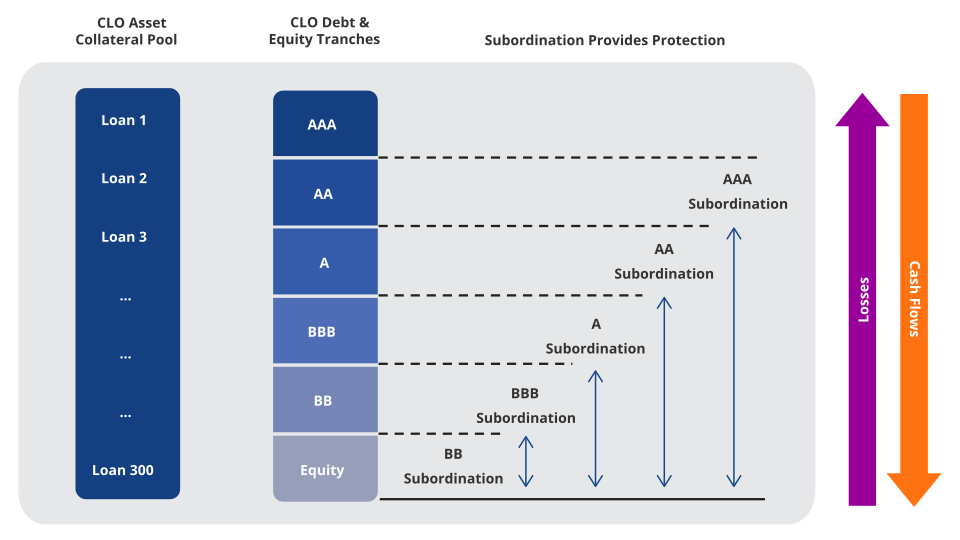
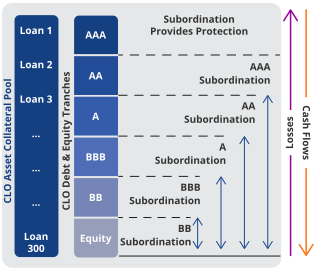
Source: PineBridge Investments. This is not an offer to buy or sell, or recommendation to buy or sell any of the securities mentioned herein. Past performance is no guarantee of future results. For illustrative purposes only.
Recommended subscription
Equity investors also benefit from embedded optionality in CLOs. They can direct the manager to call the CLO (liquidating the portfolio and capturing any value above par), refinance when debt spreads tighten (which increases residual payments), or reset the deal at current market prices (locking in favorable spreads and extending the life of the transaction).
The trade-off for this return potential is risk: equity absorbs default losses first, and leveraged exposure amplifies price volatility. However, several structural features of CLOs provide protection, including highly diversified portfolios across issuers and sectors, actively managed portfolios which helps to maintain high credit quality, and term financing from CLO debt tranches without mark-to-market triggers that would cause forced liquidation during market stress. While price volatility should be expected, it does not necessarily translate into realized losses. A deeper dive into CLO equity can be found here.
Why Combine Debt and Equity? The Power of Flexibility
As described here, mezzanine CLO debt can provide higher credit spreads and lower historical default rates, due to various structural protections, versus similarly rated bonds and loans. CLO debt is floating rate, so investors are not exposed to interest rate volatility. Although CLO debt prices are impacted by overall credit market conditions, primarily in lower-rated tranches, high yields may provide a relatively consistent stream of regular income which can offset price volatility,
The case for CLO equity exposure is the potential for double digit, front-loaded returns that are driven largely by regular cash distributions. In a performing CLO, investors receive distributions immediately with the next scheduled payment (typically quarterly), which results in a relatively shorter average life than asset classes with similar profiles such as private equity, without the negative returns typically associated with such investments in early years (i.e. the “j-curve”). In addition, a skilled CLO manager can react to changing market conditions. Upside potential accrues to the equity investor, who can benefit from a volatile market that generates attractive trading opportunities. Embedded optionality, together with active management, means that equity returns can benefit as the market changes. Because of these unique return drivers, CLO equity has exhibited low to moderate correlations versus other asset classes such as high yield bonds, mezzanine CLO debt, U.S. equities and investment grade corporate debt.
Low Correlation to Other Asset Classes
| BBB Rated CLOs | BB Rated CLOs | CLO Equity | IG CLOs | Agg | US IG | US HY | Leveraged Loans | Russell 2000 | S&P 500 | |
| BBB Rated CLOs | 1.00 | |||||||||
| BB Rated CLOs | 0.95 | 1.00 | ||||||||
| CLO Equity | 0.70 | 0.74 | 1.00 | |||||||
| IG CLOs | 0.96 | 0.90 | 0.66 | 1.00 | ||||||
| Agg | 0.41 | 0.39 | 0.12 | 0.39 | 1.00 | |||||
| US IG | 0.48 | 0.46 | 0.21 | 0.46 | 0.98 | 1.00 | ||||
| US HY | 0.48 | 0.47 | 0.38 | 0.48 | 0.74 | 0.80 | 1.00 | |||
| Leveraged Loans | 0.84 | 0.85 | 0.74 | 0.85 | 0.32 | 0.41 | 0.65 | 1.00 | ||
| Russell 2000 | 0.39 | 0.40 | 0.36 | 0.38 | 0.53 | 0.58 | 0.77 | 0.54 | 1.00 | |
| S&P 500 | 0.41 | 0.44 | 0.35 | 0.40 | 0.62 | 0.69 | 0.83 | 0.53 | 0.82 | 1.00 |
Source: Morningstar, as of 12/31/2025. BBB Rated CLOs by J.P. Morgan CLO BBB Index, BB Rated CLOs by J.P. Morgan CLO BB Index, CLO Equity median represents all redeemed CLOs assuming a purchase price at par, IG CLOs by J.P Morgan CLO IG Index, Agg by the ICE BofA US Broad Market Index, US IG by ICE BofA US Corporate Index, US HY by ICE BofA US High Yield Index, Leveraged Loans represented by Morningstar LSTA US Leveraged Loan Index. See index descriptions at the end of this presentation. Past performance is not indicative of future results. This is not an offer to buy or sell, or recommendation to buy or sell any of the securities mentioned herein. Correlation: A statistical measure that shows how closely the prices of two assets move in relation to each other.Index performance is not illustrative of fund performance. It is not possible to invest directly in an index.
Although CLO equity is the riskiest tranche, it may not always provide the most attractive risk adjusted opportunities. Depending on how current loan spread levels compare to CLO debt servicing costs, as well as assumptions on factors such as defaults and recoveries, expected returns may not always compare favorably to those of mezzanine CLO debt. The current market, for example, is characterized by very tight loan spreads versus relatively wide liability spreads, and a credit market with risks skewed to the downside given where valuations are. In general, this favors a higher allocation to debt. However, as conditions change, for example, after a significant market selloff resulting in wider loan spreads and lower equity prices, potential opportunities for attractive prospective returns can emerge, favoring a portfolio more tilted towards equity.
CLO debt and equity can have very different return drivers. For example, a strong credit environment typically favors equity over debt. Other return drivers are less obvious. For example, higher volatility may have a more negative impact on equity prices versus debt in the near term, but ultimately drive higher equity forward returns due to the ability to actively trade the loan portfolio. As shown below, the returns can vary significantly between debt and equity in a given year, and equity is not always the highest returning tranche.
Value Sharing Between Tranches Favors a Dynamic Approach
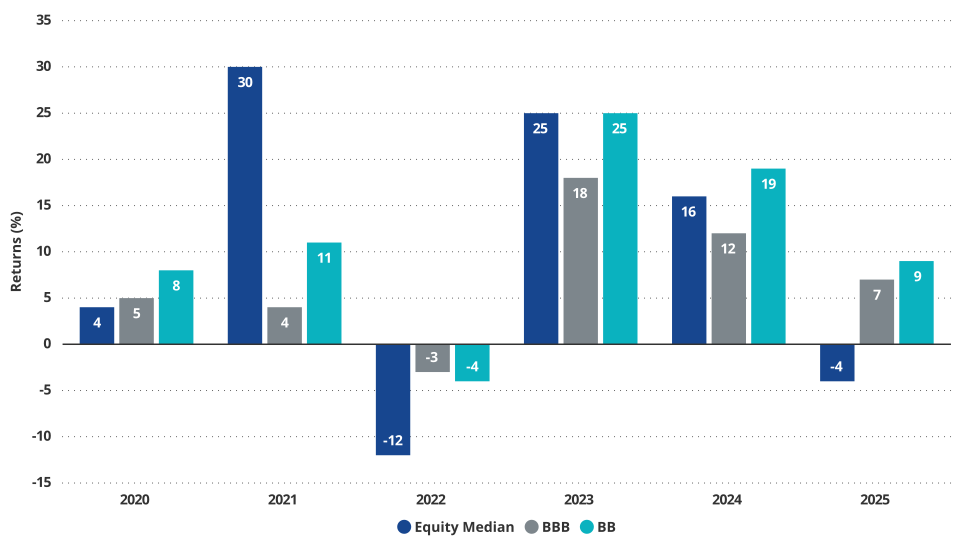
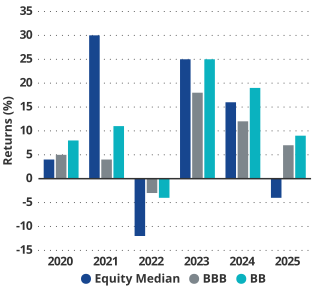
Source: BofA Research and J.P. Morgan. Equity returns represents all redeemed CLOs assuming a purchase price at par. Past performance is no guarantee of future results. For illustrative purposes only.
The economic value generated from the actively managed loan portfolio is allocated differently to debt and equity investors, and value shifts favor a dynamic approach. The key is to have the flexibility to invest across mezzanine debt and equity, with the necessary expertise to evaluate CLO portfolios and identify attractive opportunities.
Skill Matters: Why Active Management Drives Results
An active approach to CLO tranche investing, in both debt and equity, is necessary to identify the most attractive parts of a CLO capital structure in a given market environment, and to identify the most attractive individual opportunities.
Differences in loan portfolios, CLO manager quality, and vintage year result in significant dispersion within CLOs, and this is particularly true within CLO equity. As shown below, the difference between top and bottom performing tranches can be significant, even within the same vintage year, highlighting the importance of security selection.
Not All CLO Equity is Created Equal
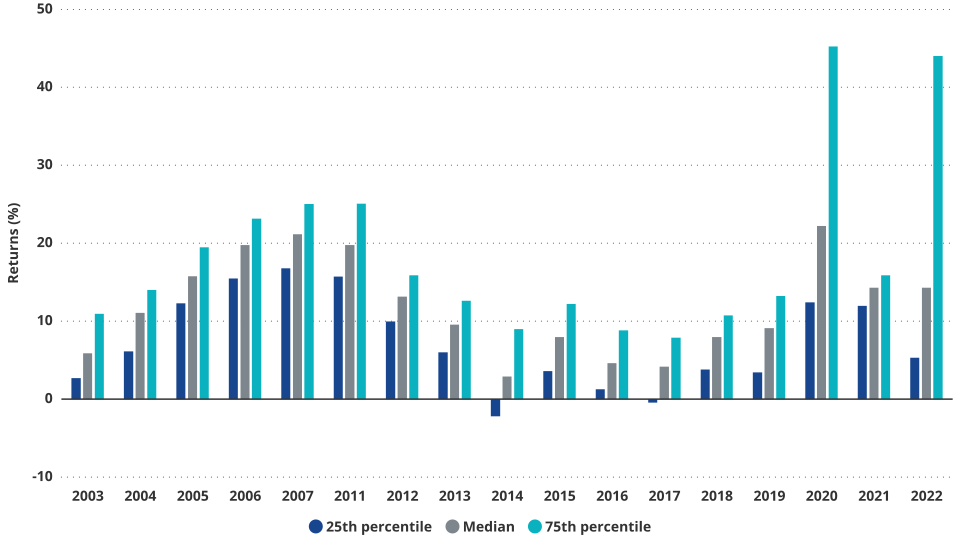
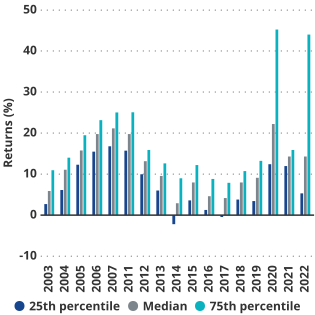
Source: BofA Research. Represents all redeemed CLOs assuming a purchase price at par. Past performance is no guarantee of future results. For illustrative purposes only.
The bottom-up nature of CLO investing requires extensive credit expertise in order to identify high quality portfolios and skilled CLO managers, and to perform the due diligence and stress testing on the deal to identify value. An understanding of the individual borrowers in the CLO portfolio allows a tranche investor to understand underlying risk and therefore identify potential opportunities.
At the same time, a top-down portfolio view must be informed by an understanding of macro return drivers such as the direction of interest rates, inflation, economic growth, credit conditions, and geopolitical events. Although the same process is used to analyze a debt and equity tranche, different factors may be more important risk and return drivers for equity versus debt, and lower-rated and equity tranches are much more sensitive to the health of the underlying loan portfolio than senior tranches. Expertise across the capital structure is key.
PineBridge Investments is the sub-advisor of the VanEck CLO Opportunities Fund. PineBridge is also the sub-advisor of the VanEck CLO ETF (CLOI) and VanEck AA-BB CLO ETF (CLOB), and the CLO Opportunities Fund benefits from the same investment team and process. PineBridge has been active in the CLO market since the 1990s and is both a CLO manager and tranche investor. PineBridge has significant credit capabilities within its integrated leveraged finance platform, including a large team of credit analysts that helps to inform CLO tranche buy and sell decisions. The VanEck CLO Opportunities Fund provides a high income option for investors who are able to tolerate a higher degree of risk in a less liquid vehicle, and can provide an attractive complement to the income potential and liquidity provided by CLOI and CLOB.
To receive more Income Investing insights, sign up in our subscription center.

Important Disclosures
BBB Rated CLOs by J.P. Morgan CLO BBB Index, subset of the J.P. Morgan CLO Index that only tracks the BBB rated CLO.
BB Rated CLOs by J.P. Morgan CLO BB Index, subset of the J.P. Morgan CLO Index that only tracks the BB rated CLO.
IG CLOs by J.P Morgan CLO IG Index, subset of the J.P. Morgan CLO Index that only tracks the IG rated CLO.
Agg by the ICE BofA US Broad Market Index tracks the performance of US dollar denominated investment grade debt publicly issued in the US domestic market, including US Treasury, quasi-government, corporate, securitized and collateralized securities.
US IG by ICE BofA US Corporate Index tracks the performance of US dollar denominated investment grade corporate debt publicly issued in the US domestic market.
US HY by ICE BofA US High Yield Index tracks the performance of U.S. dollar-denominated below investment grade corporate debt publicly issued in the U.S. domestic market.
Leveraged Loans represented by Morningstar LSTA US Leveraged Loan Index is a market-value weighted index designed to measure the performance of the US leveraged loan market.
This is not an offer to buy or sell, or a recommendation to buy or sell any of the securities, financial instruments or digital assets mentioned herein. The information presented does not involve the rendering of personalized investment, financial, legal, tax advice, or any call to action. Certain statements contained herein may constitute projections, forecasts and other forward-looking statements, which do not reflect actual results, are for illustrative purposes only, are valid as of the date of this communication, and are subject to change without notice. Actual future performance of any assets or industries mentioned are unknown. Information provided by third party sources are believed to be reliable and have not been independently verified for accuracy or completeness and cannot be guaranteed. VanEck does not guarantee the accuracy of third party data. The information herein represents the opinion of the author(s), but not necessarily those of VanEck or its other employees.
VanEck CLO Opportunities Fund (“CLOO”) Risks
The fund is subject to a high degree of risk and volatility and could result in significant losses, including the loss of a substantial portion or all of your investment.
An investment in the Fund may be subject to risks which includes, among others, CLO, CLO equity tranche, debt securities, high yield securities, income, valuation, privately issued securities, covenant lite loans, SOFR, investment sourcing, defaulted securities, syndicated loan, correlation, liquidity (quarterly repurchases and underlying investments), leveraging, CLO manager, investment focus, newly issued securities, extended settlement, private credit, underlying fund, business development company, foreign currency, derivatives, repurchase policy, distribution and RIC status, new fund, market, active management, non-diversified, potential conflicts of interest, and minimal capitalization risks, all of which may adversely affect the Fund. Debt securities may be subject to additional risks, such as liquidity, interest rate, floating rate obligations, credit, call, and extension risks.
The Fund is a closed-end management investment company structured as an “interval fund,” and its shares are not listed on any securities exchange and are not expected to have a secondary market, so an investment should be considered illiquid. Liquidity is provided only through quarterly repurchase offers conducted pursuant to Rule 23c-3 under the Investment Company Act of 1940, which generally permit the Fund to offer to repurchase between 5% and 25% of outstanding shares per quarter, as determined by the Fund’s Board. Repurchase requests may be oversubscribed and prorated, meaning you may be unable to sell all (or any) of your shares when desired and may have to hold shares for an indefinite period, and repurchase offers may be suspended or postponed in limited circumstances.
The Fund invests primarily in CLO debt and CLO equity (including BBB-rated and lower tranches and unrated equity). CLOs are complex and may be difficult to value and trade and are exposed to leveraged-loan credit risk, including borrower defaults and reduced recoveries. Investments in CLO equity and other junior tranches are subject to structural subordination and “first-loss” risk, including the diversion of cash flows to senior tranches after certain collateral quality test failures, and may result in a partial or total loss of investment.
The Fund may employ leverage, which may magnify gains and losses and increase volatility of the Fund’s net asset value. The Fund’s distributions, if any, are not guaranteed and may be paid from sources other than net investment income, including return of capital or borrowings, which may reduce the Fund’s net asset value and capital available for future investment.
VanEck AA-BB CLO ETF (CLOB) and VanEck CLO ETF (CLOI) Risks
An investment in the Funds may be subject to risks which include, but are not limited to, risks related to Collateralized Loan Obligations (CLO), debt securities, foreign currency, foreign securities, investment focus, newly-issued securities, extended settlement, affiliated fund investment, management and capital preservation, derivatives, currency management strategies, cash transactions, market, Sub-Adviser, operational, authorized participant concentration, no guarantee of active trading market, trading issues, fund shares trading, premium/discount, liquidity of fund shares, non-diversified, seed investor, and new fund risks, all of which may adversely affect the Funds. Investments in debt securities may expose the Fund to other risks, such as risks related to liquidity, interest rate, floating rate obligations, credit, call, extension, high yield securities, income, valuation, privately-issued securities, covenant lite loans, default of the underlying asset and CLO manager risks, all of which may impact the Fund’s performance. Derivatives may involve certain costs and risks such as liquidity, interest rate, and the risk that a position could not be closed when most advantageous.
Investing involves substantial risk and high volatility, including possible loss of principal. An investor should consider the investment objective, risks, charges and expenses of the Funds carefully before investing. To obtain a prospectus and summary prospectus, which contain this and other information, call 800.826.2333 or visit vaneck.com. Please read the prospectus and summary prospectus carefully before investing.
© Van Eck Securities Corporation, Distributor, a wholly-owned subsidiary of Van Eck Associates Corporation.
Related Funds
Important Disclosures
BBB Rated CLOs by J.P. Morgan CLO BBB Index, subset of the J.P. Morgan CLO Index that only tracks the BBB rated CLO.
BB Rated CLOs by J.P. Morgan CLO BB Index, subset of the J.P. Morgan CLO Index that only tracks the BB rated CLO.
IG CLOs by J.P Morgan CLO IG Index, subset of the J.P. Morgan CLO Index that only tracks the IG rated CLO.
Agg by the ICE BofA US Broad Market Index tracks the performance of US dollar denominated investment grade debt publicly issued in the US domestic market, including US Treasury, quasi-government, corporate, securitized and collateralized securities.
US IG by ICE BofA US Corporate Index tracks the performance of US dollar denominated investment grade corporate debt publicly issued in the US domestic market.
US HY by ICE BofA US High Yield Index tracks the performance of U.S. dollar-denominated below investment grade corporate debt publicly issued in the U.S. domestic market.
Leveraged Loans represented by Morningstar LSTA US Leveraged Loan Index is a market-value weighted index designed to measure the performance of the US leveraged loan market.
This is not an offer to buy or sell, or a recommendation to buy or sell any of the securities, financial instruments or digital assets mentioned herein. The information presented does not involve the rendering of personalized investment, financial, legal, tax advice, or any call to action. Certain statements contained herein may constitute projections, forecasts and other forward-looking statements, which do not reflect actual results, are for illustrative purposes only, are valid as of the date of this communication, and are subject to change without notice. Actual future performance of any assets or industries mentioned are unknown. Information provided by third party sources are believed to be reliable and have not been independently verified for accuracy or completeness and cannot be guaranteed. VanEck does not guarantee the accuracy of third party data. The information herein represents the opinion of the author(s), but not necessarily those of VanEck or its other employees.
VanEck CLO Opportunities Fund (“CLOO”) Risks
The fund is subject to a high degree of risk and volatility and could result in significant losses, including the loss of a substantial portion or all of your investment.
An investment in the Fund may be subject to risks which includes, among others, CLO, CLO equity tranche, debt securities, high yield securities, income, valuation, privately issued securities, covenant lite loans, SOFR, investment sourcing, defaulted securities, syndicated loan, correlation, liquidity (quarterly repurchases and underlying investments), leveraging, CLO manager, investment focus, newly issued securities, extended settlement, private credit, underlying fund, business development company, foreign currency, derivatives, repurchase policy, distribution and RIC status, new fund, market, active management, non-diversified, potential conflicts of interest, and minimal capitalization risks, all of which may adversely affect the Fund. Debt securities may be subject to additional risks, such as liquidity, interest rate, floating rate obligations, credit, call, and extension risks.
The Fund is a closed-end management investment company structured as an “interval fund,” and its shares are not listed on any securities exchange and are not expected to have a secondary market, so an investment should be considered illiquid. Liquidity is provided only through quarterly repurchase offers conducted pursuant to Rule 23c-3 under the Investment Company Act of 1940, which generally permit the Fund to offer to repurchase between 5% and 25% of outstanding shares per quarter, as determined by the Fund’s Board. Repurchase requests may be oversubscribed and prorated, meaning you may be unable to sell all (or any) of your shares when desired and may have to hold shares for an indefinite period, and repurchase offers may be suspended or postponed in limited circumstances.
The Fund invests primarily in CLO debt and CLO equity (including BBB-rated and lower tranches and unrated equity). CLOs are complex and may be difficult to value and trade and are exposed to leveraged-loan credit risk, including borrower defaults and reduced recoveries. Investments in CLO equity and other junior tranches are subject to structural subordination and “first-loss” risk, including the diversion of cash flows to senior tranches after certain collateral quality test failures, and may result in a partial or total loss of investment.
The Fund may employ leverage, which may magnify gains and losses and increase volatility of the Fund’s net asset value. The Fund’s distributions, if any, are not guaranteed and may be paid from sources other than net investment income, including return of capital or borrowings, which may reduce the Fund’s net asset value and capital available for future investment.
VanEck AA-BB CLO ETF (CLOB) and VanEck CLO ETF (CLOI) Risks
An investment in the Funds may be subject to risks which include, but are not limited to, risks related to Collateralized Loan Obligations (CLO), debt securities, foreign currency, foreign securities, investment focus, newly-issued securities, extended settlement, affiliated fund investment, management and capital preservation, derivatives, currency management strategies, cash transactions, market, Sub-Adviser, operational, authorized participant concentration, no guarantee of active trading market, trading issues, fund shares trading, premium/discount, liquidity of fund shares, non-diversified, seed investor, and new fund risks, all of which may adversely affect the Funds. Investments in debt securities may expose the Fund to other risks, such as risks related to liquidity, interest rate, floating rate obligations, credit, call, extension, high yield securities, income, valuation, privately-issued securities, covenant lite loans, default of the underlying asset and CLO manager risks, all of which may impact the Fund’s performance. Derivatives may involve certain costs and risks such as liquidity, interest rate, and the risk that a position could not be closed when most advantageous.
Investing involves substantial risk and high volatility, including possible loss of principal. An investor should consider the investment objective, risks, charges and expenses of the Funds carefully before investing. To obtain a prospectus and summary prospectus, which contain this and other information, call 800.826.2333 or visit vaneck.com. Please read the prospectus and summary prospectus carefully before investing.
© Van Eck Securities Corporation, Distributor, a wholly-owned subsidiary of Van Eck Associates Corporation.