CLOs: Pressure-Tested in Q1, Built for What Comes Next
April 17, 2026
Read Time 10+ MIN
Key Takeaways:
- CLOs proved their resilience: IG-rated tranches delivered positive returns even as geopolitical shocks and rising Treasury yields rattled broader credit markets.
- The macro tide has shifted: A Fed on hold, sticky inflation, and Middle East tensions are keeping rates elevated and spreads under pressure.
- Volatility is creating opportunity: Conservative positioning and widening spreads are opening selective entry points, particularly lower in the capital stack.
CLOs demonstrated relative resilience in Q1 2026, outperforming most credit sectors despite a challenging macro backdrop marked by rising Treasury yields, geopolitical escalation in the Middle East and growing recession concerns in the back half of the quarter. IG-rated tranches posted positive total returns, while mezzanine tranches faced had pressure. A sharp selloff in software loans, the largest sector in the leveraged loan index at roughly 10-15%, was a defining feature of the quarter, driving meaningful dispersion across CLO portfolios and reinforcing the importance of manager and security selection. During the quarter, VanEck CLO ETF (CLOI) (30-day SEC yield: 5.12% as of 3/31/2026) underperformed its benchmark, J.P. Morgan CLO IG Index, by 17bps (0.75% vs 0.92%). Meanwhile, VanEck AA-BB CLO ETF (CLOB) (30-day SEC yield: 6.20% as of 3/31/2026) was relatively in line with its benchmark, J.P. Morgan CLOIE Balanced Mezzanine Index (-0.33% vs -0.32%).
CLOs continued to compare favorably to investment grade corporates, high yield bonds, and leveraged loans, reinforcing their role as a compelling source of income and relative value amid heightened uncertainty. Our preference for higher-rated tranches remains given tight valuations and increasing tail risks, although select shorter spread-duration opportunities lower in the capital stack are beginning to present more attractive entry points.
Average Annual Total Returns* (%)
| 1 MO | 3 MO | YTD | 1 YR | 3 YR | 5 YR | 10 YR | LIFE 06/21/22 | |
| CLOI (NAV) | -0.08 | 0.75 | 0.75 | 5.31 | 7.15 | -- | -- | 7.22 |
| CLOI (Market Price) | 0.00 | 0.62 | 0.62 | 5.40 | 7.08 | -- | -- | 7.20 |
| J.P. Morgan CLO IG Index | 0.15 | 0.92 | 0.92 | 5.53 | 7.41 | -- | -- | 7.13 |
| J.P. Morgan Collateralized Loan Obligation Index | 0.06 | 0.74 | 0.74 | 5.51 | 7.78 | -- | -- | 7.44 |
*Returns less than one year are not annualized.
Effective May 1, 2025, the J.P. Morgan CLO IG Index replaced the J.P. Collateralized Loan Obligation Index as the Fund’s benchmark
The performance data quoted represents past performance. Past performance is not a guarantee of future results. Investment return and principal value of an investment will fluctuate so that an investor’s shares, when redeemed, may be worth more or less than their original cost. Performance may be lower or higher than performance data quoted. Please call 800.826.2333 or visit vaneck.com for performance current to the most recent month ended.
CLOI’s gross expense ratio is 0.36% and the total expense ratio is 0.36%. Van Eck Associates Corporation (the “Adviser”) will pay all expenses of the Fund, except for the fee payment under the investment management agreement, acquired fund fees and expenses, interest expense, offering costs, trading expenses, taxes and extraordinary expenses. Notwithstanding the foregoing, the Adviser has agreed to pay the offering costs until at least May 1, 2027. “Other Expenses” have been restated to reflect current fees.
Average Annual Total Returns* (%)
| 1 MO | 3 MO | YTD | 1 YR | 3 YR | 5 YR | 10 YR | LIFE 09/24/24 | |
| CLOB (NAV) | -0.75 | -0.33 | -0.33 | 5.41 | -- | -- | -- | 6.28 |
| CLOB (Market Price) | 0.23 | -0.42 | -0.42 | 5.37 | -- | -- | -- | 6.24 |
| J.P. Morgan CLOIE Balanced Mezzanine Index | -0.47 | -0.32 | -0.32 | 5.68 | -- | -- | -- | 6.37 |
*Returns less than one year are not annualized.
The performance data quoted represents past performance. Past performance is not a guarantee of future results. Investment return and principal value of an investment will fluctuate so that an investor’s shares, when redeemed, may be worth more or less than their original cost. Performance may be lower or higher than performance data quoted. Please call 800.826.2333 or visit vaneck.com for performance current to the most recent month ended.
CLOB’s gross expense ratio is 0.45% and the total expense ratio is 0.45%. Van Eck Associates Corporation (the “Adviser”) will pay all expenses of the Fund, except for the fee payment under the investment management agreement, acquired fund fees and expenses, interest expense, offering costs, trading expenses, taxes and extraordinary expenses. Notwithstanding the foregoing, the Adviser has agreed to pay the offering costs until at least May 1, 2026. “Other Expenses” have been restated to reflect current fees.
Market Update
Total returns were marginally positive for CLOs at the index level in March. The asset class endured its worst monthly return in the past year. However, CLOs held in better than most other asset classes. Investors navigated a confluence of headwinds including an escalating and unresolved conflict in the Middle East centered on the Strait of Hormuz, sharply rising Treasury rates, and ongoing fears of AI disintermediation. The macro backdrop was difficult across risk assets broadly. Brent crude approached $120/bbl before pulling back toward $100/bbl by month-end, the S&P 500 fell 5.0% in March, and 10-year Treasury yields remain more than 30bp above pre-conflict levels, reflecting market uncertainty about the inflationary and growth implications of a prolonged Hormuz closure. The conflict has extended into April, though broader risk markets have caught a bid on hopes of a ceasefire. Despite the difficult tone, two positives are worth noting. Fourth quarter 2025 earnings season was constructive as issuers largely beat expectations and offered cautiously positive guidance and primary market activity held up well. Functioning capital markets suggest the technical picture, while challenged, is not yet in distress territory. Two-, 5- and 10-year Treasury rates traded 42bp, 44bp and 38bp higher, respectively.
Higher rated CLOs outperformed bank loans and investment grade credit and high yield bonds during the quarter.
| Asset class | Q1 2026 Return (%) | Yield to Worst (%) | Spreads (bps) |
| CLOs | 0.74 | 5.53 | 179 |
| CLOs IG | 0.92 | 5.18 | 151 |
| CLOs Mezz | -0.26 | 7.57 | 381 |
| AAA | 1.01 | 4.91 | 125 |
| AA | 0.99 | 5.22 | 156 |
| A | 1.05 | 5.62 | 192 |
| BBB | -0.15 | 7.28 | 351 |
| BB | -3.15 | 12.17 | 828 |
| B | -9.80 | 17.64 | 1,346 |
| U.S. Agg | 0.06 | 4.60 | 32 |
| Investment Grade Corporates | -0.42 | 5.15 | 90 |
| High Yield Bonds | -0.55 | 7.44 | 328 |
| Leveraged Loans | -0.44 | 8.63 | 493 |
Source: JP Morgan and ICE Data Indices as of 3/31/2026. CLOs represented by J.P. Morgan Collateralized Loan Obligation Index, CLOs IG represented by J.P. Morgan Collateralized Loan Obligation IG Index, CLOs Mezz represented by J.P. Morgan Collateralized Loan Obligation Balanced Mezzanine Index, AAA Rated CLOs represented by J.P. Morgan CLO AAA Index, AA Rated CLOs represented by J.P. Morgan CLO AA Index, A Rated CLOs represented by J.P. Morgan CLO A Index, BBB Rated CLOs represented by J.P. Morgan CLO BBB Index, BB Rated CLOs represented by J.P. Morgan CLO BB Index, B Rated CLOs represented by J.P. Morgan CLO B Index, US Agg is represented by the ICE BofA US Broad Market, Investment Grade Corporates represented by ICE BofA US Corporate Index, High Yield Bonds represented by ICE BofA US High Yield Index.and Leveraged Loans represented by JP Morgan Leveraged Loan Index. Past performance is no guarantee of future results. Index performance is not representative of fund performance. It is not possible to invest directly in an index
CLO new issue supply decreased month-over-month, totaling $17.5bn in March, compared to $20.2bn in February. Refinancing and reset activity also decreased month-over-month, with $11.1bn pricing, after $23.7bn in February. Quarterly new issue volume of over $37bn was roughly in line with Q1 2025, although slightly behind the overall pace from last year, while refi reset volumes were 40% lower than Q1 last year. Retail demand continued, albeit at a slower pace, with CLO ETFs reporting $600mn in inflows in March, following inflows of $1.5bn in February. Total CLO ETF AUM is now over $44bn.
Loan market technicals remained supportive even as demand growth slowed, because repayments outpaced net new loan supply for the month. Institutional loan issuance remained constrained as the limited number of loans trading above par brought repricing activity to a halt. Wider market spreads along with the uncertain macroeconomic outlook limited issuance activity overall. However, the primary market was not fully frozen. Another wave of large M&A and LBO transactions launched during the month, bringing total quarterly volume for these types of transactions to a multi-year high. Retail loan funds saw $3.3bn in outflows in March, down from $4.1bn in February, albeit still elevated.
The trailing twelve-month default rate within the Morningstar US Leveraged Loan Index increased 6bp to 1.44%. As measured by JP Morgan, the default rate including distressed exchanges, decreased 19bp to 3.04%. Activity has been elevated as borrowers with unsustainable capital structures endeavored to manage their liabilities and avoid the bankruptcy process through liability management exercises, keeping the “official” default rate lower than otherwise. The default rate has declined 148bp off January 2025’s high.
CLO credit fundamentals largely remain strong but were marginally softer month-over-month. The overall picture appears stable as evidenced by the trailing 3-month downgrade / upgrade ratio for loans in CLOs at 1.72, down from 2.57 last month. Market value metrics saw some improvement month-over-month, largely driven by relative strength of Software and Services loans during the month, but remain suppressed overall.
US CLO secondary spreads widened in Q1. AAA’s tranche widened by 20bps, AA’s by 18, As by 29, BBBs by 77, BBs by 161 and Bs by 136. Meanwhile, the JP Morgan Leveraged Loan Index widened 87bps and the ICE BofA US HY Index widened 47bps.
Portfolio Strategy
The borrowing rate for leveraged loan companies remains high following rate increases from central banks in 2022 and 2023. However, borrowing rates moved lower following three rate cuts from the Fed at the end of 2025. The Fed has since shifted to a wait-and-see approach and held rates steady at their January meeting given solid economic growth, a stabilizing labor market and inflation above target. Markets now see the Fed on hold this year after partially pricing in a rate hike at the beginning of the month. This is a dramatic shift from year-end where more than 2 cuts were priced in.
Valuations have improved alongside the recent increase in volatility but still appear expensive overall. Given increasing tail risks in portfolios, we continue to prefer tranche purchases higher in the capital stack. However, selective shorter spread-duration assets for lower rated credits are starting to present more attractive entry points amid increasing geopolitical tensions and signs of a K-shaped economy, where middle and low economic earners continue to demonstrate weakness. This dynamic increases tail risks in portfolios, as evidenced by the recent selloff in the software sector, and underscores the need for rigorous fundamental credit analysis in CLOs, including stressing recoveries for distressed loans. Despite feeling that IG spreads are tight, we are finding value in AAA, AA, and A rated securities. We have also seen increased dispersion between managers lower in the capital stack, which could present attractive opportunities for select purchases of lower rated paper. We also expect there to be additional bouts of volatility in the coming months and would like to maintain the ability to shift further into lower rated tranches during future periods of market weakness. We previously preferred buying in the primary market, but following the software related selloff, buying in the secondary market has become more attractive.
CLOI Total Return and Credit Allocation
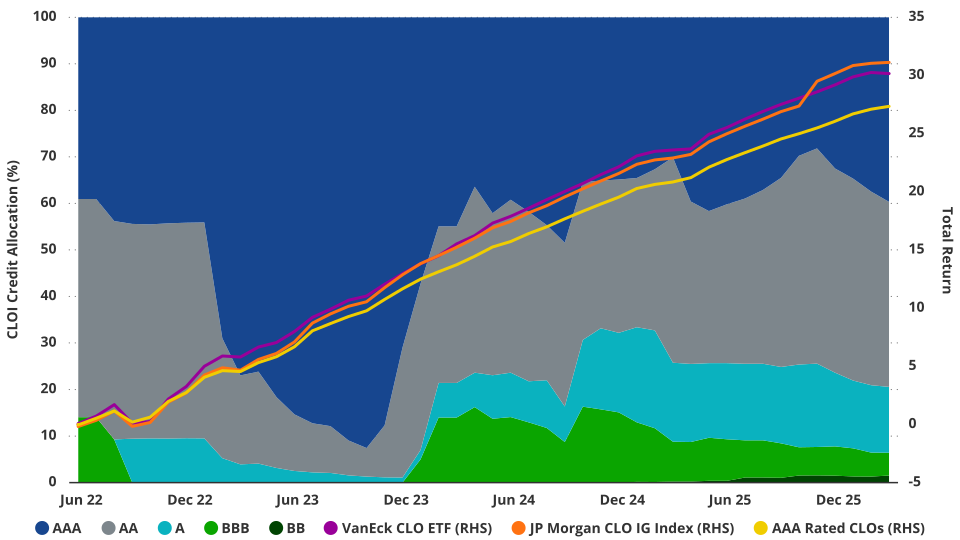
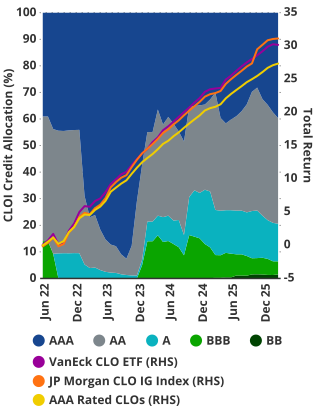
Source: Factset, JP Morgan, VanEck as of 3/31/2026. AAA Rated CLOs represented by J.P. Morgan CLO AAA Index, AA Rated CLOs represented by J.P. Morgan CLO AA Index, A Rated CLOs represented by J.P. Morgan CLO A Index, BBB Rated CLOs represented by J.P. Morgan CLO BBB Index, BB Rated CLOs represented by J.P. Morgan CLO BB Index, Index performance is not representative of Fund performance. It is not possible to invest directly in an index. Past performance is no guarantee of future results. Fund performance current to the most recent month end is available by visiting vaneck.com or by calling 800.826.2333.
CLOB Total Return and Credit Allocation
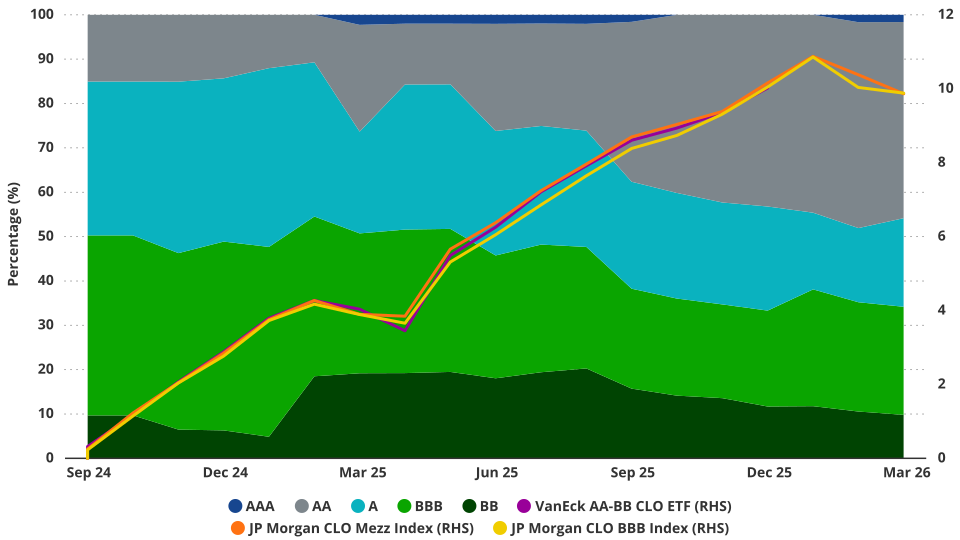
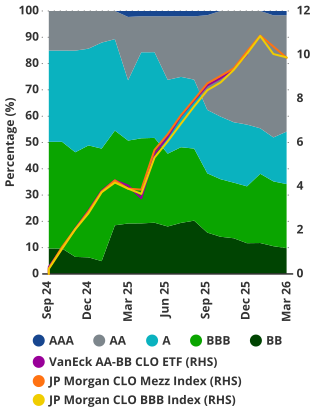
Source: Factset, JP Morgan, VanEck as of 3/31/2026. AA Rated CLOs represented by J.P. Morgan CLO AA Index, A Rated CLOs represented by J.P. Morgan CLO A Index, BBB Rated CLOs represented by J.P. Morgan CLO BBB Index, BB Rated CLOs represented by J.P. Morgan CLO BB Index, B Rated CLOs represented by J.P. Morgan CLO B Index. Index performance is not representative of Fund performance. It is not possible to invest directly in an index. Past performance is no guarantee of future results. Fund performance current to the most recent month end is available by visiting vaneck.com or by calling 800.826.2333.
Recommended subscription
Outlook
For risk assets generally, oil prices remain the key driver as investors grapple with a broadening supply shock, as well as hopes for deescalation of the Iran conflict. In the near term, we expect geopolitical uncertainty to remain elevated, contributing to increased market volatility and dispersion across issuers. This environment continues to reinforce a highly bifurcated loan market, where performing credits trade at relatively tight levels while a smaller group of stressed and idiosyncratic issuers drive downside risk and increase tail risk in portfolios.
While AI fears have taken a backseat following the onset of the war in Iran, the outcome is likely to have a bigger impact on long-term performance for loan issuers. We continue to see a repricing of risk premia in credit as a result of AI disintermediation in Software and other sectors as well as continued pressure in the Chemicals sector. We have seen this play out more acutely in the private credit market given the asset class’s high exposure to Software. However, while risks in the private credit market are notable, we don’t believe they pose a systemic threat and don't expect a broader market contagion.
Combined with geopolitical risks and risks to higher inflation, lower growth, and higher long-term rates, we believe that spreads are more likely to widen in the short-term and stay wider over the medium term. Given conservative portfolio positioning at the beginning of the year, we have been and continue to be well positioned to opportunistically add both in the primary and secondary markets across the cap stack, but particularly in strategies that can add BBB and lower rated tranches. However, the bifurcation in the market is notable, particularly for lower mezzanine and equity tranches. More stressed/seasoned CLOs (lower BB MVOCs and equity NAVs) are being heavily punished versus cleaner portfolios. As such, security selection is of paramount importance, and we remain highly selective when purchasing securities lower in the cap stack. We believe our bottoms-up approach of re-underwriting portfolios puts us in a good position to take advantage of security selection as spreads widen, focusing on credit selection.
Explore Investment Ideas
To receive more Income Investing insights, sign up in our subscription center.

Important Disclosures
This is not an offer to buy or sell, or a recommendation to buy or sell any of the securities, financial instruments or digital assets mentioned herein. The information presented does not involve the rendering of personalized investment, financial, legal, tax advice, or any call to action. Certain statements contained herein may constitute projections, forecasts and other forward-looking statements, which do not reflect actual results, are for illustrative purposes only, are valid as of the date of this communication, and are subject to change without notice. Actual future performance of any assets or industries mentioned are unknown. Information provided by third party sources are believed to be reliable and have not been independently verified for accuracy or completeness and cannot be guaranteed. VanEck does not guarantee the accuracy of third party data. The information herein represents the opinion of the speaker(s), but not necessarily those of VanEck or its other employees.
30-Day SEC Yield is a standard yield calculation developed by the Securities and Exchange Commission that allows for fairer comparison among funds. It is based on the most recent 30-Day period. This yield figure reflects the interest earned during the period after deducting the Fund’s expenses for the period. It does not reflect the yield an investor would have received if they had held the Fund over the last twelve months assuming the most recent NAV.
ICE BofA US Corporate Index tracks the performance of US dollar denominated investment grade corporate debt publicly issued in the US domestic market.
ICE BofA US High Yield Index tracks the performance of U.S. dollar-denominated below investment grade corporate debt publicly issued in the U.S. domestic market.
ICE BofA U.S. Broad Market tracks the performance of U.S. dollar denominated investment grade debt publicly issued in the U.S. domestic market, including US Treasury, quasi-government, corporate, securitized and collateralized securities.
ICE BofA US Treasury Index tracks the performance of US dollar denominated sovereign debt publicly issued by the US government in its domestic market.
J.P. Morgan Collateralized Loan Obligation Index tracks U.S. dollar denominated broadly-syndicated, arbitrage CLOs.
AAA Rated CLOs represented by J.P. Morgan CLO AAA Index is a subset of the J.P. Morgan CLO Index that only tracks the AAA rated CLO.
AA Rated CLOs represented by J.P. Morgan CLO AA Index is a subset of the J.P. Morgan CLO Index that only tracks the AA rated CLO.
A Rated CLOs represented by J.P. Morgan CLO A Index is a subset of the J.P. Morgan CLO Index that only tracks the A rated CLO.
J.P. Morgan Leveraged Loan Index tracks broadly syndicated leveraged loans.
J.P. Morgan Collateralized Loan Obligation Index tracks broadly-syndicated, arbitrage US CLO debt.
J.P. Morgan CLOIE Balanced Mezzanine Index which tracks broadly-syndicated, arbitrage US CLO debt rated AA to BB, comprised of 25% of each rating category.
J.P. Morgan CLO BBB Index is a subset of the CLOIE index that only tracks the BBB rated CLO.
J.P. Morgan CLO BB Index is a subset of the CLOIE index that only tracks the BB rated CLO.
Morningstar LSTA US Leveraged Loan 100 Index seeks to mirror the market-weighted performance of the largest institutional leveraged loans as determined by criteria based upon market weightings, spreads, and interest payments.
The Fund’s benchmark is the JP Morgan CLOIE Index which is the first rules-based total return benchmark for broadly-syndicated, arbitrage US CLO debt. Information has been obtained from sources believed to be reliable but J.P. Morgan does not warrant its completeness or accuracy. The Index is used with permission. The index may not be copied, used or distributed without J.P. Morgan’s written approval. © 2024, J.P. Morgan Chase & Co. All rights reserved. Index performance is not representative of Fund performance. It is not possible to invest directly in an index.
An investment in the VanEck AA-BB CLO ETF (CLOB) and VanEck CLO ETF (CLOI) may be subject to risks which include, but are not limited to, risks related to Collateralized Loan Obligations (CLO), debt securities, foreign currency, foreign securities, investment focus, newly-issued securities, extended settlement, affiliated fund investment, management and capital preservation, derivatives, currency management strategies, cash transactions, market, Sub-Adviser, operational, authorized participant concentration, no guarantee of active trading market, trading issues, fund shares trading, premium/discount, liquidity of fund shares, non-diversified, seed investor, and new fund risks, all of which may adversely affect the Funds. Investments in debt securities may expose the Fund to other risks, such as risks related to liquidity, interest rate, floating rate obligations, credit, call, extension, high yield securities, income, valuation, privately-issued securities, covenant lite loans, default of the underlying asset and CLO manager risks, all of which may impact the Fund’s performance. Derivatives may involve certain costs and risks such as liquidity, interest rate, and the risk that a position could not be closed when most advantageous.
Investing involves substantial risk and high volatility, including possible loss of principal. An investor should consider the investment objective, risks, charges and expenses of the Funds carefully before investing. To obtain a prospectus and summary prospectus, which contain this and other information, call 800.826.2333 or visit vaneck.com. Please read the prospectus and summary prospectus carefully before investing.
© Van Eck Securities Corporation, Distributor, a wholly owned subsidiary of Van Eck Associates Corporation.
Related Funds
Important Disclosures
This is not an offer to buy or sell, or a recommendation to buy or sell any of the securities, financial instruments or digital assets mentioned herein. The information presented does not involve the rendering of personalized investment, financial, legal, tax advice, or any call to action. Certain statements contained herein may constitute projections, forecasts and other forward-looking statements, which do not reflect actual results, are for illustrative purposes only, are valid as of the date of this communication, and are subject to change without notice. Actual future performance of any assets or industries mentioned are unknown. Information provided by third party sources are believed to be reliable and have not been independently verified for accuracy or completeness and cannot be guaranteed. VanEck does not guarantee the accuracy of third party data. The information herein represents the opinion of the speaker(s), but not necessarily those of VanEck or its other employees.
30-Day SEC Yield is a standard yield calculation developed by the Securities and Exchange Commission that allows for fairer comparison among funds. It is based on the most recent 30-Day period. This yield figure reflects the interest earned during the period after deducting the Fund’s expenses for the period. It does not reflect the yield an investor would have received if they had held the Fund over the last twelve months assuming the most recent NAV.
ICE BofA US Corporate Index tracks the performance of US dollar denominated investment grade corporate debt publicly issued in the US domestic market.
ICE BofA US High Yield Index tracks the performance of U.S. dollar-denominated below investment grade corporate debt publicly issued in the U.S. domestic market.
ICE BofA U.S. Broad Market tracks the performance of U.S. dollar denominated investment grade debt publicly issued in the U.S. domestic market, including US Treasury, quasi-government, corporate, securitized and collateralized securities.
ICE BofA US Treasury Index tracks the performance of US dollar denominated sovereign debt publicly issued by the US government in its domestic market.
J.P. Morgan Collateralized Loan Obligation Index tracks U.S. dollar denominated broadly-syndicated, arbitrage CLOs.
AAA Rated CLOs represented by J.P. Morgan CLO AAA Index is a subset of the J.P. Morgan CLO Index that only tracks the AAA rated CLO.
AA Rated CLOs represented by J.P. Morgan CLO AA Index is a subset of the J.P. Morgan CLO Index that only tracks the AA rated CLO.
A Rated CLOs represented by J.P. Morgan CLO A Index is a subset of the J.P. Morgan CLO Index that only tracks the A rated CLO.
J.P. Morgan Leveraged Loan Index tracks broadly syndicated leveraged loans.
J.P. Morgan Collateralized Loan Obligation Index tracks broadly-syndicated, arbitrage US CLO debt.
J.P. Morgan CLOIE Balanced Mezzanine Index which tracks broadly-syndicated, arbitrage US CLO debt rated AA to BB, comprised of 25% of each rating category.
J.P. Morgan CLO BBB Index is a subset of the CLOIE index that only tracks the BBB rated CLO.
J.P. Morgan CLO BB Index is a subset of the CLOIE index that only tracks the BB rated CLO.
Morningstar LSTA US Leveraged Loan 100 Index seeks to mirror the market-weighted performance of the largest institutional leveraged loans as determined by criteria based upon market weightings, spreads, and interest payments.
The Fund’s benchmark is the JP Morgan CLOIE Index which is the first rules-based total return benchmark for broadly-syndicated, arbitrage US CLO debt. Information has been obtained from sources believed to be reliable but J.P. Morgan does not warrant its completeness or accuracy. The Index is used with permission. The index may not be copied, used or distributed without J.P. Morgan’s written approval. © 2024, J.P. Morgan Chase & Co. All rights reserved. Index performance is not representative of Fund performance. It is not possible to invest directly in an index.
An investment in the VanEck AA-BB CLO ETF (CLOB) and VanEck CLO ETF (CLOI) may be subject to risks which include, but are not limited to, risks related to Collateralized Loan Obligations (CLO), debt securities, foreign currency, foreign securities, investment focus, newly-issued securities, extended settlement, affiliated fund investment, management and capital preservation, derivatives, currency management strategies, cash transactions, market, Sub-Adviser, operational, authorized participant concentration, no guarantee of active trading market, trading issues, fund shares trading, premium/discount, liquidity of fund shares, non-diversified, seed investor, and new fund risks, all of which may adversely affect the Funds. Investments in debt securities may expose the Fund to other risks, such as risks related to liquidity, interest rate, floating rate obligations, credit, call, extension, high yield securities, income, valuation, privately-issued securities, covenant lite loans, default of the underlying asset and CLO manager risks, all of which may impact the Fund’s performance. Derivatives may involve certain costs and risks such as liquidity, interest rate, and the risk that a position could not be closed when most advantageous.
Investing involves substantial risk and high volatility, including possible loss of principal. An investor should consider the investment objective, risks, charges and expenses of the Funds carefully before investing. To obtain a prospectus and summary prospectus, which contain this and other information, call 800.826.2333 or visit vaneck.com. Please read the prospectus and summary prospectus carefully before investing.
© Van Eck Securities Corporation, Distributor, a wholly owned subsidiary of Van Eck Associates Corporation.