The Case for Real Assets: Demand Is Rising While Supply Stays Constrained
October 07, 2026
Read Time 10 MIN
Key Takeaways
- Long-run demand for energy, copper, and grain has risen steadily for six decades, and electrification is adding a new layer of load on top of it.
- Processing of critical minerals is concentrated in a handful of countries, with China dominating copper, cobalt, lithium, graphite, and rare earths.
- Producers have prioritized balance sheets over growth. Oil and gas capex is projected to keep falling, and the past decade has added very little to the global copper pipeline.
The first two articles in this series made the case that real assets are one of the most under-owned corners of the market and that commodities are historically inexpensive relative to U.S. stocks, with a return profile that has improved as inflation rises.
Both of those arguments center around price and positioning. The final question we will answer in this series is the one that matters most for long-term investors: what is actually happening to supply and demand in the physical economy?
Structural Demand Keeps Climbing
Over the long run, demand for energy, copper and grain continues to rise alongside industrialization and electrification. Global energy usage has risen from roughly 40,000 TWh in 1960 to more than 160,000 TWh in 2024. Refined copper consumption has grown from about 5 million tonnes to roughly 28 million. U.S. grain consumption has nearly quadrupled over the same period.
Long-Run Demand for Energy, Copper, and Grain (1960 to 2024)


Source: USDA, ICSG, ourworldindata.org. Data as of December 2025. For illustrative purposes only.
The story these charts tell are centered on decades of industrialization, urbanization, and rising living standards, which have kept pushing demand higher through recessions, commodity busts, and three decades of investor indifference to the asset class.
Electrification Is Becoming A Major Demand Driver
Over the next decade, electricity demand is expected to rise significantly. Rio Tinto projects global electricity demand rising from roughly 32,600 TWh in 2025 to 46,700 TWh in 2035, an increase of about 43% in a decade. Industry, buildings, and primary sectors account for the largest share of the increase, with transport and data centers adding to it.
Electricity Demand Growth, 2025F to 2035F (000, TWh per year)


Source: Rio Tinto. Data as of December 2025. For illustrative purposes only. Not a projection of future results.
The investment implication is that more electricity requires more generation capacity, more grid, and more of the metals that go into both. Copper, aluminum, and the industrial metals complex sit at the center of that buildout, whether the generation source is natural gas, nuclear, or renewables.
Critical Supply Chains Are Highly Concentrated
If demand is diversified across the global economy, supply is not. The IEA's data on the top three producing countries for selected minerals shows that production is concentrated, and processing is more concentrated still. China alone dominates the processing of copper, cobalt, lithium, graphite, and rare earths. The DRC supplies the majority of mined cobalt. Indonesia leads nickel.
Top 3 Producing Countries of Selected Minerals and Fossil Fuels


Source: IEA. Data as of March 2025. For illustrative purposes only.
Concentration of this kind raises supply-security risk and has already started pulling policy and capital toward domestic and allied investment in mining and processing. That is a slow process, measured in years and permits, and it tends to raise the cost of supply rather than lower it.
Capital Discipline Is Tightening Future Supply
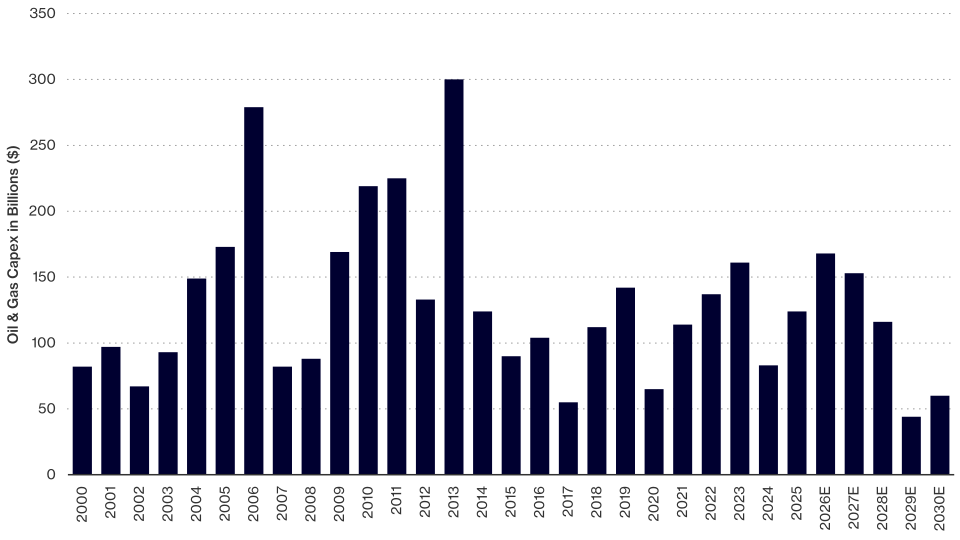
Supply is also being constrained from the inside. Global oil and gas capital expenditure peaked near $300 billion in 2013. It sits well below that level today and is projected to decline further through 2030. Producers have spent the past decade prioritizing balance sheets, buybacks, and dividends over new production.
Global Oil & Gas Capex ($bn), 2000 to 2030E

Source: Goldman Sachs. Data as of December 2025. For illustrative purposes only. Not a projection of future results.
From a shareholder's perspective, that discipline has been welcome. From a supply perspective, it means the industry is less prepared than it has been in decades if demand surprises to the upside.
The Copper Pipeline Is Running Thin
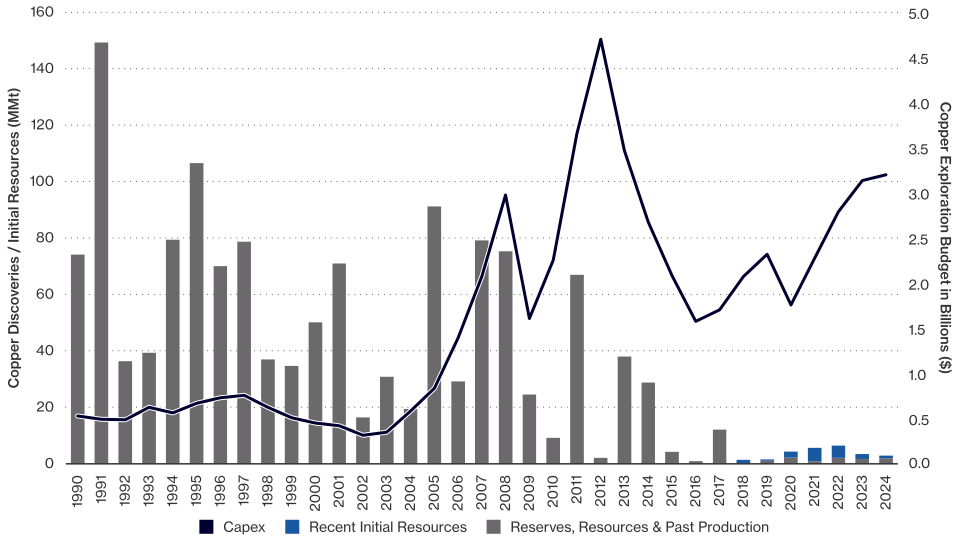
Copper illustrates the supply-demand mismatch most clearly. Exploration budgets rose from under $1 billion a year in the early 2000s to roughly $3 billion today. Yet the volume of new initial resources discovered has collapsed since 2010. Most of the copper produced today was discovered decades ago, and the past decade has added very little to the pipeline.
Copper Discoveries vs. Exploration Capex, 1990 to 2024

Source: S&P Global. Data as of December 2025. For illustrative purposes only.
Because a new copper mine typically takes 10 to 20 years to move from discovery to production, the supply response to higher prices is slow by construction. Even if exploration were to succeed tomorrow, the metal would not arrive until the mid 2030s, roughly when the electrification forecasts above suggest it would be needed most.
Recommended subscription
What This Means for Portfolios
Taken together, the three articles in this series describe an unusual setup. Real assets are under-owned, with allocations below 1% of fund assets. They are historically inexpensive relative to U.S. equities. And the fundamentals underneath them point to structurally rising demand meeting supply that is concentrated, under-invested, and slow to respond.
This is not a forecast for the next 12 months as commodity cycles have historically turned on a decade-plus clock (which the second article in this series showed) and they rarely turn on schedule. Investors should beware that demand forecasts can disappoint, supply discipline can break, and correlations can rise in a liquidity shock.
But for a portfolio built from a core equity fund and a core bond fund, the question is not whether to take a view on commodities. It is whether a near-zero allocation reflects any view at all, at a moment when the physical economy is being asked to deliver more than it has in a generation.
VanEck Natural Resources and Commodities Solutions
VanEck has a history of investing in natural resources and commodities for over 50 years, offering investors actively and passively managed strategies, from physical commodities to natural resource equities. We offer specialized exposure to individual sectors and diversified solutions with broad exposure across sectors and industries.
| Symbol | Name | Agriculture / Agri-Food Technology |
Gold/ Precious Metals |
Base/ Industrial Metals |
Strategic/ Rare Earth Metals |
Renewable/ Alternative Energy |
Traditional Energy (Oil & Gas) |
Energy MLPs |
Infrastructure | REITs |
| GHAAX / GHAIX | Global Resources Fund | ■ | ■ | ■ | ■ | ■ | ■ | |||
| CMCAX / COMIX | CM Commodity Index Fund | ■ | ■ | ■ | ■ | |||||
| CMCI | CMCI Commodity Strategy ETF | ■ | ■ | ■ | ■ | |||||
| INIVX / INIIX | International Investors Gold Fund | ■ | ||||||||
| CRAK | Oil Refiners ETF | ■ | ||||||||
| EINC | Energy Income ETF | ■ | ■ | |||||||
| GDX | Gold Miners ETF | ■ | ||||||||
| GDXJ | Junior Gold Miners ETF | ■ | ||||||||
| EMET | Copper and Electrification ETF | ■ | ■ | ■ | ||||||
| HAP | Natural Resources ETF | ■ | ■ | ■ | ■ | ■ | ■ | |||
| MOO | Agribusiness ETF | ■ | ||||||||
| NLR | Uranium and Nuclear ETF | ■ | ■ | |||||||
| OIH | Oil Services ETF | ■ | ||||||||
| OUNZ1 | VanEck Merk Gold ETF | ■ | ||||||||
| PIT | VanEck Commodity Strategy ETF | ■ | ■ | ■ | ■ | |||||
| RAAX | Real Assets ETF | ■ | ■ | ■ | ■ | ■ | ■ | ■ | ■ | ■ |
| REMX | Rare Earth and Strategic Metals ETF | ■ | ||||||||
| SLX | Steel ETF | ■ | ||||||||
| SMOG | Low Carbon Energy ETF | ■ |
1OUNZ Prospectus Click Here: prospectus
An investment in the VanEck Merk Gold ETF ("OUNZ," or the “Trust”) is subject to significant risk and may not be suitable for all investors. OUNZ is not an investment company registered under the Investment Company Act of 1940 (the “1940 Act”) and therefore is not subject to the same protections as mutual funds or ETFs registered under the 1940 Act.
More information, including recent performance and current holdings, can be found by clicking the fund names below:
Global Resources Fund: Actively-managed approach to companies with unique competitive advantages associated with traditional commodities and those leading the development of emerging resource applications and technologies.
International Investors Gold Fund: Proven fundamental, bottom-up process emphasizes stock selection based on industry experience to access opportunities across the gold mining sector.
CM Commodity Index Fund: A passively managed fund that offers diversified commodities exposure by spreading its exposure across multiple maturities and maintaining a constant maturity per commodity to mitigate the impact of negative roll yield.
CMCI Commodity Strategy ETF: A passively managed ETF that spreads its exposure across multiple maturities to offer diversified exposure and mitigates the impact of negative roll yield by maintaining a constant maturity per commodity.
VanEck Oil Refiners ETF (CRAK): Provides exposure to an industry that may generally benefit from lower oil prices, a segment that has historically interacted differently with oil prices and market dynamics than other energy segments.
VanEck Energy Income ETF (EINC): Offers exposure to MLPs and energy infrastructure companies that have historically exhibited attractive yield characteristics without burdensome K-1 tax reporting.
VanEck Gold Miners ETF (GDX): The nation's first ETF to offer direct exposure to the gold mining industry. Gold miners have historically shown leverage to gold prices, which can amplify returns when prices rise and losses when they fall.
VanEck Junior Gold Miners ETF (GDXJ): Access to junior gold miners, including smaller exploratory or early development phase companies that are responsible for many gold reserve discoveries worldwide.
Copper and Electrification ETF (EMET): Capture companies involved in the production of the metals that enable the energy transition from fossil fuels to cleaner energy sources and technologies.
VanEck Natural Resources ETF (HAP): Offers exposure to global companies involved in six natural resources segments (including agriculture, energy, metals and renewable energy).
VanEck Agribusiness ETF (MOO): Positioned to meet growing demand as global population growth is driving increasing food demand and the need for efficient agricultural solutions.
VanEck Uranium and Nuclear ETF (NLR): Access to an important segment of the nuclear energy market, which is a significant clean energy source at an inflection point from increasing demand.
VanEck Oil Services ETF (OIH): Invests in highly liquid companies in oil services industry, including both domestic and U.S. listed foreign companies, allowing for enhanced industry representation.
VanEck Merk Gold ETF (OUNZ): Provides investors with a convenient and cost-efficient way to invest in gold through shares with the option to take physical delivery.
VanEck Real Assets ETF (RAAX): Comprehensive allocation strategy that invests across real assets and seeks to reduce volatility by responding to changing market environments.
VanEck Rare Earth and Strategic Metals ETF (REMX): Provides access to the rare earth or strategic metals industry, which supplies key inputs to many of the world’s most advanced technologies.
VanEck Steel ETF (SLX): Access to the steel industry, an industry supporting global industrialization and economic expansion.
VanEck Low Carbon Energy ETF (SMOG): Exposure to low carbon energy that includes not only solar, wind and hydro companies, but also in more recently developing areas of the market such as electric vehicles, battery tech, hydrogen and fuel cells.
VanEck Commodity Strategy ETF (PIT): Actively managed exposure to a broad basket of commodity futures.
To receive more Natural Resources insights, sign up in our subscription center.

Important Disclosures
This is not an offer to buy or sell, or a recommendation to buy or sell any of the securities, financial instruments or digital assets mentioned herein. The information presented does not involve the rendering of personalized investment, financial, legal, tax advice, or any call to action. Certain statements contained herein may constitute projections, forecasts and other forward-looking statements, which do not reflect actual results, are for illustrative purposes only, are valid as of the date of this communication, and are subject to change without notice. Actual future performance of any assets or industries mentioned are unknown. Information provided by third party sources are believed to be reliable and have not been independently verified for accuracy or completeness and cannot be guaranteed. VanEck does not guarantee the accuracy of third-party data. The information herein represents the opinion of the author(s), but not necessarily those of VanEck or its other employees.
VanEck Merk Gold ETF (OUNZ) Disclosures
VanEck Merk® Gold ETF: This material must be preceded or accompanied by a prospectus for the VanEck Merk Gold ETF (the “Trust”). Before investing you should carefully consider the VanEck Merk Gold ETF's ("OUNZ," or the "Trust") investment objectives, risks, charges and expenses.
Investing involves significant risk, including possible loss of principal. The Trust is not an investment company registered under the Investment Company Act of 1940 or a commodity pool for the purposes of the Commodity Exchange Act. Shares of the Trust are not subject to the same regulatory requirements as mutual funds. Because shares of the Trust are intended to reflect the price of the gold held in the Trust, the market price of the shares is subject to fluctuations similar to those affecting gold prices. Additionally, shares of the Trust are bought and sold at market price, not at net asset value (“NAV”). Brokerage commissions will reduce returns.
The request for redemption of shares for gold is subject to a number of risks including but not limited to the potential for the price of gold to decline during the time between the submission of the request and delivery. Delivery may take a considerable amount of time depending on your location.
The Sponsor of the Trust is Merk Investments, LLC. The Marketing Agent for the Trust is Van Eck Securities Corporation.
© Merk Investments LLC. © Van Eck Associates Corporation.
VanEck ETFs and Mutual Funds
The principal risks of investing in VanEck ETFs and mutual funds include sector, market, economic, political, foreign currency, world event, index tracking, active management, social media analytics, derivatives, blockchain, commodities and non-diversification risks, as well as fluctuations in net asset value and the risks associated with investing in less developed capital markets. VanEck ETFs may also be subject to authorized participant concentration, no guarantee of active trading market, trading issues, passive management, fund shares trading, premium/discount risk and liquidity of fund shares risks. VanEck ETFs or mutual funds may loan their securities, which may subject them to additional credit and counterparty risk. ETFs or mutual funds that invest in high-yield securities are subject to subject to risks associated with investing in high-yield securities; which include a greater risk of loss of income and principal than funds holding higher-rated securities; concentration risk; credit risk; hedging risk; interest rate risk; and short sale risk. ETFs or mutual funds that invest in companies with small capitalizations are subject to elevated risks, which include, among others, greater volatility, lower trading volume and less liquidity than larger companies. Please see the prospectus of each Fund for more complete information regarding each Fund’s specific risks.
Investing involves substantial risk and high volatility, including possible loss of principal. An investor should consider the investment objective, risks, charges and expenses of a Fund carefully before investing. To obtain a prospectus and summary prospectus, which contain this and other information, call 800.826.2333 or visit vaneck.com. Please read the prospectus and summary prospectus carefully before investing.
© Van Eck Securities Corporation, Distributor, a wholly owned subsidiary of Van Eck Associates Corporation.
Related Funds
Important Disclosures
This is not an offer to buy or sell, or a recommendation to buy or sell any of the securities, financial instruments or digital assets mentioned herein. The information presented does not involve the rendering of personalized investment, financial, legal, tax advice, or any call to action. Certain statements contained herein may constitute projections, forecasts and other forward-looking statements, which do not reflect actual results, are for illustrative purposes only, are valid as of the date of this communication, and are subject to change without notice. Actual future performance of any assets or industries mentioned are unknown. Information provided by third party sources are believed to be reliable and have not been independently verified for accuracy or completeness and cannot be guaranteed. VanEck does not guarantee the accuracy of third-party data. The information herein represents the opinion of the author(s), but not necessarily those of VanEck or its other employees.
VanEck Merk Gold ETF (OUNZ) Disclosures
VanEck Merk® Gold ETF: This material must be preceded or accompanied by a prospectus for the VanEck Merk Gold ETF (the “Trust”). Before investing you should carefully consider the VanEck Merk Gold ETF's ("OUNZ," or the "Trust") investment objectives, risks, charges and expenses.
Investing involves significant risk, including possible loss of principal. The Trust is not an investment company registered under the Investment Company Act of 1940 or a commodity pool for the purposes of the Commodity Exchange Act. Shares of the Trust are not subject to the same regulatory requirements as mutual funds. Because shares of the Trust are intended to reflect the price of the gold held in the Trust, the market price of the shares is subject to fluctuations similar to those affecting gold prices. Additionally, shares of the Trust are bought and sold at market price, not at net asset value (“NAV”). Brokerage commissions will reduce returns.
The request for redemption of shares for gold is subject to a number of risks including but not limited to the potential for the price of gold to decline during the time between the submission of the request and delivery. Delivery may take a considerable amount of time depending on your location.
The Sponsor of the Trust is Merk Investments, LLC. The Marketing Agent for the Trust is Van Eck Securities Corporation.
© Merk Investments LLC. © Van Eck Associates Corporation.
VanEck ETFs and Mutual Funds
The principal risks of investing in VanEck ETFs and mutual funds include sector, market, economic, political, foreign currency, world event, index tracking, active management, social media analytics, derivatives, blockchain, commodities and non-diversification risks, as well as fluctuations in net asset value and the risks associated with investing in less developed capital markets. VanEck ETFs may also be subject to authorized participant concentration, no guarantee of active trading market, trading issues, passive management, fund shares trading, premium/discount risk and liquidity of fund shares risks. VanEck ETFs or mutual funds may loan their securities, which may subject them to additional credit and counterparty risk. ETFs or mutual funds that invest in high-yield securities are subject to subject to risks associated with investing in high-yield securities; which include a greater risk of loss of income and principal than funds holding higher-rated securities; concentration risk; credit risk; hedging risk; interest rate risk; and short sale risk. ETFs or mutual funds that invest in companies with small capitalizations are subject to elevated risks, which include, among others, greater volatility, lower trading volume and less liquidity than larger companies. Please see the prospectus of each Fund for more complete information regarding each Fund’s specific risks.
Investing involves substantial risk and high volatility, including possible loss of principal. An investor should consider the investment objective, risks, charges and expenses of a Fund carefully before investing. To obtain a prospectus and summary prospectus, which contain this and other information, call 800.826.2333 or visit vaneck.com. Please read the prospectus and summary prospectus carefully before investing.
© Van Eck Securities Corporation, Distributor, a wholly owned subsidiary of Van Eck Associates Corporation.